102 guides
Rewards, Points and Allowance for Kids
How to set up a reward system that motivates kids: points per chore, reward ideas that are not toys, reward charts by age, allowance amounts and paid chores.
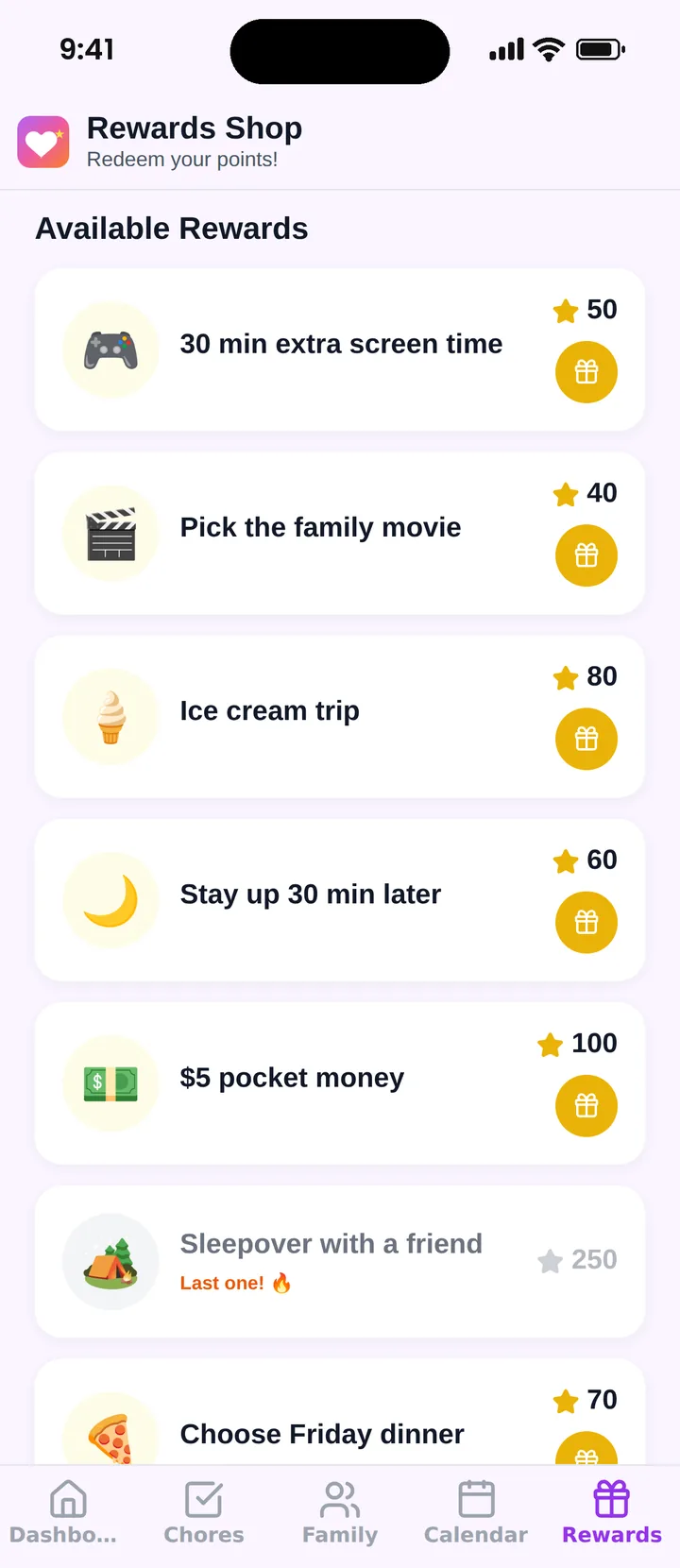
Rewards & motivation
- Chore Point System: How Many Points per Chore?
How many points each chore should be worth, how to price rewards so kids can actually afford them, and a worked week of points for a 9-year-old.
- Delayed Gratification for Kids: Why It Matters and How to Build It
What delayed gratification is, what the marshmallow test really showed, realistic waits by age, everyday examples for kids and how to practice it at home.
- Earn Screen Time With Chores: A Fair System
How to let kids earn screen time with chores without daily fights: a base amount that isn't earned, a fair points price, daily caps and a sample week.
- How to Create a Reward System for Kids in 5 Steps
Build a reward system for kids in 5 steps: pick behaviors, choose points, price rewards, set rules and review after 3 weeks. Includes a price table and examples.
- How to Motivate a Child With ADHD to Study: 8 Practical Steps
How to motivate a child with ADHD to study: shorter work blocks, immediate small rewards, a clear start and fewer fights, plus a sample homework hour.
- How to Motivate a Child With ADHD: What Actually Works
Why motivation looks different with ADHD and 7 methods that work: faster rewards, shorter tasks, interest, and a calm way to set up a points-and-rewards system.
- How to Motivate a Teenager to Get a Job
Find out why teens put off getting a job and what actually moves them: a real want, a low-risk first step, and a parent who steps back. Includes a 4-week plan.
- How to Motivate a Teenager to Study: What Works
Teens study when they see a reason, feel some control and have a workable routine. Here is how to build all three, with scripts, a weekly plan and rewards that last.
- How to Motivate a Teenager Who Doesn't Care: 6 Reasons and Fixes
When a teen shrugs at grades, chores and consequences, the cause matters. Learn six common reasons they stop caring and what to say and do for each.
- How to Motivate a Teenager Who Hates School: 7 Steps That Help
Find out why your teen hates school, then rebuild motivation in seven steps: rule out problems, give back control, shrink the work and reward effort.
- How to Motivate a Teenager With ADHD: What Works
Why motivation looks different with ADHD, and what to try: shorter steps, immediate rewards, real choices and a rewards shop a teen will actually use.
- How to Motivate a Teenager With Anxiety
What looks like laziness in an anxious teen is often avoidance. Here is how to lower the pressure, shrink the first step and reward effort instead of results.
- How to Motivate a Teenager: What Works and What Backfires
Teens work harder when they get a say, a fair deal and a visible win. Here is how to motivate a teenager with choices, clear trades and rewards they pick.
- How to Motivate Kids to Do Homework: What Works and Why
How to motivate kids to do homework: set a fixed time and place, shrink the task, reward effort with quick, small payoffs, and know when to step back.
- How to Motivate Kids to Learn: What Actually Works
How to motivate kids to learn: build curiosity, choice and early wins first, then use small rewards for the dull parts. What the research says, by age.
- How to Motivate Kids to Practice (Sports and Music)
How to get kids to practice an instrument or a sport without nagging: shorter sessions, a fixed slot, small rewards for effort, and when to let them quit.
- How to Motivate Kids to Read: What Works at Each Age
How to motivate kids to read: let them choose, keep reading aloud, make books easy to reach, and use small rewards the right way. Ideas for ages 4 to 14.
- How to Motivate Kids to Study: What Works and What Backfires
How to motivate kids to study without nagging: reward effort instead of grades, shrink the session, protect sleep, and follow a simple weekly plan.
- How to Reward Kids for Chores: What Works and What Backfires
How to reward kids for chores without bribing them: when to use praise, points, privileges or money, how big rewards should be, and how to phase them out.
- How to Reward Kids for Good Behavior (What Works and What Backfires)
How to reward good behavior so it lasts: praise first, small rewards second, clear rules, fast timing, and a step-by-step plan with examples by age.
- How to Reward Kids for Good Grades Without Backfiring
Should you pay for A's? Research is mixed, so reward effort you can control, keep rewards small and plan to fade them. Here is a setup that works.
- How to Reward Kids for Reading (Without Killing the Love of It)
Rewards can build a reading habit if you pick them carefully. Learn which rewards work, how much to give by age, and when to stop, with a sample plan.
- Intrinsic Motivation in Kids: How to Build It
Kids build intrinsic motivation when they have real choices, doable challenges and close adults. How to grow it at home and use rewards without crowding it out.
- Is a Reward System Good or Bad for Kids?
What the evidence says about reward systems for kids: when rewards help, when they backfire, a quick test for your own chart and how to design one that works.
- Kids Motivation: What Really Drives Children
What drives kids' motivation, how it changes from preschool to the teens, when rewards help or hurt, and what to check if a child seems unmotivated.
- Kids Reward App: What to Look For (and What to Skip)
How to pick a kids reward app: the features worth having, the ones to skip, questions to ask before you download and how to test it in a week.
- Kids Reward Chart App: Does It Work and How to Use One
Do reward chart apps work for kids? What behavior research suggests about immediate rewards, how a digital chart differs from paper, and rules that keep it working.
- Point System for Kids: How It Works at Home
A point system for kids turns everyday tasks into points they spend on rewards. Here is how to set one up at home, price the rewards and keep it fair.
- Point System for Kids' Behavior: How to Set One Up
How to build a point system for kids' behavior: pick 2 or 3 target behaviors, award points quickly, price rewards fairly and avoid taking points away.
- Positive Reinforcement for Kids With ADHD: What Works and Why
Why kids with ADHD need praise and rewards that are faster, more frequent and more specific, with scripts, a points table and fixes for when it stops working.
- Positive Reinforcement for Kids With Autism: What Works
Positive reinforcement for kids with autism works when the reward is one your child truly likes, comes right away and follows a clear goal. Examples inside.
- Positive Reinforcement for Kids With ODD: What Works
Positive reinforcement for kids with ODD works best when it is immediate, specific and kept free of power struggles. Scripts, examples and a simple chart plan.
- Positive Reinforcement for Kids: Examples That Work
How positive reinforcement works for kids, with examples by age, the difference between praise, rewards and bribes, and how to use it without backfiring.
- Reward Chart App for Kids: Features, Limits and Free Options
What to expect from a reward chart app for kids, where free plans run out, what charts cannot do and free alternatives that work, from paper to a spreadsheet.
- Reward System for Kids With ADHD: What Works and Why
A reward system for kids with ADHD works best when rewards are small, immediate and visible. Here is how to set one up, with point values and examples.
- Reward System for Kids With Autism: A Practical Guide
How to build a reward system for an autistic child: pick real motivators, keep rewards visible and immediate, set clear rules, and adjust as skills grow.
- Reward System for Kids: How to Build One That Lasts
How to build a reward system for kids that lasts: pick targets, set point values and prices, handle limits, and fade rewards out. Examples and tables included.
- Reward System for Kids' Behavior: What Works and Why
How to build a reward system for kids' behavior: pick target behaviors, set prices, time the rewards, and fade them out, with examples by age and a sample shop.
- Reward System for Kids' Chores: How to Build One That Works
How to design a reward system for chores: what to reward, how to price rewards, when to pay in points versus money, and how to keep it from backfiring.
- Reward System for Teenagers: What Works and What Backfires
A reward system for teenagers works when teens help design it, rewards are real and earned, and rules stay predictable. Here is how to build one, with examples.
- Reward Tracker App for Families: How It Should Work
What a good reward tracker app does: keep a clear points balance, log history, handle siblings fairly and make rewards easy to redeem. Plus a first-week setup.
- Sticker Chart App for Kids: Digital vs Paper
Should you use a sticker chart app or paper? Compare both by child age, setup effort, motivation and cost, with a first-week plan for either one.
- Token Economy for Kids: A Parent's Guide
A token economy for kids explained: how tokens, target behaviors and a reward menu fit together, how to set prices, and when to fade it out as habits form.
- Token System for Kids With ADHD: How to Set One Up
A token system for kids with ADHD works when tokens come fast, rewards are cheap and frequent, and the rules are visible. Here is how to build one, step by step.
- Token System for Kids With Autism: How to Set One Up
How a token system works for autistic children: pick the tokens, choose rewards your child actually wants, start with quick wins, and fade it over time.
- Token System for Kids' Behavior: How to Set One Up and Fade It
A token system for kids' behavior works when tokens come fast, buy rewards the child picks, and fade out over time. Here is the setup and a sample menu.
Paid chores & money
- Allowance App for Kids: How to Choose One
How to choose an allowance app for kids: money-moving vs tracking-only, fees, parent controls, age fit and red flags, plus a way to set it up in week one.
- Allowance for Kids: The Complete Guide for Parents
How to set up an allowance for kids: which model to pick, how much by age, how to pay it in a mostly cashless home, and rules for in-app purchases.
- Allowance for Teenagers: How Much, How Often and What It Should Cover
Allowance for teenagers explained: typical weekly amounts by age, weekly vs monthly payouts, what a teen allowance should cover and rules for digital spending.
- Allowance Ideas for a 10-Year-Old: Money, Points or Both?
Eight allowance ideas for a 10-year-old, from a flat $7 to $10 a week to points and hybrids, with a sample chart and what each setup teaches.
- Chore Allowance: How to Set Up a Fair System
How to link allowance and chores fairly: pick a model, split unpaid family jobs from paid extras, set a payday and handle missed chores without fights.
- Chore List for Kids to Earn Money: Jobs and What to Pay
A pay-ready chore list for kids to earn money: 30 paid jobs sorted by size, with dollar amounts, point values and rules for keeping basic chores unpaid.
- Chores for 13 Year Olds to Earn Money (With Pay Rates)
Chores for 13 year olds to earn money at home, with fair pay rates per job, what should stay unpaid, how to track it and when to use points.
- Chores for 14 Year Olds to Earn Money (With Pay Rates)
Paid chores for 14 year olds with pay rates: which jobs stay unpaid, which earn $0.25 to $5, a sample week, and how to pay by phone or in points.
- Chores for 15 Year Olds to Earn Money at Home
Paid chores for 15 year olds that build real skills: bigger projects, fair pay of $2 to $5 per job, a monthly job board and ways to pay by app or points.
- Chores for 16 Year Olds to Earn Money at Home
Paid chores for 16 year olds: household jobs worth paying for, pay of $2 to $5 per big job, a written agreement and how to link money to real costs.
- Chores for 5-Year-Olds to Earn Money: Jobs and What to Pay
Paid chores for 5-year-olds: which jobs to pay for, what to pay (25 cents to a few dollars), and how to track it with points so money stays simple.
- Chores for Teenagers to Earn Money: Fair Rates and Bigger Jobs
Paid chores for teens: which jobs to pay for, fair rates of $0.25 to $5 a job, how to price bigger projects and how to handle payday without arguments.
- Clothing Allowance for Teenagers: How to Set One Up
How to set a clothing allowance for a teenager: what to include, how much to start with, how to pay it, and rules that keep shopping from turning into a fight.
- Do Most Kids Get Paid for Chores? What Families Do
Do most kids get paid for chores? There is no single answer: families split between pay, no pay and a mix. Here is how each works and how to choose for yours.
- Extra Chores Kids Can Do for Money (Beyond the Basics)
30 extra chores kids can do to earn money, grouped by size, with minutes, fair pay from $0.25 to $5, and the rules that keep them separate from everyday chores.
- First Jobs for Teens: A Parent's Guide
A parent's guide to a teen's first job: when to start, which jobs suit ages 14 to 17, how work permits and paychecks work, and how to handle the money.
- How Much Allowance for a 10-Year-Old? Typical Amounts
A 10-year-old typically gets $7 to $10 a week, with $10 from the dollar-per-year rule. See how to split it, what it covers and how to decide.
- How Much Allowance for a 12-Year-Old? Typical Amounts
Most 12-year-olds get $10 to $15 a week. See how to pick an amount, what it should cover, and how to pay it in cash, a bank app or points.
- How Much Allowance for a 13-Year-Old? Typical Amounts
Most 13-year-olds get $10 to $15 a week, and some $15 or more. Here is how to choose an amount, what it should cover and how to pay it.
- How Much Allowance for a 14 Year Old?
Most 14-year-olds get $15 to $25 a week. See what that should cover, how to decide where your teen lands in the range, and how to pay it in a digital world.
- How Much Allowance for a 4 Year Old?
Most 4-year-olds do not need a real allowance yet. If you want one, $1 to $2 a week in coins is plenty. Here is how to start without the pressure.
- How Much Allowance for a 5 Year Old?
Most 5-year-olds get $3 to $5 a week, or less. See how to start small, make it visible with coins and points, and avoid the usual mistakes.
- How Much Allowance for a 6 Year Old?
A 6-year-old usually gets $3 to $7 a week. Here is how to pick your number, split it into spend, save and give, and keep payday simple.
- How Much Allowance for a 9 Year Old?
A 9 year old's allowance is usually $7 to $10 a week, with $9 as the rule of thumb. Learn how to choose, what chores it covers and how to add paid extras.
- How Much Allowance for an 11-Year-Old? Typical Amounts
Most 11-year-olds get $10 to $15 a week. See how to pick an amount, what it should cover, and how to pay it in cash, a bank app or points.
- How Much Allowance for an 18 Year Old Living at Home?
At 18 an allowance is a budget conversation. See what to pay, what your adult child should cover, and when to stop paying a flat weekly amount.
- How Much Allowance for an 8 Year Old?
An 8 year old's allowance is usually $7 to $10 a week. See how to choose within that range, what it should cover, the spend, save, give split and a sample week.
- How Much Allowance Should a Kid Get? A Chart by Age
How much allowance to give a kid by age, from $3 a week at 5 to $25 at 14+, what it should cover, and how to handle chores, cash and digital money.
- How Much Allowance Should a Teenager Get?
Most teens get about $15 to $25 a week, but the right number depends on what it has to cover. Here is how to pick an amount and how to pay it.
- How Much Money Should a 15 Year Old Have?
Most 15-year-olds get $15 to $25 a week in allowance. Here is how to set the amount, what it should cover and how to let a teen earn the rest.
- How Much to Pay Kids for Chores: A Simple Pay Scale
How much to pay kids for chores: $0.25 to $1 for small extra jobs, $2 to $5 for big ones, with a pay scale by task size and tips for paying in a digital world.
- How to Make Money as a 10-Year-Old: 15 Safe Ideas
15 safe ways a 10-year-old can make money, from pet care and yard help to a lemonade stand, with realistic earnings, safety rules and a note on handling the cash.
- How to Make Money as a Kid: 30 Ideas Parents Approve
30 safe ways for kids to make money at home, in the neighborhood and online with a parent's help, with age ranges, realistic pay and the safety rules to set first.
- How to Teach Kids About Money: A Parent's Guide by Age
What to teach kids about money at each age, how to make tap-to-pay and in-app spending visible, and the words to use when they ask to buy something.
- How to Teach Kids Financial Responsibility
Teach kids financial responsibility with an age-by-age plan: small allowance, spend-save-give jars, real choices and mistakes, plus how to handle digital money.
- How to Teach Teens to Be Responsible With Money
How to teach teens to be responsible with money: a budget that covers real costs, room for small mistakes, saving goals, and honest talk about digital spending.
- Jobs for 14-Year-Olds: 20 Legal Ways to Earn Money
Jobs for 14-year-olds, both formal and informal: what US rules allow, 20 real ideas by type, how to set a price, and how to track earnings with a phone.
- Jobs for Kids Under 13: 25 Safe Ways to Earn Money
Real jobs for kids under 13: pet care, yard work, tutoring younger kids and more, grouped by age with safety rules and what to pay in a digital world.
- Kids Saving Money: How to Build the Habit Early
How to get kids saving money: goals that fit their age, a simple save split, parent matching, and how to keep savings visible when most money is digital.
- Money Games to Teach Kids About Money (Ages 4 to 14)
Ten money games kids actually want to play, with ages, setup and what each one teaches, from Needs vs Wants cards to a pretend bank that pays interest.
- Paid Chores for 10-Year-Olds: Jobs to Earn Money and What to Pay
Paid chores for 10-year-olds: which jobs to pay for, which to keep free, and a fair rate for each, from $0.25 for small tasks to $5 for big ones.
- Paid Chores for 11-Year-Olds: Jobs to Earn Money and What to Pay
Which chores an 11-year-old can do to earn money, what each job is worth, and how to run it with cash or points so it teaches something about money.
- Paid Chores for 12-Year-Olds: Jobs to Earn Money and What to Pay
Paid chores for a 12-year-old: bigger household jobs, simple outside jobs, fair rates and how to track earnings in cash or points without nagging.
- Paid Chores for 4-Year-Olds: Jobs to Earn Money and What to Pay
Which extra jobs a 4-year-old can earn coins for, what to pay (usually $0.25 to $0.50), and how to start without turning every chore into a deal.
- Paid Chores for 6-Year-Olds: Jobs to Earn Money and What to Pay
Paid chores for a 6-year-old: 15 extra jobs worth $0.25 to $5, what to keep unpaid, a sample week, and how to run it with cash, points or both.
- Paid Chores for 7-Year-Olds: Jobs to Earn Money and What to Pay
Chores for 7-year-olds to earn money: 15 paid jobs with prices from $0.25 to $5, which chores stay free, and how to track pay with points or an app.
- Paid Chores for 8-Year-Olds: Jobs to Earn Money and What to Pay
Paid chores for 8-year-olds that make sense: 18 extra jobs with fair prices from $0.25 to $5, which chores stay unpaid, and how to track it all on a phone.
- Paid Chores for 9-Year-Olds: Jobs to Earn Money and What to Pay
Chores for 9-year-olds to earn money: 20 paid jobs with fair rates, what should stay unpaid, and how to track earnings in points or cash without nagging.
- Pocket Money by Age: What Is Typical
Pocket money by age, in dollars: the $1 per year of age rule, typical weekly ranges from 5 to 14+, and how to adjust for what your child pays for.
- Should Kids Get Paid for Chores? The Pros and Cons
Should kids get paid for chores? The honest pros and cons, a hybrid model that keeps basic jobs unpaid, sample pay rates and how to do it in a cashless world.
- Teaching Kids About Money and Investing, Age by Age
How to teach kids about money and investing by age: what to cover from 5 to 17, simple compound growth examples, and how to practice with real choices.
- Teaching Kids About Money Management at Every Age
A practical guide to teaching kids money management: what to teach at ages 3 to 17, how spend-save-give works, and how to make tap-to-pay money feel real.
- Teaching Kids About Money: 15 Activities to Do at Home
Fifteen real-life money activities for kids, grouped by earning, spending, saving and giving, with ages and time needed, including tap-to-pay and in-app purchases.
- Ways for Kids to Make Money in the Neighborhood
Neighborhood money ideas for kids by age, from lemonade stands to pet sitting, with safety rules, how to price jobs and how to handle the cash.
- Ways for Kids to Make Money in the Summer
Summer money ideas for kids by age, from lemonade stands to dog walking and online selling, with safety rules and how to track earnings without a mess.
- Why Kids Should Not Get Paid for Chores (and When They Should)
The case that kids should not get paid for chores, where it breaks down, and a split that works: unpaid family jobs, paid extras, and an allowance for money lessons.
Choosing an app for this?
Common questions
Do reward systems spoil kids?
Not when rewards are small, earned for specific behavior and faded out as the habit forms. Experiences and privileges, like choosing the family movie, work as well as toys and keep the focus on effort.
How much allowance should a child get?
A common starting point is $1 per week for each year of age, so an 8-year-old gets about $8. Typical ranges are $3 to $7 for ages 5-7, $7 to $10 for ages 8-10 and $10 to $15 for ages 11-13.
How many points should a chore be worth?
Tie points to effort: 5 for a task of a few minutes, 10 for 10 to 15 minutes and 20 for a job of half an hour or more. Price rewards so a child can afford something small every 2 to 3 days.
More guide topics
Make it stick with Famiyo
A shared family calendar, chores with points and a rewards shop for kids. Free on iPhone and Android.