How to Motivate a Teenager: What Works and What Backfires
Teens work harder when they get a say, a fair deal and a visible win. Here is how to motivate a teenager with choices, clear trades and rewards they pick.
By Famiyo Editorial Team4 min read
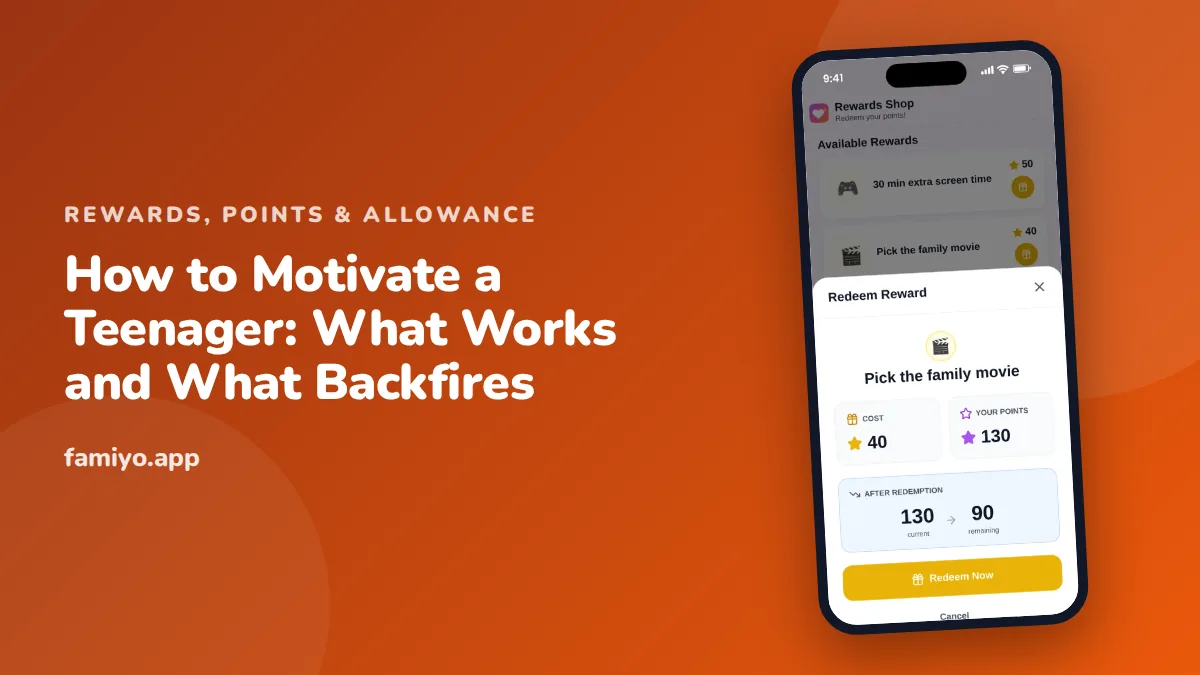
Your teenager used to race you to the front door. Now getting them to start homework, empty the dishwasher or even leave their room feels like a negotiation with no end. This page explains why teen motivation shifts, what the research on motivation keeps pointing to, and a step-by-step way to try it at home this week.
Why a teenager's motivation seems to disappear
Motivation does not vanish at 13. It moves. Teens are building an identity, and they care a great deal about autonomy, their friends and what other people think of them. Your priorities (grades, chores, a tidy room) now compete with theirs.
Two other things get in the way. The first is sleep. The AAP and AASM recommend 8 to 10 hours a night for ages 13 to 18, and many teens run well below that, which looks a lot like laziness. The second is the gap between effort and reward. A teen who thinks "this will take hours and nothing will change" will not start.
Before you try any technique, ask yourself whether your teen is tired, overloaded or discouraged. Each needs a different fix.
What actually moves a teenager
Self-determination theory, one of the most widely used frameworks in motivation research, says people stay motivated when three needs are met. It fits teens well.
- Autonomy: they have real choices. Not "do it now or lose your phone," but "which of these three jobs do you want, and when?"
- Competence: they can see themselves getting better, and the task is neither trivially easy nor impossible.
- Relatedness: they feel their parent is on their side, not just monitoring them.
Notice that none of the three is "be more afraid of the consequences." Pressure and threats can produce short bursts of compliance, but they tend to shrink a teen's own interest in the task. Control works better when it is shared.
A 5-step way to try it this week
- Pick one thing. Not grades, chores, screens and attitude together. Choose the single area that causes the most friction.
- Ask before you tell. Try: "I've noticed homework is a fight most nights. What would make it easier?" Then listen for a full minute without fixing anything.
- Offer a menu. "You can do it right after school, after dinner, or tomorrow before first period. Which works?" Two or three options keep it their decision.
- Agree on a trade in writing. "Each night of finished homework earns 10 points. 100 points gets you a movie night with a friend." Both of you sign off on it.
- Review after two weeks. Ask what worked, what felt unfair, and adjust. Teens trust systems they are allowed to change.
If your teen answers "I don't know" to everything, that is normal. Give it a day and try again, ideally in the car or while doing something side by side. Face-to-face at the kitchen table feels like an interrogation.
Rewards that work for teens (and ones that don't)
Rewards have a bad reputation with some parents, and the worry is fair: if a teen only acts for a prize, the prize can crowd out their own interest. In practice, rewards work best for tasks that are boring but necessary, such as chores or routine homework, and worst for things you hope they will love.
Pick rewards your teen would actually choose. A table helps keep the trade fair.
| Reward | Typical price in points | Why it works |
|---|---|---|
| 15 extra minutes of screen time | 30 to 50 | Small, quick to earn |
| Choose dinner or dessert | 30 to 50 | Gives them a say |
| Stay up 30 minutes later on a weekend | 100 | Feels like a privilege |
| Pick the family movie | 100 | Status in the family |
| Day out with a friend, or something around $20 | 300 to 500 | A goal worth saving for |
If points convert to money, 100 points equal $1. Aim for a small reward every 2 to 3 days so the effort feels worth it.
Avoid rewards that cut against your own rules (extra phone time after midnight), moving goalposts, and taking back something already earned. Taking points away for a mood or an eye roll teaches teens that the system is about control.
What backfires
- Lectures about the future. A 15-year-old does not feel next decade the way you do.
- Comparing them to a sibling or to you at their age.
- Praise that sounds like grading. "Good job on that assignment" lands better than "See, I knew you could do it if you tried."
- Taking over. If you do the task for them to avoid a fight, you confirm that they cannot do it.
Setting up the reward shop in Famiyo
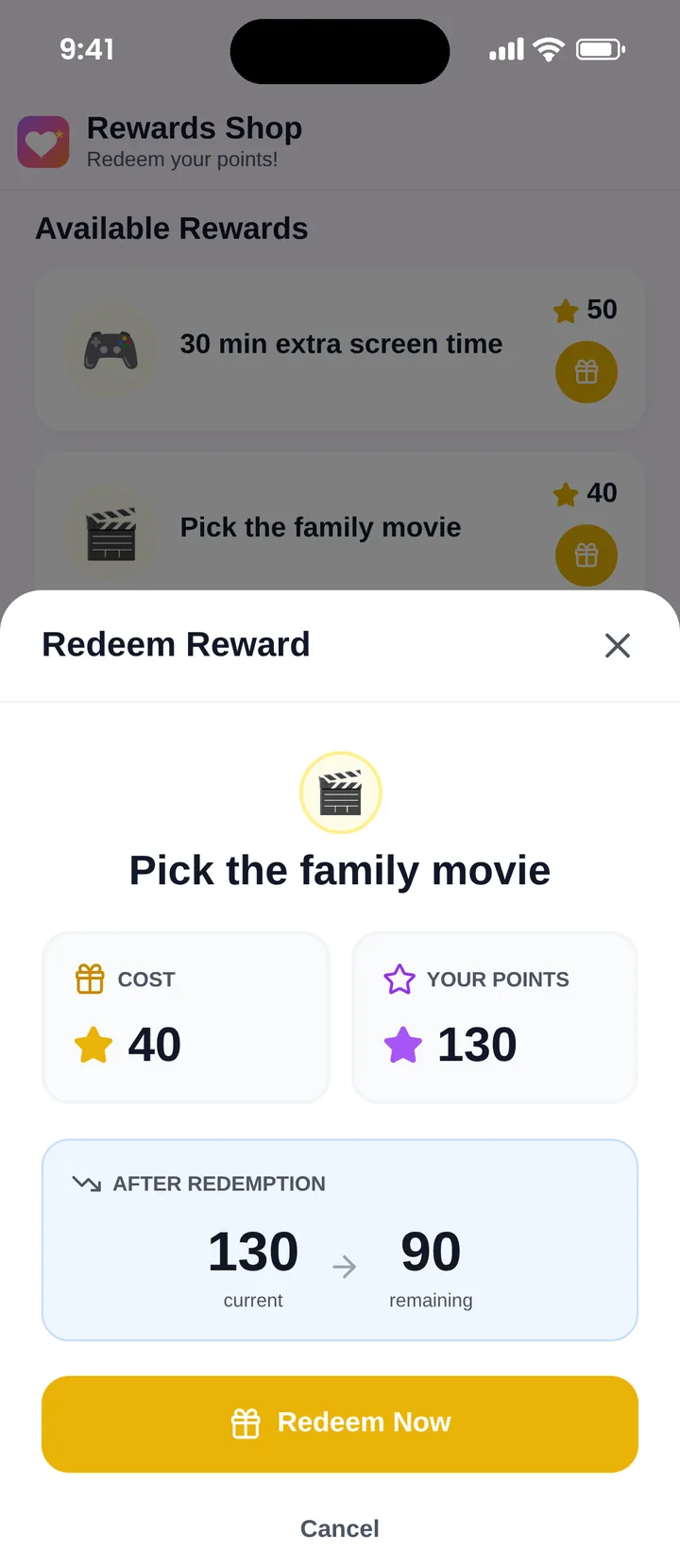
Famiyo is a free family app for iPhone and Android that combines a shared family calendar, chores with points and a rewards shop; kids join with a code, no email needed. For a teenager, the shop is the useful part: you create rewards together with a price in points, how many are available and when, and your teen redeems them from their own phone, seeing how many points will be left before they confirm. Tasks and homework slots can be worth points, and you decide whether your teen checks them off or you approve them. You get a notification when a chore is done or a reward is redeemed, so you do not have to chase.
If you want to compare tools first, see our list of the best reward chart apps for kids.
When it is more than motivation
A teen who is flat for weeks, has lost interest in everything they used to enjoy, sleeps far too much or too little, or pulls away from friends may be dealing with something bigger than attitude. Mention it to your pediatrician. And if apathy is the main picture, our guide on how to motivate a teenager who doesn't care goes further. For attention difficulties, see how to motivate a teenager with ADHD, and for school specifically, how to motivate kids to study.
Start with one task and one reward your teen picked. Give it two weeks before you decide it failed.
Frequently asked questions
What motivates a teenager the most?
Most teens respond to three things: having a say in decisions, feeling they are getting better at something, and feeling their parents are on their side. Rewards help, but only when the teen helped choose them and the rules stay consistent.
Do rewards work on teenagers?
Yes, when they are agreed in advance, tied to a specific action and valued by the teen. Rewards imposed from above, or taken away unpredictably, tend to breed resentment. Money, screen time and privileges are common choices.
How much sleep does a teenager need?
The American Academy of Pediatrics and AASM recommend 8 to 10 hours per 24 hours for ages 13 to 18. A tired teen often looks unmotivated, so check sleep before assuming attitude is the problem.
Should I punish a teenager who has no motivation?
Punishment rarely builds motivation. Natural consequences and a calm conversation about what is getting in the way work better. If low energy lasts weeks or comes with withdrawal or mood changes, talk to your pediatrician.
Try Famiyo With Your Family
Chores with points, a rewards shop for kids and one shared family calendar. Set it up in a couple of minutes.



Free to download • No credit card required • Available on iOS & Android