How to Teach Teens to Be Responsible With Money
How to teach teens to be responsible with money: a budget that covers real costs, room for small mistakes, saving goals, and honest talk about digital spending.
By Famiyo Editorial Team5 min read
A 15-year-old with a phone can spend money in four taps. A subscription renews quietly, a game offers a limited-time bundle, a friend sends a payment request. The old advice (save a quarter, put it in the jar) still matters, but it doesn't cover what teens actually face. This guide gives you a practical way to teach money skills in the years when mistakes are still cheap.
Start with a budget that covers real things
An allowance that is only fun money teaches nothing, because there is nothing to decide. A budget that covers actual costs teaches a lot.
Pick three to five categories your teen will own. Common ones are clothes beyond basics, snacks and eating out with friends, entertainment, a phone add-on or two, and gifts. Write the list down, put a weekly or monthly number beside it, and hand over the responsibility along with the money.
As a rough guide, typical weekly ranges run $10 to $15 for ages 11 to 13 and $15 to $25 for ages 14 and up. Those are starting points. A teen who buys their own clothes needs more than one who doesn't. For one category, our piece on clothing allowance for teenagers shows how to set it up.
A teen money plan in five steps
- Sit down together and list what the money covers, one line each.
- Agree the amount and the day it arrives. Same day each week, no negotiating.
- Split it. A simple starting point is spend, save and give, for example 50%, 40% and 10%, which teens can adjust once they have a goal.
- Pick one saving target with a price and a date: headphones, a concert ticket, a used bike.
- Review for ten minutes once a month. Ask "what worked, what didn't," and listen more than you talk.
Keep it dull and predictable. The routine does the teaching.
Let small mistakes happen
This is the hard part. Your teen will spend the month's fun money in the first week and then want a ride and a snack on the weekend. Do not top up. The point of the exercise is to feel the gap while it costs $12.
What to say afterward, without sarcasm: "What would you do differently?" and "What do you want to protect next month?" Most teens find the answer themselves, and they remember it far better than your lecture.
The exception is real needs. If the money was supposed to cover a coat and it's January, that is a different conversation. Agree in advance which things you will always cover.
Talk about digital money
Money teens touch is mostly invisible. Cover these directly.
- In-app purchases and game currency. Show your teen how many real dollars the shiny coins add up to over a month. Set a game budget as a category, and make it the teen's own.
- Subscriptions. Have them list every one they pay for, with renewal dates. Cancelling one on purpose is a skill.
- Buy now, pay later. Explain it in one sentence: it is borrowing, and the fee shows up when you miss a payment.
- Payment apps between friends. Agree on a rule such as no sending money to people they haven't met in person.
- Scams. Free gift cards, "you won" messages and DMs asking for codes. Teens fall for these too, so talk about them early.
Use a recent example from the news or your own bank statement, not a hypothetical. Kids can smell a lecture, but they'll listen to a story with numbers in it.
Show them your own numbers
Teens learn from what they see. You don't need to share your salary, but let them watch you compare prices, cancel a subscription, or decide that a purchase can wait a week. Say it out loud: "I want this, but the car insurance renews Friday, so I'm holding off." A few sentences like that, repeated over months, teach more than a formal talk. When they ask what things cost (rent, groceries, a phone plan), answer honestly and in real dollars. Teens who never see the cost of running a household tend to guess far too low.
Connect money to effort
Teens who have never linked effort and income often struggle later. There are several ways to build the link, and families disagree about which is best. If you are weighing pay for chores, why kids should not get paid for chores (and when they should) lays out both sides. A workable middle path: basic household help is unpaid because it comes with living there, and bigger extras (washing the car, painting a fence, babysitting a sibling for an evening) are paid at fair rates of a few dollars for a big job. For ideas, see extra chores kids can do for money.
A part-time job, dog walking or lawn mowing for neighbors adds a lesson no allowance can: money comes from someone else's needs, and showing up matters.
Use points as a practice round
Some families find points a gentler way to practice the idea of earning and spending before cash is involved, or alongside it. Chores earn points, points buy rewards the parents list, and the teen learns to save toward something bigger. If points convert to money, a common rate is 100 points to $1. For the details, see our chore point system article.
Doing this with Famiyo
Famiyo is a free family app for iPhone and Android that combines a shared family calendar, chores with points and a rewards shop; kids join with a code, no email needed.
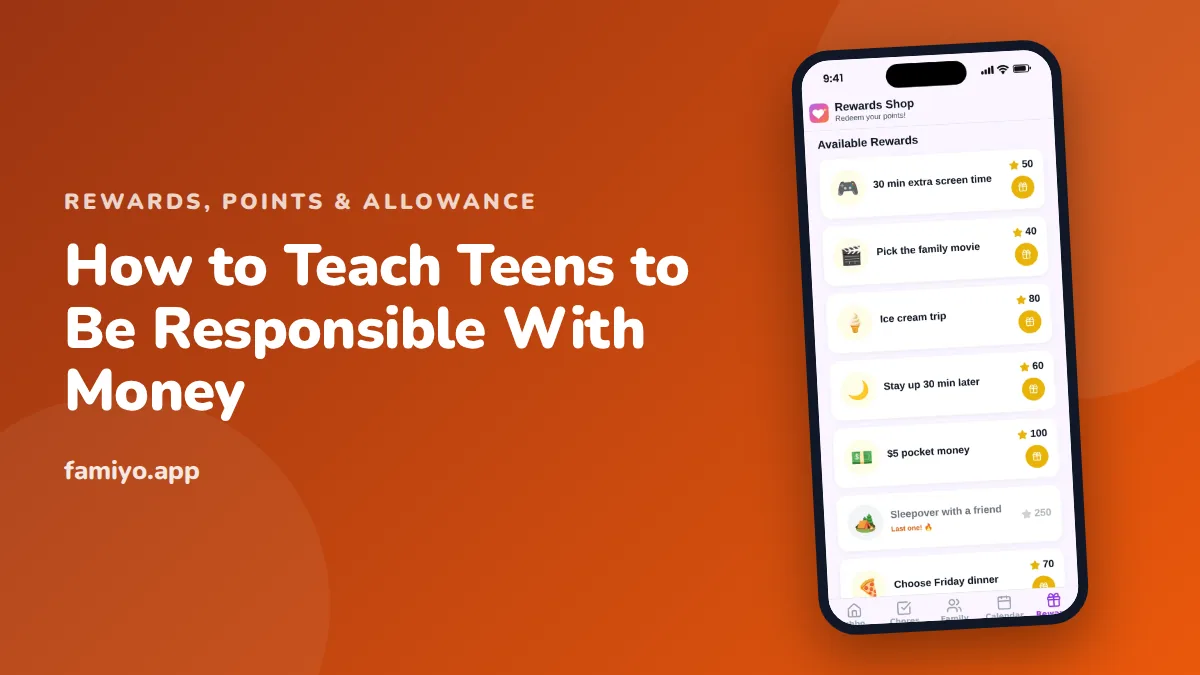
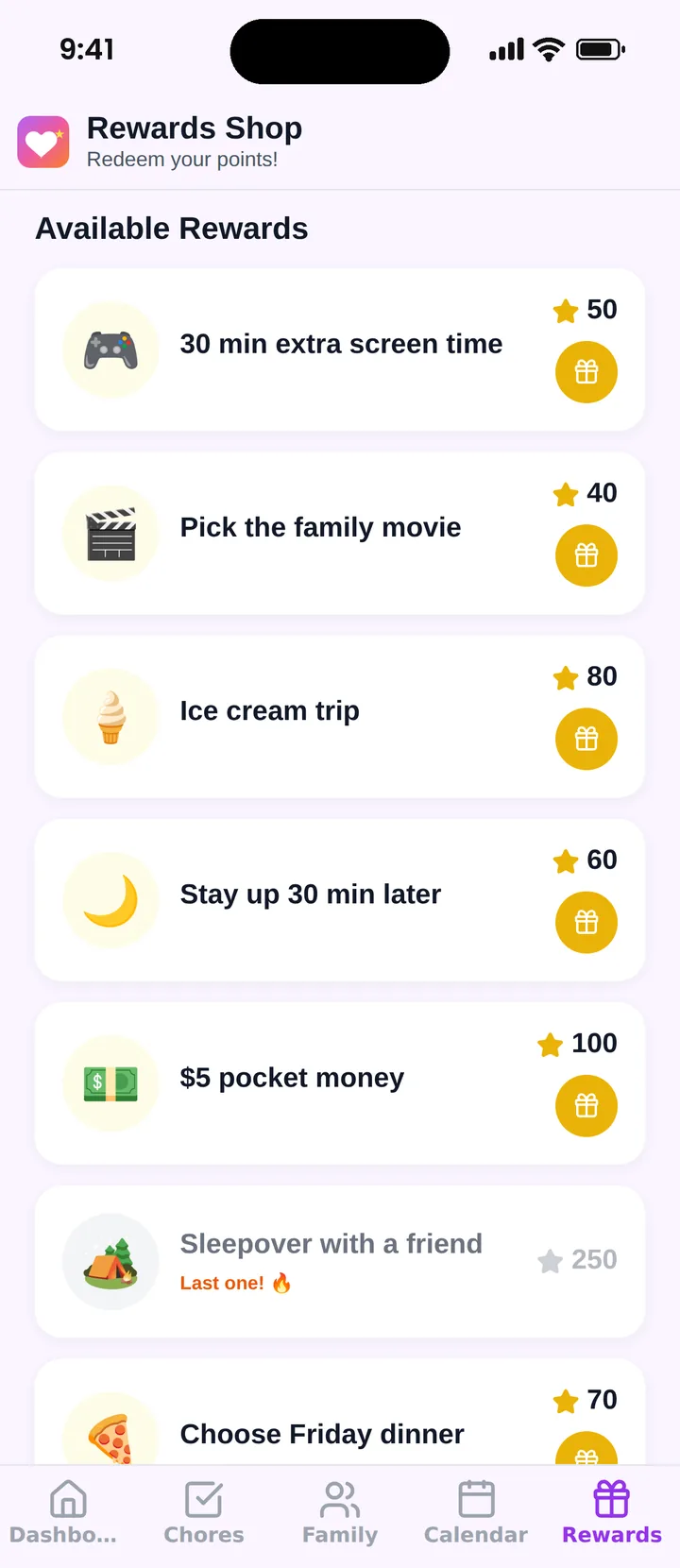
In the rewards shop you create rewards with a price in points, how many are available and when. Pocket money can be one of those rewards, for example $10 for 1,000 points, once a week. Your teen redeems it from their own phone and sees how many points they have left, which is a small lesson in choosing between a cheap reward now and a bigger one later. The app doesn't hold or move real money. You hand over the cash or send the transfer yourself. If you are comparing tools, our list of the best allowance apps for kids covers the field.
Pick one thing this week: either write the budget list, or have your teen audit their subscriptions. Do that first, and the rest follows.
Frequently asked questions
How much money should a teenager get?
A common range for ages 14 and up is $15 to $25 a week, and $10 to $15 for ages 11 to 13. Better than a number is a clear list of what it covers. The more it covers, the more it should be.
Should teens pay for their own phone and subscriptions?
Having teens cover add-ons like extra game currency, streaming they chose or accessories teaches trade-offs fast. Parents usually keep the phone and plan itself. Agree the split in writing so nobody is surprised at renewal time.
What if my teen blows all their money in a day?
Let them, as long as the stakes are small. Don't top it up. Next week, ask what they would do differently and help them pick one change. A $20 mistake at 14 is cheaper than a $2,000 one at 22.
At what age should a teen get a bank account?
Many banks offer teen or custodial accounts from around age 13 to 14, with a parent attached. Check each bank's terms yourself. The point is to see real balances and a real statement, since cash in a drawer is easy to forget.
Try Famiyo With Your Family
Chores with points, a rewards shop for kids and one shared family calendar. Set it up in a couple of minutes.



Free to download • No credit card required • Available on iOS & Android