How to Reward Kids for Reading (Without Killing the Love of It)
Rewards can build a reading habit if you pick them carefully. Learn which rewards work, how much to give by age, and when to stop, with a sample plan.
By Famiyo Editorial Team5 min read
Some kids pick up a book and vanish for an hour. Others treat 15 minutes of reading like a dental appointment. If yours is in the second group, a reward can help get the habit started. The trick is choosing a reward that points back to reading itself, then letting it fade before it becomes the only reason.
Do rewards for reading actually work?
A little, for a while, and only when they are designed well. Motivation research warns about a pattern: when a child is rewarded for something they already like, they sometimes like it less once the reward stops. At the same time, a child who finds reading hard or dull may never get far enough to discover the fun part without a push.
That makes the case for short, modest rewards aimed at starting the habit rather than at buying it. Two things tend to help. First, the reward should be related to books. Second, the child should have a say in the book. Choice is one of the strongest levers for kids who resist reading.
Reading itself is also one of the most reliable things a family can do for school success, and both the American Academy of Pediatrics and many librarians recommend reading with children every day from infancy. Rewards are a helper to that habit, not a replacement.
Rewards that feed the habit
| Reward | Works well for | Why |
|---|---|---|
| Pick the next book at the bookstore or library | Ages 4 to 12 | Connects effort to more reading |
| A later bedtime, 15 to 20 minutes, for reading in bed | Ages 6 to 13 | Makes reading a privilege |
| A cozy reading spot with pillows and a lamp | Ages 4 to 10 | Creates a place to look forward to |
| A family read-aloud night with a snack | Ages 3 to 9 | Adds connection |
| A new bookmark or a reading journal | Ages 6 to 12 | Cheap, tangible, personal |
| Movie night after finishing a book that has a film | Ages 8 to 13 | Natural link to the story |
| Choosing the weekend outing after a reading streak | All ages | A shared payoff |
Screen time is a common reward, but it can teach that reading is the unpleasant thing you get through to reach the good thing. If you use it, keep it a small extra, not the main prize. Candy has a similar problem. Our guide to how to reward kids for good behavior has more non-food options.
Reward minutes, not books or test scores
Pay attention to what you count. Rewarding the number of books pushes kids toward short, easy ones. Rewarding scores on a reading test makes reading about being measured. Counting minutes is fair across levels, and it counts any reading: a graphic novel, an audiobook, a magazine, a recipe.
A simple plan:
- Pick a daily minute goal your child can hit almost every day. For a 6-year-old, 10 minutes. For a 10-year-old, 20.
- Mark each day on a calendar or in an app.
- After a week of hitting the goal 5 days out of 7, give a small reward.
- After a month, give a bigger one, like a book trip.
- After two months, drop to one reward a month and start asking about the story instead.
Ask about what they are reading in a real way. "What's the funniest part so far?" does more than a sticker.
How big should the reward be?
Small. If you use points, a good scale is that 10 minutes of reading earns 5 points, a small reward costs 30 to 50 points, a medium one about 100 and a big one 300 to 500. At that rate a child reading 10 minutes a day earns a small reward in a week and a bigger one over a few weeks. Keep the most valuable rewards for the biggest efforts, like finishing a long book or a month of steady reading.
Be careful with competitions. A leaderboard can motivate a confident reader and crush a struggling one. If you have more than one child, set a personal goal for each, rather than ranking siblings.
What if your child still will not read?
Look at why. Reluctance has several causes.
- The books are wrong. Let your child choose, including series, comics and nonfiction about their interests.
- It is hard. If decoding is a struggle, reading feels like failing. Talk to the teacher, and consider mentioning it to your pediatrician, because vision and learning differences are common and treatable.
- It is boring compared with screens. Keep the reading time and the screens apart: reading first, then screens, or a screen-free hour before bed.
- It feels forced. Add read-aloud time, where you do the reading and they listen.
For grades-linked goals, see our guide to how to reward kids for good grades. If you want a general framework, how to reward kids for chores shows how to set up the same system for jobs around the house.
How to fade the reward
The point of a reading reward is to make it unnecessary. Watch for signs that it is working: your child reads when nobody asked, brings a book to the car, asks for the next in a series. When you see that, shift from prizes to praise and shared experiences. Talk about the book. Take them to the library without a points chart. If the habit slips, you can bring the reward back for a few weeks.
Reading rewards in Famiyo
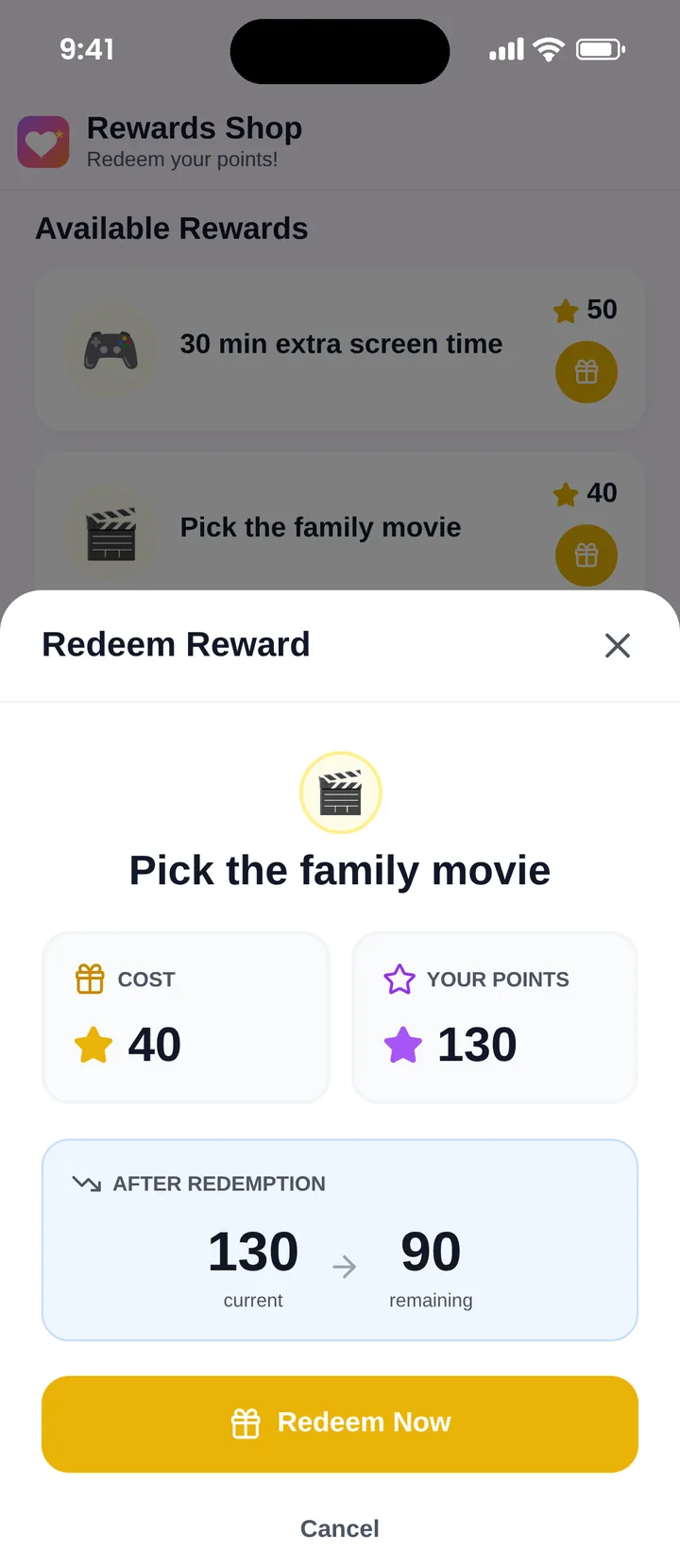
Famiyo is a free family app for iPhone and Android that combines a shared family calendar, chores with points and a rewards shop; kids join with a code, no email needed. For reading, add "Read for 20 minutes" as a repeating task worth points. Then stock the rewards shop with prices you choose, such as a library trip, a later bedtime to read or a new book, and decide how many are available and when. Your child redeems from their own phone and sees how many points they will have left. You are notified when a reward is redeemed. Our list of the best reward chart apps for kids compares the options.
Pick one reward this week
Ask your child what book they would most like next, set a 10-minute daily goal and make the book the prize at the end of the first week.
Frequently asked questions
What is a good reward for reading?
The best rewards are connected to books: choosing the next book, a bookstore or library trip, a later bedtime to read, or a cozy reading corner. They tell your child that reading leads to more reading, not to something unrelated.
Should you pay kids to read?
Cash is a risky choice because it can make reading feel like a job. Small, short-term rewards tied to minutes read work better, and they should fade over a few weeks. If you do use money, keep it modest and separate from chores.
How many minutes a day should kids read?
There is no single official number. Many teachers suggest about 15 to 20 minutes a day for early elementary children, 20 to 30 for older kids, and reading together counts. Begin with a goal your child can reach easily and build up.
Do reading rewards stop kids loving books?
They can if the prize becomes the only point. Rewards connected to books, short plans and plenty of talk about what your child is reading reduce that risk. Stop or change the plan when your child starts reading without being asked.
How do I reward a reluctant reader?
Lower the bar and shorten the time between effort and reward. Count 10 minutes of any reading, including comics and audiobooks, and celebrate small wins. Let your child choose the book. Talk to the teacher if reading seems hard rather than boring.
Try Famiyo With Your Family
Chores with points, a rewards shop for kids and one shared family calendar. Set it up in a couple of minutes.



Free to download • No credit card required • Available on iOS & Android