How to Make Money as a Kid: 30 Ideas Parents Approve
30 safe ways for kids to make money at home, in the neighborhood and online with a parent's help, with age ranges, realistic pay and the safety rules to set first.
By Famiyo Editorial Team4 min read

Most kids who ask how to make money have a specific thing in mind: a game, a bike, a trip with friends. That is good news, because a goal makes the work feel worth it. Below are 30 ideas sorted by where the work happens, with rough ages and pay, plus the rules to settle before anything starts. For younger kids, see how to make money as a 10-year-old for a narrower list.
Set three rules before anything else
Money ideas for kids go wrong in predictable ways. Fix these first.
- Anything online runs through a parent. Most platforms have a minimum age of 13 or 18, and a child should not hold an account or share their name, address or photos with strangers. Under 13, the parent is the seller, with the child doing the work.
- In person means people you know. Neighbors, relatives and family friends, with a parent aware of where the child is.
- Agree on price and job before starting. "$3 to rake the front yard, finished by Saturday" prevents most arguments.
Pay in the range of $0.25 to $1 for a small extra job and $2 to $5 for a big one. Basic family chores, such as making the bed and clearing dishes, stay unpaid.
10 ideas at home
These work from about age 6, with a parent nearby.
| Job | Rough age | Typical pay |
|---|---|---|
| Wash the family car | 8+ | $2 to $5 |
| Sweep the garage or porch | 7+ | $1 to $3 |
| Rake leaves | 8+ | $2 to $5 |
| Organize the pantry or toy shelf | 7+ | $1 to $3 |
| Clean the bathroom (full job) | 10+ | $3 to $5 |
| Wash windows | 9+ | $1 to $3 |
| Pull weeds | 7+ | $1 to $3 |
| Mow the lawn | 12+ | $3 to $5 |
| Help grandparents with errands | 9+ | $1 to $5 |
| Walk the family dog during a busy week | 9+ | $0.50 to $2 |
More options sit in our guide to extra chores kids can do for money.
10 ideas in the neighborhood
- Lemonade or baked-goods stand with a parent on the porch.
- Dog walking for neighbors, with the parent's OK on distance.
- Watering plants and bringing in mail while neighbors travel.
- Pet feeding for neighbors on short trips.
- Car washing for the street.
- Shoveling snow (age 12+, with a parent nearby).
- Yard work, such as raking and bagging leaves.
- Helping a neighbor carry groceries.
- Mother's helper for a family with toddlers (age 12+, parent at home next door).
- Recycling collection and returns, where deposits apply.
For slightly older kids, the next step is a list of jobs for kids under 13 with what is realistic in practice.
10 ideas for making and selling
Kids who like making things can earn from it, usually with a parent handling listings and payment.
- Sell outgrown toys, books or clothes (the parent lists them).
- Friendship bracelets or beaded keychains at a school fair or craft stall.
- Baked goods at a bake sale or street stand.
- Hand-drawn greeting cards or bookmarks.
- Garage sale table for their own things.
- Painted rocks or small crafts at a community market.
- Tutoring younger kids in a subject they are strong in (age 13+, in person, parent aware).
- Simple designs sold at a family-run shop.
- Plant cuttings or seed packets from the home garden.
- Cleaning out and reselling gently used sports gear.
Each of these teaches something besides money: pricing, counting change and what happens when something does not sell.
Online ideas, with a parent running the account
Searches for how to make money as a kid online or for free turn up a lot of advice that does not fit a child. Be realistic: sites that pay for surveys, videos or apps usually need an adult account, and many "easy money" offers are scams. A kid should never pay a fee to start earning, never give out ID or banking details, and never message strangers about work.
What does fit is the parent acting as the business owner. Your child photographs and describes outgrown toys, books or sports gear, you post the listing and handle the meeting and payment, and the child gets the money. Another option is a family-run craft shop where the child makes the product and you manage the account. These cost nothing to start and teach pricing, honest descriptions and patience. At home, the free version is simpler still: extra jobs from the list above, paid in cash or points.
What to do with the money they earn
Earning is half the lesson. The other half is what happens afterward. A simple split for younger kids is spend, save, give, for example 50%, 40% and 10%. Write the goal on a card ("Lego set, $40") and track progress toward it. For games that make this stick, see money games to teach kids about money.
Using points while kids are too young for jobs
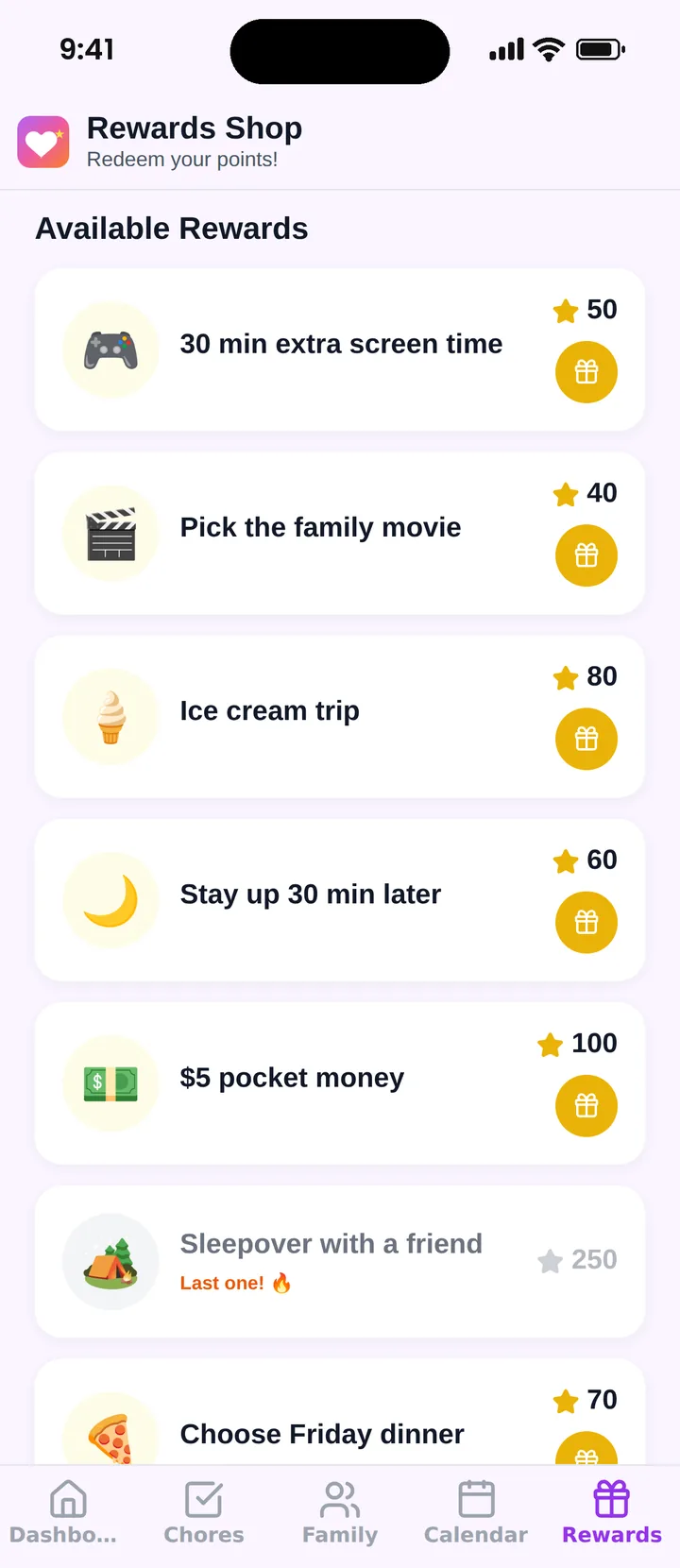
Some kids are not old enough for neighborhood work, but they can still earn at home through a points system. Famiyo is a free family app for iPhone and Android that combines a shared family calendar, chores with points and a rewards shop; kids join with a code, no email needed. You set a price in points for each reward, and pocket money can be one of the rewards in the shop. If you convert points to cash, 100 points is $1, but the money itself changes hands outside the app. Famiyo does not hold or move real money.
For comparison, see our list of the best allowance apps for kids.
Pick one idea from each list, agree on a price, and let your child run it for a month.
Frequently asked questions
How can a 10-year-old make money at home?
Pay for extra jobs beyond the basics: washing the car, raking leaves, organizing the garage, helping a grandparent with errands. Typical pay is $0.25 to $1 for a small job and $2 to $5 for a big one. Keep everyday family chores unpaid.
Can a kid make money online for free?
Mostly through a parent. Most platforms require users to be 13 or 18, and kids should not run accounts or share personal details alone. A parent can help sell outgrown toys or handmade items, and the child does the work.
What is the easiest way for a kid to make money?
Odd jobs for people they know: a lemonade stand, walking a dog, watering plants while neighbors travel, washing cars. They need no start-up cost, no account and are easy to supervise. Agree on a price before the job starts.
Is it okay for kids to be paid for chores?
Many families pay only for extra jobs and keep basic chores unpaid, so kids learn that helping at home is part of being in the family. Paid extras teach that effort earns money. Both ideas can sit side by side.
Try Famiyo With Your Family
Chores with points, a rewards shop for kids and one shared family calendar. Set it up in a couple of minutes.



Free to download • No credit card required • Available on iOS & Android