How to Motivate Kids to Do Homework: What Works and Why
How to motivate kids to do homework: set a fixed time and place, shrink the task, reward effort with quick, small payoffs, and know when to step back.
By Famiyo Editorial Team5 min read
Homework resistance is rarely about laziness. It usually comes from one of four places: the child is tired, the work feels too big, they don't understand it, or the evening has no shape. Each one has a different fix. This guide walks through them in the order that tends to pay off, and says where the research is solid and where it depends on your child.
Why kids resist homework
Before changing anything, work out which problem you have. Watch two or three evenings and look for the pattern.
| What you see | Likely cause | First thing to try |
|---|---|---|
| Stalls for an hour before starting | Task feels huge or unclear | Break it into 10 to 15 minute pieces |
| Melts down mid-way | Doesn't understand the material | Stop, note the question, tell the teacher |
| Rushes through badly | Wants screens or play | Set the work block before the fun thing, not after |
| Wrecked after school | Tired or hungry | Snack and 30 minutes of movement first |
| Fine at school, fights at home | Control and autonomy | Give choices about order and timing |
If it is the second row every night, that is a signal about learning, not motivation. A teacher conversation comes before any reward chart.
Build the routine before the rewards
The best-supported advice is also the dullest: same time, same place, same starting ritual. The CDC and the AAP both point parents to predictable routines as a base for school success, and a predictable slot removes a daily negotiation.
- Pick a window that follows a break: after a snack and some movement, not straight off the bus.
- Choose one spot with a flat surface and good light. The kitchen table works for most kids, and having you nearby cooking is fine.
- Phones and tablets go in another room. Homework done with a screen in reach takes longer, and it is usually the child's phone that wins.
- Start with the hardest or least liked item while energy is highest, then finish with the easy one.
- Use a timer: 15 minutes of work, 3 minutes of break for younger children, 25 and 5 for older ones.
Give it two to three weeks of consistent use before judging it. A routine feels forced for the first several days, and that is normal.
Make the task smaller
A blank worksheet looks like an hour. Three problems looks like five minutes. Ask your child to write down every item for the night, then pick the order. Cross things off as they finish. Seeing the pile shrink is motivating on its own and costs nothing.
For long projects, work backward from the due date with your child and write the mini-deadlines on a calendar. Kids who never see the whole plan often panic at the end.
Where rewards help (and where they don't)
Researchers who study motivation often distinguish between doing something because it is interesting and doing it for an outside payoff. Outside rewards can dull interest in tasks a child already enjoys, which is why reading for fun is a poor place to bolt on a prize. Homework is different for most kids: it is assigned, often routine, and rarely enjoyed. A small reward there is unlikely to damage anything that wasn't already missing.
Some guardrails that follow from this:
- Reward effort and process: starting on time, finishing the block, writing the plan. Do not pay for grades, which the child cannot fully control.
- Keep the payoff quick. A reward promised for the end of the month does nothing on a Tuesday.
- Keep it small and varied: choose the dinner, 15 extra minutes of screen time, a friend over on Saturday.
- Plan to fade. After the habit holds for several weeks, move to rewards for the week, then occasionally.
A simple points frame many families use: 10 points for starting without a reminder, 10 for finishing the planned work, a bonus of 2 for doing it unprompted. Small rewards cost 30 to 50 points, medium ones about 100. For a deeper walkthrough of building a system like this, see how to create a reward system for kids in 5 steps.
What to say at the table
Language matters more than most parents expect. A few swaps:
- Instead of "Have you done your homework?" try "What's on the list tonight, and what's first?"
- Instead of "Why is this taking so long?" try "Where did it get tricky?"
- Instead of "You're so smart" try "You kept going on that one even when it was annoying."
- When they are stuck: "What do you think the question is asking? What would you try first?"
Stay close, but keep your pencil in your own hand. Homework that parents do for kids teaches the teacher the wrong thing about what the child knows.
If the issue is wider than homework, our pieces on how to motivate kids to learn and how to motivate kids to study go into curiosity and study habits.
When to get outside help
Persistent trouble may have a cause beyond motivation: attention, reading difficulties, anxiety, vision or hearing, poor sleep. Children 6 to 12 need 9 to 12 hours a night and teens 8 to 10, and a tired child will fight any task. If homework has been a nightly struggle for several weeks even with a routine, talk to the teacher and your pediatrician. Neither of those conversations is an overreaction.
Setting up the rewards in Famiyo
Famiyo is a free family app for iPhone and Android that combines a shared family calendar, chores with points and a rewards shop; kids join with a code, no email needed.
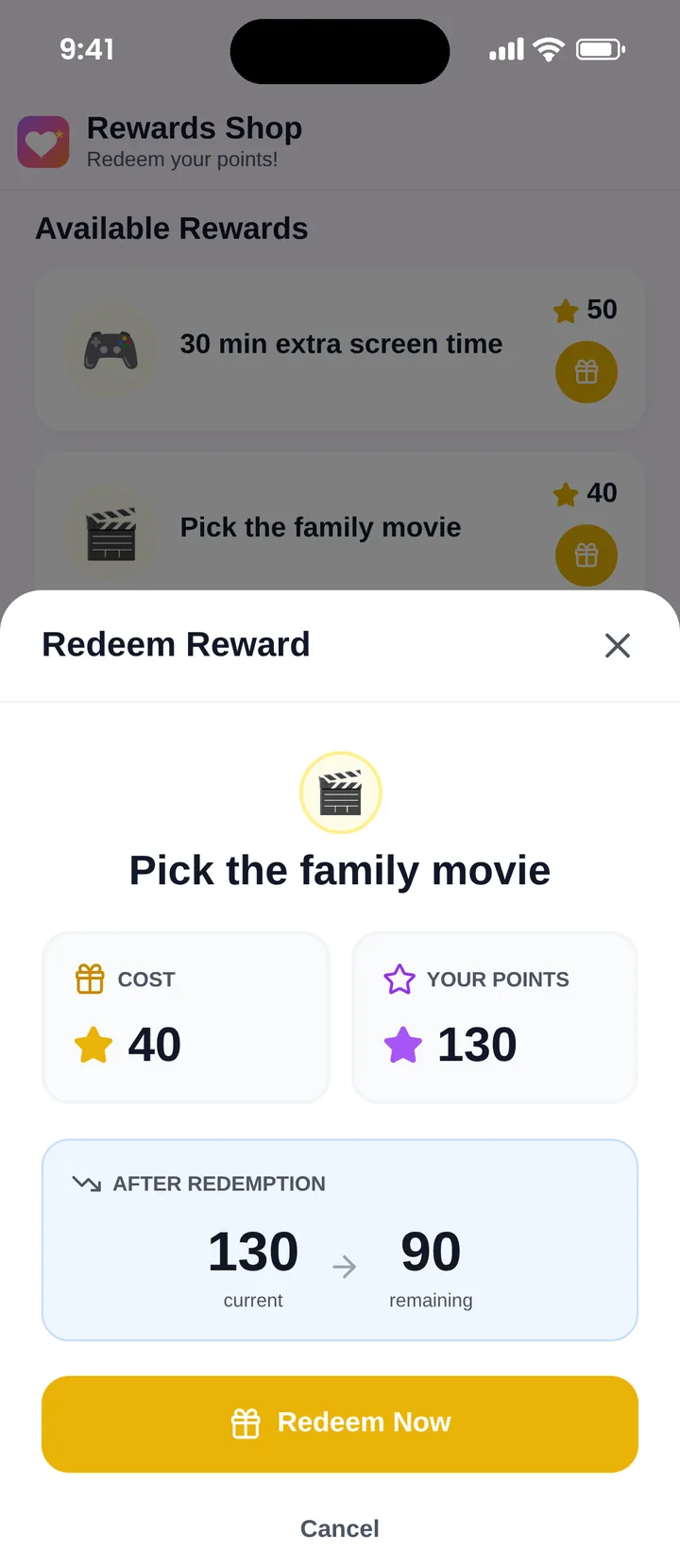
For homework, you add it as a repeating task with a few points, and your child checks it off on their own phone (or you approve it, your call). The rewards shop is where the points go: you create rewards with a price in points, how many are available and when, and your child redeems from their own phone and sees how many points they will have left. A "friend over Saturday" reward available once a week keeps the limit clear. For other options, see our list of the best reward chart apps for kids.
Start with one subject or one daily block, not the whole week. Add rules only when the first one works.
Frequently asked questions
Should I reward my child for doing homework?
Small rewards can help build a routine, especially for kids who find homework dull. Reward starting and finishing on time rather than grades, keep the prize modest, and fade it out once the habit holds. Praise for effort should always come with it.
How long should homework take?
A common guideline from education groups is about 10 minutes per grade level per night, so roughly 10 minutes in first grade and 60 in sixth. If your child regularly takes far longer, tell the teacher instead of pushing through.
What if my child says they have no homework?
Check the school portal or planner together, and set a fixed daily work block anyway. Use that time for reading, review or planning ahead. It keeps the routine steady, and the question stops being a negotiation.
Should I help with homework or let them struggle?
Help with how to start, not with answers. Ask what the question is asking and what they would try first. Productive struggle is part of learning. If your child is stuck and upset, stop, note where, and send the teacher a short message.
Try Famiyo With Your Family
Chores with points, a rewards shop for kids and one shared family calendar. Set it up in a couple of minutes.



Free to download • No credit card required • Available on iOS & Android