How to Motivate Kids to Study: What Works and What Backfires
How to motivate kids to study without nagging: reward effort instead of grades, shrink the session, protect sleep, and follow a simple weekly plan.
By Famiyo Editorial Team5 min read
Studying is a different kind of problem from chores. Nobody grades a clean sink, but a test result feels personal, and a child who has been struggling will do almost anything to avoid the subject. This page covers what tends to help, what tends to backfire, and a weekly structure you can start with, using established ideas about motivation rather than tricks.
Start by finding out why they avoid it
A child who will not study is usually avoiding something specific: a subject they find hard, a worry about looking dumb, a sense that effort will not change the result, or plain tiredness. The behavior looks the same from the outside, but the fix is different each time.
Ask one open question at a time and listen: "What part of studying is the worst?" "When you sit down, what happens first?" Resist the urge to correct the answer. If the reply is "I don't get it," the problem is the material, and no reward will fix that. If it is "I'm too tired," look at sleep before you look at motivation. The AAP and AASM recommend 9 to 12 hours a day for ages 6 to 12 and 8 to 10 hours for ages 13 to 18, and a child running short on sleep will find every task harder.
What research on motivation says in plain terms
Decades of work on motivation, including self-determination theory, keeps pointing at the same three needs. Children are more willing to do something when they feel they have some choice, when they feel capable, and when they feel connected to the people around them. You do not need citations to use this. It translates into three simple parent moves.
- Offer choices inside limits. "Math first or reading first?" "Kitchen table or your desk?" The study still happens, but the child owns part of it.
- Make success likely. Break a big task into pieces small enough that finishing is realistic.
- Stay close without hovering. Sit nearby with your own work for the first few minutes. Presence helps more than supervision.
The same body of work suggests that rewards can crowd out interest when they are large, unpredictable or attached to something the child already enjoys. So we use them sparingly, on routines that are plain hard work, and plan to fade them. Our overview of kids motivation goes deeper on the theory.
Reward effort, not the grade
A grade depends on the teacher, the test, the sleep the night before and a dozen other things. A child can study well and still miss a question. If you pay for the grade, you teach that effort only counts when it works.
Instead, reward the parts your child controls: starting on time, staying with the task for the planned block, finishing the plan. Here are examples of effort targets and fair points. The scale follows our usual rule of 5 points for a small task, 10 for a medium one and 20 for a big one, with a +2 bonus for doing it without a reminder.
| Study behavior | Size | Points |
|---|---|---|
| Start the session at the agreed time | Small | 5 |
| Finish a 20-minute focused block | Medium | 10 |
| Make flashcards or a summary page for a test | Medium | 10 |
| Complete a full test-prep plan across the week | Big | 20 |
| Start without a reminder | Bonus | +2 |
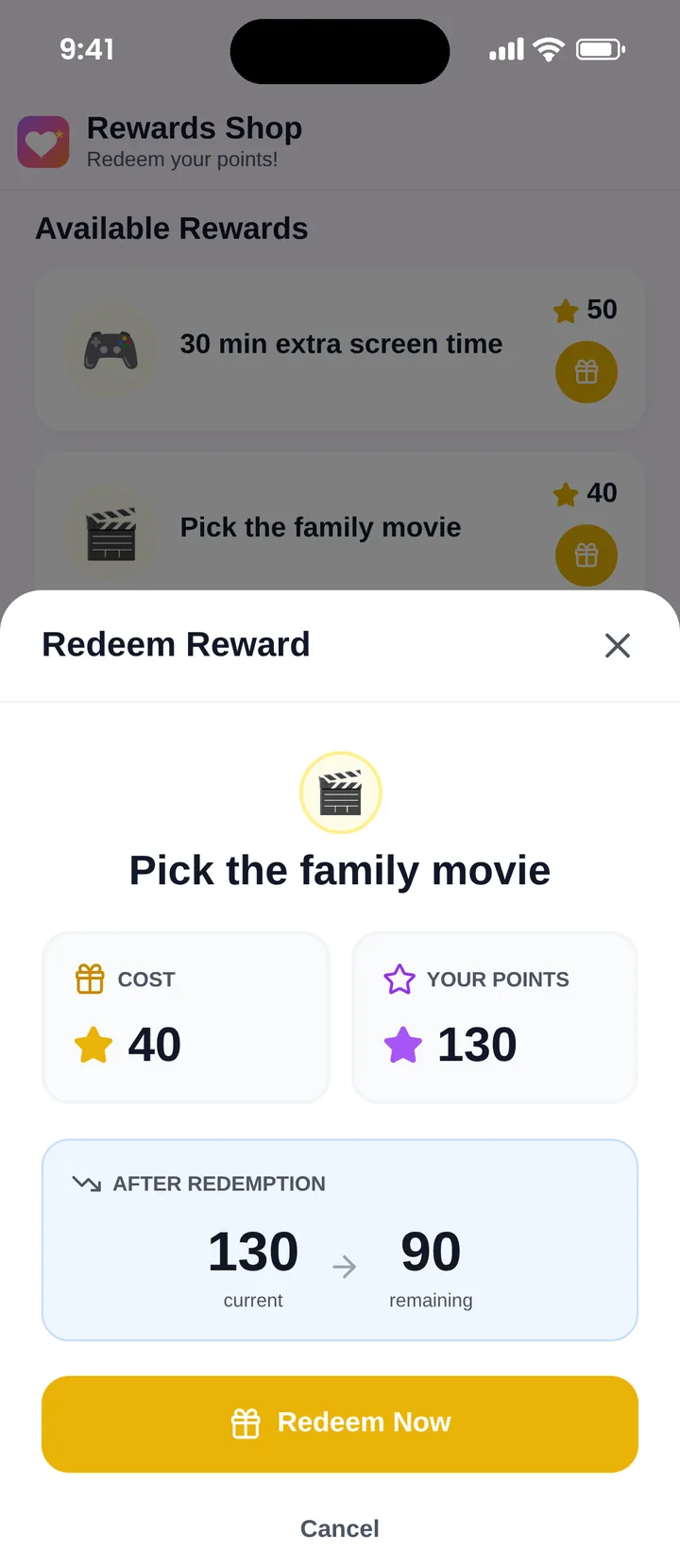
Then connect points to rewards a child actually wants: a small one costs 30 to 50 points (15 extra minutes of screen time, a choice of dessert), a medium one about 100 (pick the family movie), a big one 300 to 500. Aim for a small reward every 2 to 3 days, so the link between work and reward stays fresh.
A simple weekly study plan
A routine beats a burst of effort. Try this for a school-age child, adjusted to the age and the school's homework load.
- Pick a time that is the same every school day, such as 4:30 pm after a snack. Write it on the family calendar.
- Clear the space. Phone in another room, one subject on the table.
- Set a timer for 20 minutes (younger kids) or 25 to 30 (older kids). When it rings, they get a 5-minute break.
- After the block, the child names one thing they finished. You do not grade it, you just note it.
- On Friday, spend 5 minutes looking at what is coming next week, so Sunday night is not a surprise.
- Review after three weeks. Keep what worked, and shorten or move what did not.
New habits need 2 to 3 weeks of consistent use before you judge them, so avoid changing the plan every few days.
What to avoid
A few common moves feel natural and tend to backfire.
- Threats about the future ("You'll end up with no job"). They raise anxiety, and anxious kids study worse.
- Comparison with siblings or classmates. It hurts the relationship and rarely changes the behavior.
- Taking over. If you do the project, they learn it is your project.
- Praise for being smart. "You worked hard on that" lands better than "You're so clever," because it points to something they can repeat.
- Grounding for a bad grade. It links studying with punishment, which is the opposite of what you want.
For readers who want to see the same approach for a teen, our piece on how to motivate a teenager adapts it to older kids, and how to motivate a child with ADHD to study covers shorter steps and faster feedback. For the wider habit of enjoying school work, see how to motivate kids to learn.
Using a rewards shop for study routines
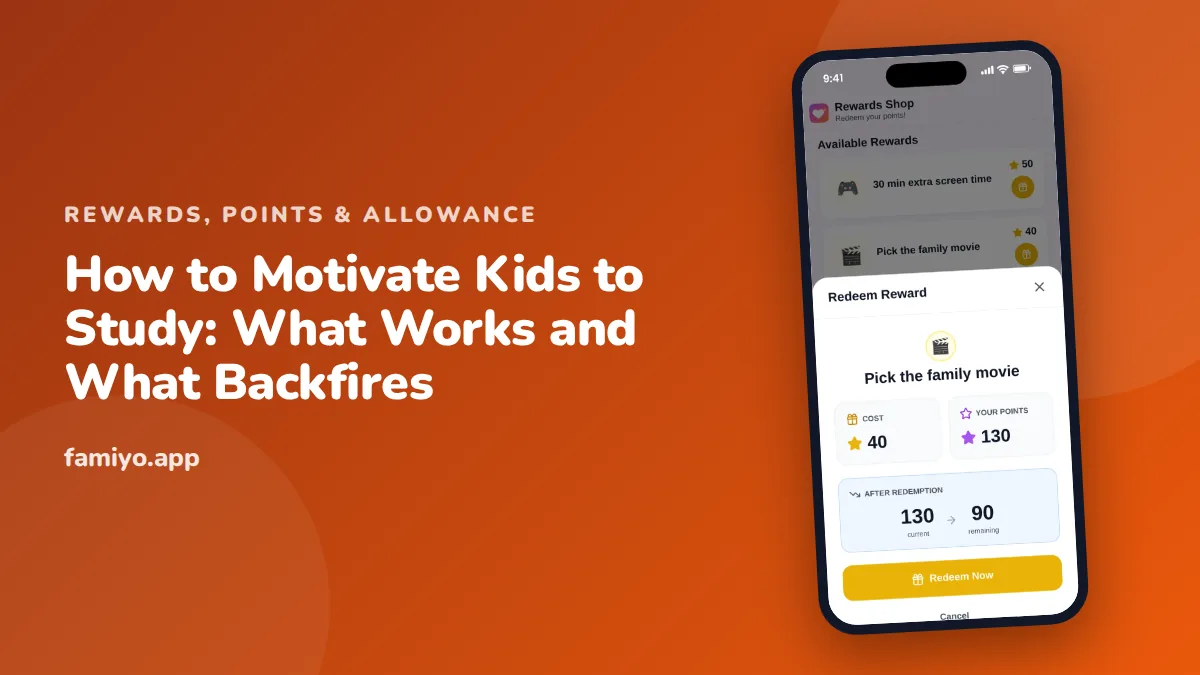
Famiyo is a free family app for iPhone and Android that combines a shared family calendar, chores with points and a rewards shop; kids join with a code, no email needed. For study, you add the routine (say, a 20-minute study block, Monday to Friday) as a repeating task with points. Then you stock the rewards shop with prices in points, a limit on how many are available and the dates they run, so a movie night reward might be available once a week. Your child redeems from their own phone and sees how many points they will have left, and you get a push notification when a reward is redeemed. Looking for alternatives? Our best reward chart apps for kids compares them.
A first step for tonight
Choose one subject and one 20-minute block. Sit nearby, set the timer and let your child decide where to sit. Tomorrow, do the same at the same time.
Frequently asked questions
Should I pay my child for good grades?
It is risky. A grade depends on many things a child does not fully control, so a reward for the grade can feel unfair and push attention onto the result. Rewarding the study routine itself, like finishing a planned 25-minute session, works better.
How long should a child study each day?
There is no fixed number. Most school-age children do better with short blocks, about 15 to 25 minutes for younger kids and a bit longer for teens, with breaks between. Quality and a regular time slot matter more than total hours.
What if my child says studying is pointless?
Take the feeling seriously and ask what feels pointless. Often it is one subject or one fear of failing. Link the work to something they care about, and keep the first steps tiny so they can win quickly and rebuild confidence.
Do rewards kill a child's love of learning?
Heavy or unpredictable rewards for things a child already enjoys can reduce interest, according to the broader motivation research. Use them for routines a child finds dull, keep them small, and phase them out as the habit forms.
Try Famiyo With Your Family
Chores with points, a rewards shop for kids and one shared family calendar. Set it up in a couple of minutes.



Free to download • No credit card required • Available on iOS & Android