How to Motivate Kids to Practice (Sports and Music)
How to get kids to practice an instrument or a sport without nagging: shorter sessions, a fixed slot, small rewards for effort, and when to let them quit.
By Famiyo Editorial Team6 min read
Your 8-year-old loved the first violin lesson. By week six, the case sits by the door and every practice session starts with negotiating. Or your 11-year-old agreed to join the swim team, then discovered that the part nobody cheers for is the daily work. Here is how to make practice a normal part of the day, what to reward, and when to stop pushing.
Why practice is a motivation problem, not a discipline problem
Practice is hard for a simple reason: the payoff is far away and the discomfort is right now. A child who is working on a tricky scale or a weak backhand feels bad at something in the present, while the recital or the tournament is weeks off. Adults struggle with the same gap.
Psychologists who study motivation generally describe three things that keep people going: feeling competent, having some say in what they do, and feeling connected to others. That framework (self-determination theory) is widely published, and it maps neatly onto practice. Kids keep going when they can see themselves improving, when part of it is their choice, and when the people they care about are on their side.
So the first question is not "how do I make them practice?" It is "which of those three is missing?" A child who feels stuck needs smaller steps. A child who feels bossed around needs more choice. A child who practices alone in a cold room might simply need company.
Make practice small, fixed and easy to start
Most practice fights are really starting fights. Reduce the cost of starting and the rest gets easier.
- Keep the instrument or gear out, not in a closet or a bag. If the guitar is on a stand in the living room, it gets picked up.
- Anchor practice to something that already happens, such as right after a snack or before dinner. A fixed slot removes the daily debate.
- Start with a time that feels almost too short. Ten minutes that happen beat thirty that don't. Most children's teachers and coaches would take a consistent 10 to 15 minutes over one long Sunday session.
- Begin with something your child enjoys or already does well. Ending on a hard piece sours the whole session.
- Write the plan down so there is no arguing about what "practice" means: three drills, one piece, done.
If your child tends to drift, a visual list helps. A short checklist on the fridge works for a 6-year-old, and a phone reminder works better for a 12-year-old.
Give your child a say in the plan
Choice is cheap and powerful. You do not have to hand over the whole thing, but let your child decide something every time.
Offer two options, both of which you can live with: "Do you want to start with the scales or the new song?" or "Practice before dinner or right after?" Let older kids choose the piece for the last five minutes, or pick the playlist for conditioning drills. Ask them to teach you one thing they learned this week. Explaining it to you tests their understanding and makes them the expert.
Avoid hovering. Sitting beside a child correcting every note turns practice into a performance review. Unless they are very young or ask for help, listen from the next room and comment on what you heard afterward.
What to say, and what not to say
Your words matter as much as any reward. Compare these:
| Instead of | Try |
|---|---|
| "You're so talented." | "That run was cleaner than yesterday. What did you change?" |
| "Why didn't you practice?" | "What got in the way today? What would make tomorrow easier?" |
| "If you practiced more you'd be better." | "Which part feels hardest right now? Let's pick one thing for this week." |
| "I'm not paying for lessons so you can quit." | "I want to hear what is bugging you about it. Then we'll decide together." |
| "Great job!" | "You kept going even when the fingering was annoying. I noticed." |
Praise for effort and strategy tells a child what to repeat. Praise for talent gives them something to lose when practice goes badly.
Using rewards without ruining the fun
Rewards are a tool, and they work best in a narrow way. Research on the so-called overjustification effect suggests that heavy rewards for something a child already enjoys can make the activity feel like work. The practical lesson is not "never reward." It is "reward the routine, keep it small, and plan to taper."
A workable setup looks like this:
- Reward showing up, not how it sounded. A session counts if your child did the plan, even if it was messy.
- Use points or stickers for each session, with a small reward at the end of a week. A week of practice earning a family movie pick or 15 extra minutes of screen time is plenty.
- Add a separate, non-material goal that is tied to the activity itself: learn one song you love, hit a target time, play at the family gathering.
- Say the reward is for building a habit, and that you will phase it out. "For the next month, each session earns points. After that we'll see how it feels without them."
- Taper by stretching the gap. Move from daily rewards to weekly, then to the occasional celebration.
If you want a deeper look at setting up the structure, our guide on how to create a reward system for kids in 5 steps covers prices, caps and what to do when points stop working.
A sample week for a 9-year-old learning piano
Keeping it concrete helps. Here is one way a family might lay out a first month of practice. Adjust the minutes for your child.
| Day | Plan | Time | Points |
|---|---|---|---|
| Mon | Warm-up scales, one piece, play a favorite | 15 min | 10 |
| Tue | New piece, hands separately | 15 min | 10 |
| Wed | Lesson day, no extra practice | none | 0 |
| Thu | Fix the one hard bar from the lesson | 15 min | 10 |
| Fri | Free choice: anything on the piano | 10 min | 10 |
| Sat | Play the week's piece for a family member | 10 min | 10 |
| Sun | Rest | none | 0 |
At 10 points a session that is 50 points for a full week, so a small reward at 50 points lands once a week. That fits the pattern where a child can afford a small prize every few days and a bigger one every few weeks.
When practice is not working
Sometimes motivation is not the real problem. Check these before you add more rewards:
- The piece or drill is too hard. If your child fails more than they succeed, ask the teacher for easier material.
- Too much on the calendar. A child with three activities and homework may be tired, not lazy.
- The activity belongs to you, not them. If they would rather quit, talk about it honestly.
- A bad match with the teacher or the team. Sometimes a change of coach fixes everything.
On quitting: agree at the start to finish the term or the season, then decide together. A deliberate ending after a fair try teaches something very different from walking away after a bad Tuesday. If you are dealing with a broader pattern across school subjects, see how to motivate kids to learn, and for the reading side of things, how to motivate kids to read uses a similar approach.
Setting it up in Famiyo
Famiyo is a free family app for iPhone and Android that combines a shared family calendar, chores with points and a rewards shop; kids join with a code, no email needed. Add "Piano practice" as a repeating chore worth 10 points, and your child checks it off on their own phone or you approve it, whichever you choose. In the rewards shop you set the price in points, how many are available and when, then your child redeems from their phone and sees how many points they will have left.
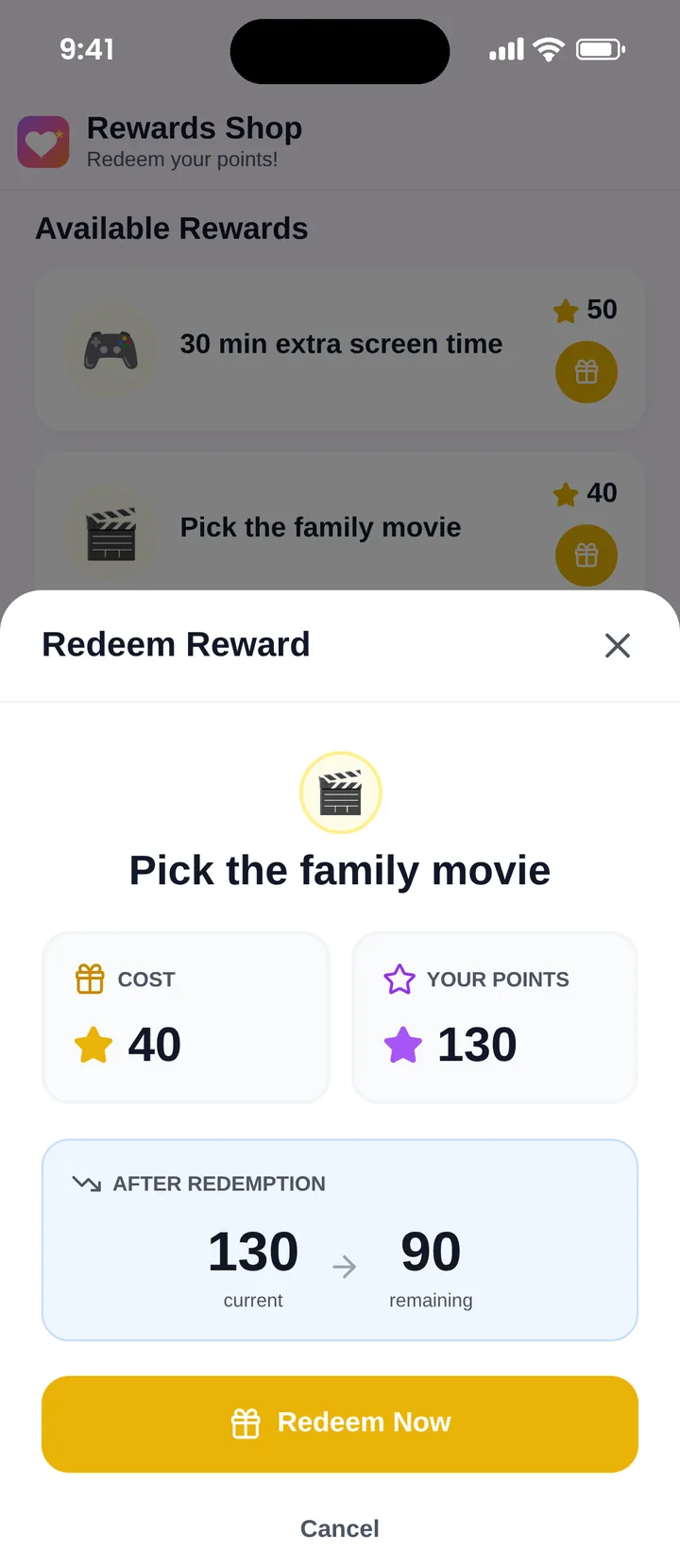
You get a notification when practice is done and when a reward is redeemed. Our list of the best reward chart apps for kids compares your options.
Start with one week
Pick a time, shrink the session, and let your child choose one thing about it. Run that for a week before you change anything else.
Frequently asked questions
How long should a child practice each day?
Short and regular beats long and rare. For young beginners, 10 to 15 minutes a day is a sensible start, and school-age kids can build toward 20 to 30. Let the length grow because your child wants more, not because the calendar says so.
Should I pay my child to practice?
Small rewards for showing up can start the habit, but cash for every session tends to make the activity feel like a job. Keep rewards modest, tie them to effort and routine, and shift to praise and real goals like a recital or a game as the habit settles.
What if my child says they hate practicing?
Find out what exactly they hate: the piece, the drill, the time of day, or the pressure. Fix that one thing first. If it is still miserable after a fair stretch, a break or a switch to another activity is a legitimate choice.
Is it okay to let a child quit an instrument or sport?
Yes, with a plan. Agree up front to finish the season or term, then decide together. Quitting after a rough week teaches a different lesson than ending something deliberately after a fair try.
Try Famiyo With Your Family
Chores with points, a rewards shop for kids and one shared family calendar. Set it up in a couple of minutes.



Free to download • No credit card required • Available on iOS & Android