Money Games to Teach Kids About Money (Ages 4 to 14)
Ten money games kids actually want to play, with ages, setup and what each one teaches, from Needs vs Wants cards to a pretend bank that pays interest.
By Famiyo Editorial Team5 min read

Kids tune out lectures about money fast. Hand them a pile of coins and a store to run, and they'll stay at the table for an hour. Below are ten games that work at home with things you already own, sorted by age, with what each one teaches and how to run it.
Ten money games to play at home
| Game | Ages | Time | What it teaches |
|---|---|---|---|
| Pretend store | 4-7 | 15 min | Counting, prices, change |
| Needs vs Wants cards | 5-9 | 15 min | Telling essentials from extras |
| Three jars | 5-12 | 10 min, then weekly | Spend, save, give |
| Price detective | 6-10 | 30 min | Comparing prices and unit costs |
| Wait or now | 6-10 | 5 min | Delayed gratification |
| Family auction | 7-12 | 30 min | Bidding, scarcity, regret |
| Pretend bank | 8-12 | 10 min a week | Interest and compounding |
| The $20 challenge | 9-13 | 45 min | Budgeting and trade-offs |
| Lemonade stand on paper | 9-14 | 30 min | Cost, price, profit |
| Birthday budget | 10-14 | 30 min | Planning against a limit |
Games for ages 4 to 7
Pretend store. Put sticky notes on ten household items, priced from 1 to 10 coins. Give your child 15 coins (pennies, buttons or pasta shells all work). They shop, you ring them up, and they count the change. Then swap roles so they have to add up your order. Don't correct every mistake. Let them notice that 10 coins won't buy three things priced at 4.
Needs vs Wants cards. Draw or cut out 12 pictures: a coat, a tablet, apples, a toy dragon, a toothbrush, bubble tea, shoes, a movie ticket. Your child sorts them into two piles. The fun is in the arguments. Is a coat a need if it's 80 degrees? Is a snack a need? Accept any answer they can defend in one sentence.
Three jars. This one is a game for a week, not an afternoon. Label three jars Spend, Save and Give, and split any coins your child receives, for example 50%, 40% and 10%. At the end of the week they empty the Spend jar on purpose. Watching the Save jar slowly fill while Spend sits empty teaches more than any explanation.
Games for ages 6 to 10
Price detective. Give your child a grocery flyer or store app and a short list: pasta, cereal, juice, yogurt. Their job is to find the cheapest option for each and write down the price per ounce or per item. Say a prize goes to whoever saves the most compared with the first thing they picked. Kids discover that the big box isn't always the better deal, which surprises most adults too.
Wait or now. Offer a choice: one cookie today, or two after dinner tomorrow. Or 30 points now, or 50 points on Sunday. Run it as a quick game with no lecture, then ask "Which one did you pick, and why?" Our guide on delayed gratification for kids explains why this small habit matters later.
Family auction. Wrap or write down eight small prizes: pick the playlist, skip one dish duty, first choice of seat in the car. Everyone gets 100 play dollars. Bid against each other. Someone will blow the whole budget on the first item and then watch the rest go by. That feeling of regret is the lesson, and it's cheap when the prize is a seat in the car.
Games for ages 8 to 14
Pretend bank. You become the bank. Your child "deposits" some of their savings with you and you pay interest each week, say 10% to start. Write it on a sheet: week 1, week 2, week 3. They'll see the balance grow on its own. Be generous with the rate, since you're teaching the idea of compounding, not the real market. When it's time to talk about investing, you'll have a shared picture to point back to.
The $20 challenge. Give your child $20 (real or imaginary) and a goal: plan a movie night for four people. They must price snacks, a rental and anything else, and stay under budget. Let them do the real shopping if you can. If they're short, they have to cut something and justify it. Teens can raise the stakes with a $50 dinner for the family.
Lemonade stand on paper. Give them these facts: cups cost $4 for 25, lemonade mix costs $6 a batch and makes 20 cups, and the stand is open for two hours. What price should they charge, and how many cups do they need to sell to break even? Run it three times with different prices and see which gives the most profit. If they want to try it for real, our list of ways for kids to make money in the neighborhood has ideas.
Birthday budget. Give a 10 to 14-year-old a pretend budget for a party: $100 for ten guests. They plan food, decorations, activities and a cake. When they go over, they cut. Ask them which cut hurt the least. It's an argument about priorities with a spreadsheet attached.
How to run any money game so it sticks
- Keep the stakes real but small. A prize like picking Friday's dinner beats a sticker.
- Let them lose. A child who overspends play money at the auction has paid the cheapest tuition they'll ever pay.
- Ask one question at the end, not five. "What would you do differently?" is enough.
- Repeat the favorites. The second round is where kids start planning ahead.
- Connect the game to a real choice that week, like what to do with this Saturday's $5.
For more everyday ideas that need no setup, see our 15 money activities to do at home.
Turning the game into a daily habit in Famiyo
Games are good for starting conversations. Real spending choices keep them going. Famiyo is a free family app for iPhone and Android that combines a shared family calendar, chores with points and a rewards shop; kids join with a code, no email needed. Kids earn points for chores, then decide what to spend them on from rewards you create, each with a price and a limit. If one of the rewards is pocket money, you set the price in points, and the money itself changes hands outside the app. Our roundup of the best allowance apps for kids compares the options.
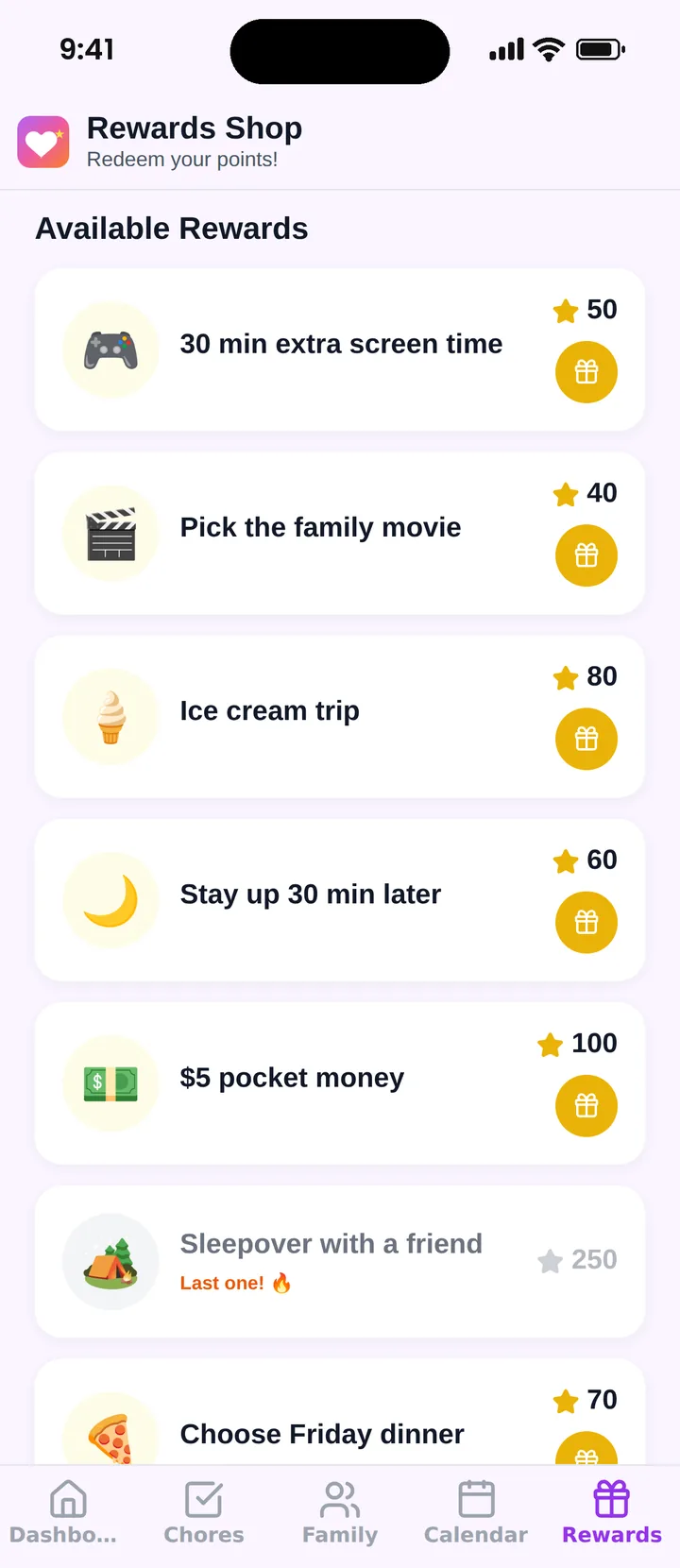
A child who has to choose between a 30-point reward today and a 100-point one next week is playing a money game every day. The difference is that the points came from their own work, so the decisions feel real.
Where to start tonight
Pick one game from the first table and run it after dinner for 15 minutes. If it goes well, repeat it next week with a small twist. If you want paid jobs to feed the games, take a look at extra chores kids can do for money.
Frequently asked questions
What is the best money game for a young child?
For ages 4 to 6, a pretend store works best. Price a few household items at 1 to 5 coins, hand over a pile of coins and let your child buy, count change and decide what to leave on the shelf. It takes 15 minutes and needs no purchase.
Are board games like Monopoly good for teaching money?
They teach counting, trading and risk, but the money is abstract. Pair a board game with something real, such as a weekly spending choice with their own cash or points, so the lessons carry over to actual decisions.
How often should we play money games?
Once a week is plenty. Short rounds of 15 to 30 minutes keep it fun. Repeat the games kids love, because the second time they make better choices and start explaining their reasoning without being asked.
Can kids learn about money without handling real cash?
Yes. Play money, points or tokens work fine, as long as the choices feel real. A child who has to pick between two rewards with a fixed number of points learns the same trade-off as one choosing between two toys.
Try Famiyo With Your Family
Chores with points, a rewards shop for kids and one shared family calendar. Set it up in a couple of minutes.



Free to download • No credit card required • Available on iOS & Android