Jobs for 14-Year-Olds: 20 Legal Ways to Earn Money
Jobs for 14-year-olds, both formal and informal: what US rules allow, 20 real ideas by type, how to set a price, and how to track earnings with a phone.
By Famiyo Editorial Team5 min read

Fourteen is an awkward age for work. Too young for most real paychecks, too old to be satisfied with $5 for emptying the dishwasher. The good news is that there is a decent list of jobs a 14-year-old can do, some formal and most informal, and a teenager who earns their own money tends to think differently about spending it. This guide covers what the rules allow, 20 specific ideas, and a way to organize the whole thing.
What the rules say at 14
In the US, 14 is the federal minimum age for most non-farm jobs. Federal child labor rules for 14 and 15-year-olds are fairly consistent, though it pays to confirm the details with your state's labor department.
- Work must be outside school hours.
- No more than 3 hours on a school day and 18 hours in a school week.
- No more than 8 hours on a non-school day and 40 hours in a non-school week.
- Between 7 a.m. and 7 p.m. in most of the year. In summer (June 1 to Labor Day) evening work can run until 9 p.m.
- Some jobs are off limits, such as most manufacturing, driving, and anything involving heavy machinery.
Many states require a work permit for formal employment, often called working papers, which are signed by a parent and sometimes the school. Informal jobs for neighbors, like babysitting or mowing, usually fall outside the permit system, though there is no harm in checking.
This is general information, not legal advice. Look up your state's rules before the first shift.
20 jobs a 14-year-old can do
Pick two or three that match your teen's interests and your area. A kid who loves dogs will stick with pet sitting far longer than one who was talked into it.
Informal jobs for neighbors and family friends
- Babysitting or mother's helper (a younger sibling's friend counts)
- Mowing lawns and trimming edges
- Raking leaves and bagging yard waste
- Weeding and watering gardens
- Dog walking
- Pet sitting while a family is away, which means feeding and checking in
- Washing cars
- Shoveling snow (where it applies)
- Tutoring younger kids in a subject they are good at
- Helping older neighbors with phones, tablets and printers
Jobs through a business or organization
- Bagging groceries or collecting carts, where the store hires at 14
- Food service helper, such as bussing tables, in places that allow it
- Camp helper or junior counselor
- Lifeguard assistant or pool helper
- Working at a family member's business
- Sports referee or umpire for younger leagues
- Library or community center volunteer that can lead to paid roles
Jobs that use a phone or laptop
- Social media or photo help for a small local business, with a parent involved
- Selling used items, with a parent managing the listing
- Making simple graphics or flyers for local events
Two things to keep in mind. First, anything that involves meeting strangers, online or off, should go through a parent. Second, a few of these, like tutoring or tech help, can be set up as a repeat weekly job, which builds income that is much easier to predict than one-off tasks.
How to set a price
Teens tend to either undercharge or invent a number that scares off customers. A simple method works better.
- Ask two neighbors or friends what they pay for the same thing.
- Set a price for the job, not the hour, for outdoor work like mowing. Set an hourly rate for babysitting or tutoring.
- Say it plainly before starting: "I charge $X for the front lawn. Does that work?"
- Raise the rate once a year or after you take on more responsibility.
Jobs done at home are a different category. The usual range for chores beyond the basics is $0.25 to $1 for a small extra job and $2 to $5 for a big one. For more ideas along those lines, see our list of extra chores kids can do for money.
Tracking money in a digital world
Most 14-year-olds get paid in a mix of cash, Venmo or Zelle transfers from a neighbor's parent, and sometimes a paycheck. That makes it easy to lose track. Two habits keep it honest.
First, a simple notes file or spreadsheet with the date, the job, who paid and how much. This takes thirty seconds and makes it easy to see what actually earns the most for the time.
Second, a rule for what happens to the money. The spend, save, give split (50, 40 and 10 percent for younger kids) can be adapted: a 14-year-old might put aside 20 to 30 percent into savings before touching the rest. If your teen needs more ideas for what a first account looks like, our guide on how to make money as a kid has a longer list.
For younger siblings, our list of jobs for kids under 13 covers what fits the age.
Turning household work into points, and points into pocket money
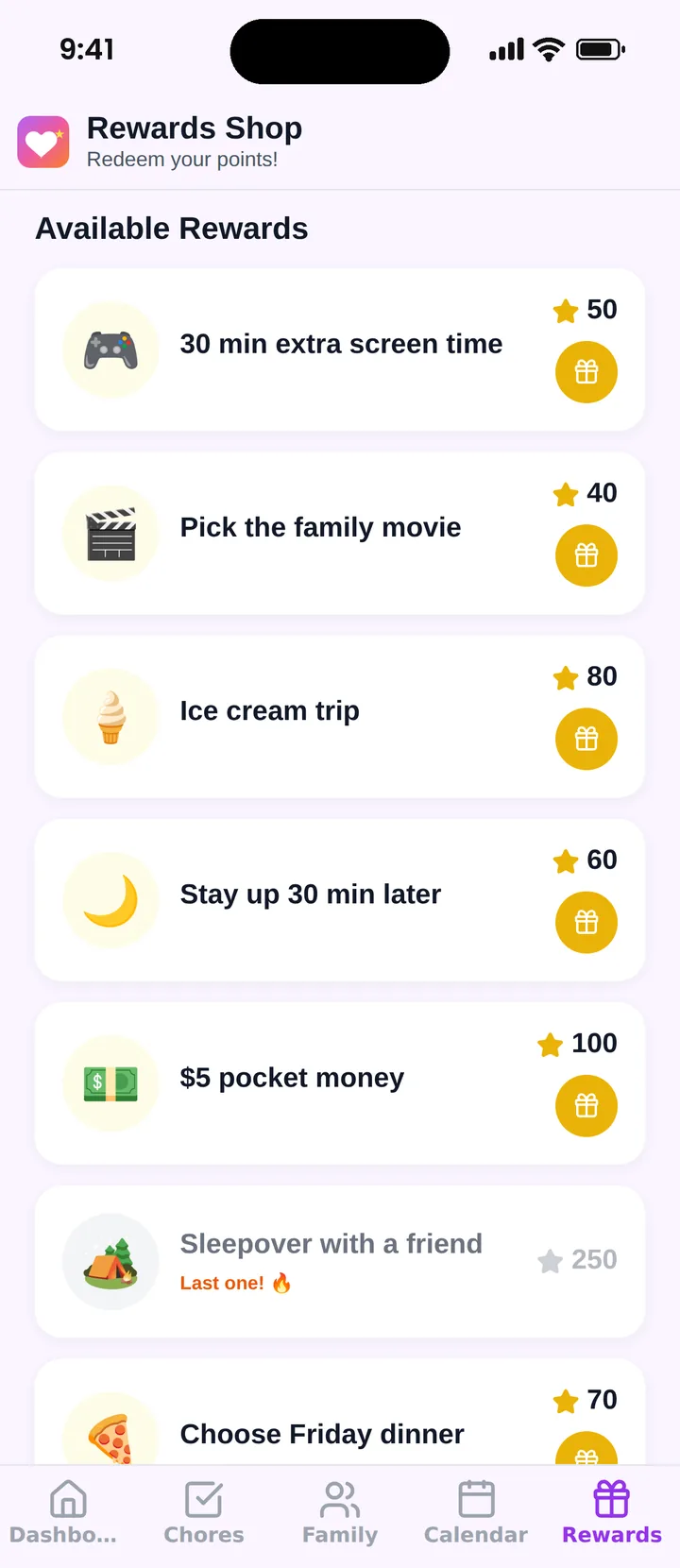
Not every 14-year-old can or wants to work outside the home right away. Household jobs can fill the gap. Famiyo is a free family app for iPhone and Android that combines a shared family calendar, chores with points and a rewards shop; kids join with a code, no email needed. Parents set point values for chores and create rewards with a price in points, including pocket money, though the money itself changes hands outside the app. At the family default of 100 points to $1, a 20-point job is 20 cents, so you can adjust the exchange rate that suits your family. Your teen sees the rewards shop on their own phone and picks what to work toward. Compare options in our list of the best allowance apps for kids.
A first step this week
Pick one informal job and one clear price. Ask your teen to write a two-sentence pitch ("I'm Sam, I mow lawns on Maple Street, $20 a yard, I bring my own mower") and give it to three neighbors. If it goes well, the second and third jobs follow quickly. If your teen needs a push, our piece on how to motivate a teenager who doesn't care is a good next read.
Frequently asked questions
What is the legal working age for a 14-year-old in the US?
Fourteen is the federal minimum age for most non-farm jobs. Hours are limited: outside school hours only, up to 3 hours on a school day and 18 hours in a school week. States can add stricter rules and often require a work permit, so check yours.
What are the best first jobs for a 14-year-old?
Informal jobs are the easiest start: babysitting, mowing lawns, pet sitting, tutoring younger kids and helping neighbors with tech. Formal options include bagging groceries, working at a family business, or being a camp helper, where local rules allow.
Do 14-year-olds need a work permit?
It depends on the state. Many require a work permit, sometimes called working papers, signed by a parent and the school for formal jobs. Informal work like babysitting or yard work for neighbors usually does not. Check your state labor department's website.
How much should a 14-year-old charge for babysitting or yard work?
Check what neighbors in your area pay for similar jobs and start close to that, not far below it. For jobs at home, our guide suggests $2 to $5 for a big chore. Agree on the price before the job, not after.
Try Famiyo With Your Family
Chores with points, a rewards shop for kids and one shared family calendar. Set it up in a couple of minutes.



Free to download • No credit card required • Available on iOS & Android