How Much Allowance for a 12-Year-Old? Typical Amounts
Most 12-year-olds get $10 to $15 a week. See how to pick an amount, what it should cover, and how to pay it in cash, a bank app or points.
By Famiyo Editorial Team4 min read
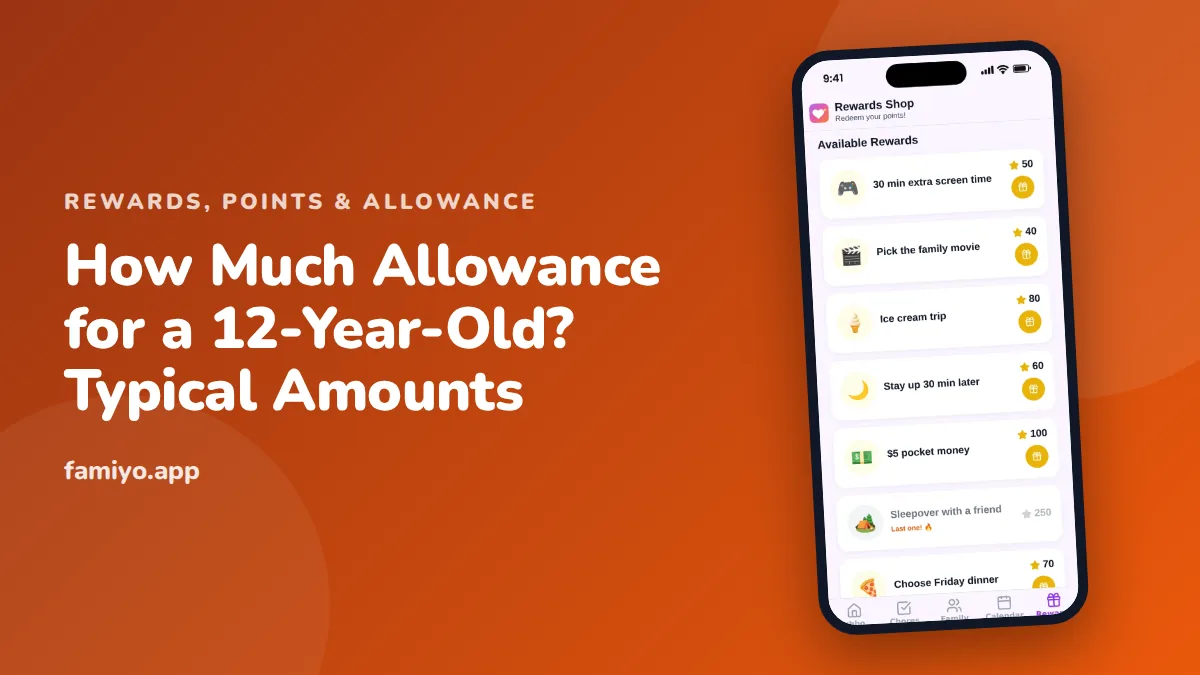
Twelve is when allowance gets real. Your child is starting to want things you will not buy on a whim: skins in a game, a hoodie from the store everyone likes, pizza with friends after school. A good allowance gives them a budget to learn on before the stakes get higher.
What do most families pay a 12-year-old?
Typical weekly ranges, as a starting point and not a standard:
| Age group | Typical weekly allowance |
|---|---|
| 5 to 7 | $3 to $7 |
| 8 to 10 | $7 to $10 |
| 11 to 13 | $10 to $15 |
| 14 and up | $15 to $25 |
At 12, that puts you at $10 to $15. The classic rule of $1 a week per year of age lands at $12. A 12-year-old who also has a phone plan, school lunches and a hobby you fund may reasonably get less. One who must cover their own snacks, entertainment and small gifts needs more.
If you are comparing across ages, see how much allowance for an 11-year-old and how much allowance for a 13-year-old.
How do you decide the exact amount?
Work backward from what the money is for. Write down what your child currently asks you to buy in a typical month, then pick the categories you want them to take over.
- List the regular wants: snacks, game currency, apps, movie tickets, small gifts for friends.
- Add up what those cost in a normal month. Be honest, not generous.
- Decide how much of that you want your child to cover. Maybe all of it, maybe two thirds.
- Divide by four to get a weekly number, then round to something simple like $12.
- Try it for a month and adjust. Saying "we'll review this in October" removes pressure to get it perfect.
If the number comes out above $15, check whether you are handing over essentials like clothes. That can be fine for older kids, but at 12 it often helps to keep the first version small.
Should allowance be tied to chores?
There are two common setups, and both work if you pick one on purpose.
Allowance as money practice: your child gets a fixed amount weekly, no strings, and everyday chores are part of living in the family. Extra jobs like washing the car or raking leaves earn separate pay, about $2 to $5 for a big job and $0.25 to $1 for a small one.
Allowance as a wage: pay depends on chores done. It teaches that work earns money, but it can also teach that nothing happens without payment. If you go this way, keep a short list of unpaid basics regardless.
Our guide to setting up a chore allowance walks through the second approach step by step.
Cash, bank app or points?
This is where a tech-minded household has options that did not exist a generation ago.
Cash is the most concrete. Kids see a pile shrink. It is also easy to lose and awkward when you have none on hand.
Kids' bank accounts and debit-style apps let money live on a card, which is practical for online purchases, but the money is abstract, and a 12-year-old can tap their way through a month's budget in a weekend.
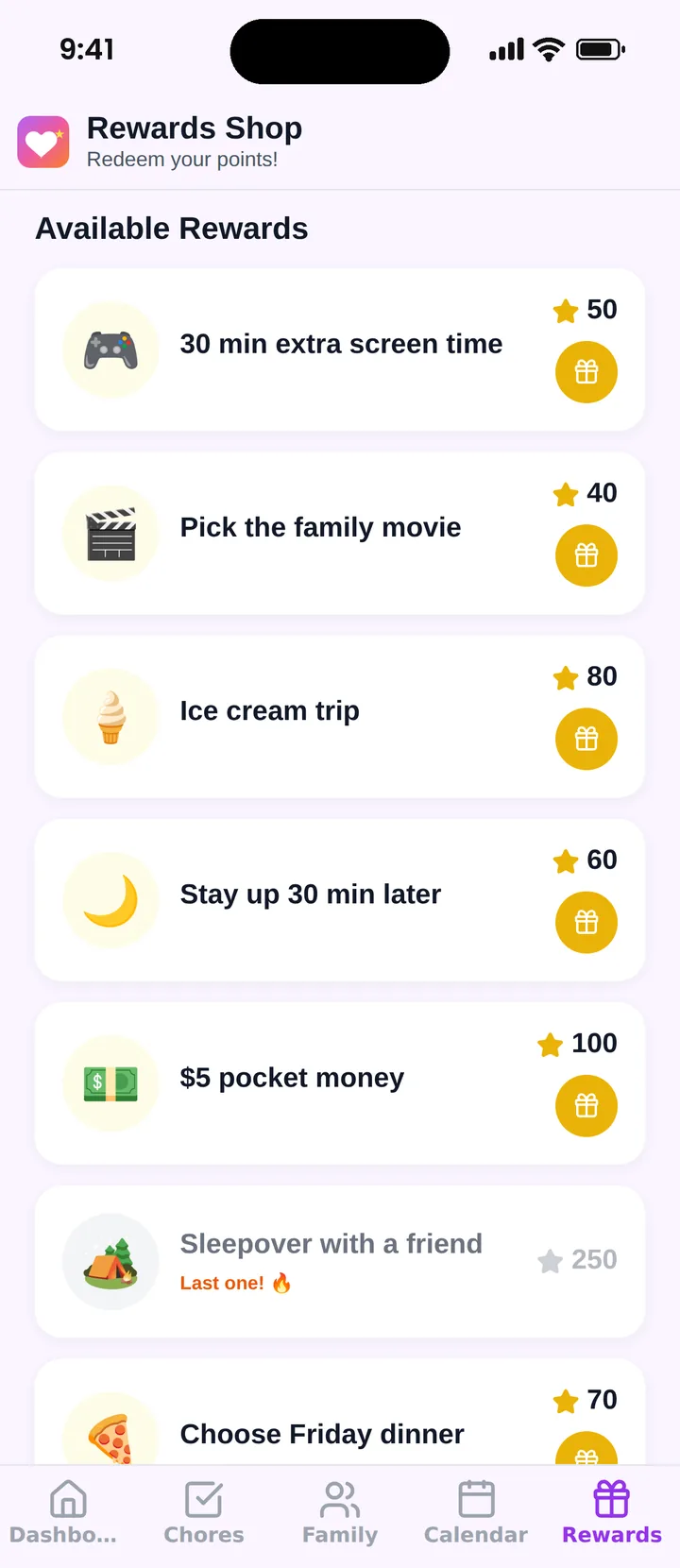
Points kids exchange for rewards you set let you control what money-like value means in your house. For instance, with the default scale of 100 points to $1, a $12 weekly allowance is 1,200 points, and your child can see exactly what they are saving toward. Our best allowance apps for kids ranking compares the options, including ones that move real money.
Whatever you choose, let your child see the balance. A number they can check beats a parent saying "you're out" at the checkout.
What about saving, spending and giving?
A split makes the lesson concrete. Younger kids often use spend, save, give at 50%, 40%, 10%. At 12 you can loosen that: set a savings goal together, such as a game or a bike part, and ask them to put a fixed part toward it. When the money runs out before the week ends, resist the urge to top it up. That is the lesson. For more on this, our article on chore points shows how to build earning and spending into one system.
Allowance in Famiyo
Famiyo is a free family app for iPhone and Android that combines a shared family calendar, chores with points and a rewards shop; kids join with a code, no email needed. For allowance, you can treat points as the currency: chores earn points, and you stock the rewards shop with things you choose, including pocket money as a reward at a price in points. Your child redeems from their own phone and sees how many points they will have left. The money itself changes hands outside the app, and Famiyo does not hold or move real funds. See Famiyo's rewards shop in action in our ranking of allowance apps.
When to raise it
Review the amount on a birthday or once a year. If your child has handled money well, add $1 or $2. If they are always broke by Tuesday, do not raise it. Look at what they are buying first.
Frequently asked questions
How much allowance should a 12-year-old get per week?
A typical range is $10 to $15 a week. The $1-per-year-of-age rule suggests $12. Start near the middle, then adjust based on what you expect them to pay for, your budget and how well they handle money.
How much is a monthly allowance for a 12-year-old?
Four weeks at $10 to $15 comes to roughly $40 to $60 a month. Some families switch to a monthly amount at this age because it teaches planning, but a weekly payment is easier for kids who run out of money fast.
Should a 12-year-old's allowance depend on chores?
Many parents keep a base allowance for money practice and treat everyday chores as part of family life. Then they offer extra pay, about $2 to $5 for a big job, for bigger tasks. Tying everything to chores can make kids bargain over every dish.
What should a 12-year-old pay for with their allowance?
Good starter categories are snacks out, in-game purchases, apps, small gifts and hobby supplies. Decide in advance what stays on your side, like school clothes and essentials, so the amount fits the job and neither of you is surprised.
Can I pay allowance through an app instead of cash?
Yes. Bank-style kids' cards and allowance apps exist, and you can also pay cash that matches points earned in a family app. What matters is that your child sees the balance, can save toward something and has to live with the choices.
Try Famiyo With Your Family
Chores with points, a rewards shop for kids and one shared family calendar. Set it up in a couple of minutes.



Free to download • No credit card required • Available on iOS & Android