How to Motivate Kids to Read: What Works at Each Age
How to motivate kids to read: let them choose, keep reading aloud, make books easy to reach, and use small rewards the right way. Ideas for ages 4 to 14.
By Famiyo Editorial Team5 min read
Your child can read perfectly well and would still rather do almost anything else. Or the reading was fine until second or third grade, when school made it a job, and now every book is a standoff. This page covers what tends to get kids reading, in rough order of how much it matters, plus how to use rewards without making things worse.
Why some kids stop reading for fun
Before you fix the habit, it helps to know which problem you have. Reluctance usually comes from one of four places.
- The reading is hard. A child who struggles with decoding or fluency will avoid books because reading feels like failing. If you suspect this, talk to the teacher or your pediatrician about a reading evaluation, since that is a different problem from motivation.
- The books are wrong. Assigned or "good for you" books can be dull. A child who has never found a story they love thinks reading is boring.
- Reading became schoolwork. Logs, quizzes and required minutes can drain the fun out of it.
- Screens are easier. A tablet gives a faster payoff than a chapter, so books lose unless you make them easy to reach.
Child development research on motivation commonly points to three needs: feeling capable, having some choice, and feeling connected to people. Each of those shows up in the advice below.
Let your child choose, even when you wince
Choice is the biggest lever. A child who picks their own book is more likely to finish it. That includes books you find silly: the 14th book in a series, a joke book, a book about a video game, a magazine about horses.
Comics and graphic novels count. So do audiobooks and books about real topics like sharks or soccer. All of them build vocabulary and story sense, and many kids use them as a bridge into longer books.
Take your child to the library or bookstore and let them choose three. Do not veto in the aisle. If a book turns out to be too hard or too boring, let them put it down. Abandoning a book is not failure. It is how real readers act.
Keep reading aloud longer than you think
The American Academy of Pediatrics encourages reading aloud to children from infancy, and nothing says it has to end when your child learns to read. Reading a chapter book together at bedtime lets a child enjoy a story that is above their own reading level, and it ties books to a warm part of the day.
For a 9- or 10-year-old who "doesn't like reading," try this: you read a chapter, then they read a page, then you read again. Stop on a cliffhanger. Many kids will pick the book up on their own to find out what happens.
Make books easy to reach and reading easy to start
Habits grow from the setting. A few cheap changes help.
- Put books where kids already sit: the car seat pocket, the couch, the bedside table, the bathroom.
- Fix a short daily reading slot, such as 15 minutes after dinner or in bed before lights out. A fixed time beats a vague "read sometime today."
- Turn off the TV and put phones in another room during that slot, yours included.
- Read where your child can see you. Kids copy what adults do, not what they say.
- Keep a "next book" ready so there is no gap after they finish one.
What to try at each age
| Age | What helps |
|---|---|
| 4 to 6 | Read aloud daily, let them "read" the pictures, point out words on signs and packages, visit the library weekly |
| 7 to 9 | Shared reading, series books, short chapter books, audiobooks in the car, a rule of one chapter before bed |
| 10 to 12 | Let them choose across formats, book clubs with a friend, the movie after the book, a place to read away from siblings |
| 13 to 14 | Respect their taste, offer high-interest books and graphic novels, suggest authors rather than assigning titles, share what you are reading |
For older kids, motivation is less about the books and more about independence. Our guide to how to motivate a teenager has more on how that shift works.
Using rewards for reading the right way
Rewards can help a reluctant reader get started, but they come with a catch. Research on what is often called the overjustification effect suggests that heavy rewards for something a child already enjoys can make it feel like work. For a child who does not yet enjoy reading, small rewards are a reasonable way to build the habit. The goal is to fade them.
Some ground rules:
- Reward the habit, not the page count. "You read for 15 minutes" earns the point, whether it was 3 pages or 30.
- Keep the prize small and unrelated to the book. Extra screen time, a pick of the family movie or a dessert choice work better than money.
- Avoid rewarding with something that makes reading feel like a means to an end. A book as a reward ("you earned a new book") is better than a toy.
- Do not turn reading into a quiz. Asking for a summary after every session kills the fun.
- Taper. After a month or two, move from daily rewards to weekly, then to the occasional celebration.
Our guide on how to motivate kids to practice goes through the same tapering idea for music and sports, and how to motivate kids to learn looks at the bigger picture.
A simple four-week plan
Week one: choose books. Visit the library, let your child take home three, and set a 10-minute daily slot.
Week two: add reading aloud. Pick a chapter book you both like and read a chapter together every night.
Week three: add a light reward. Each day your child reads earns a point, and 10 points earns a small treat such as choosing Friday's dessert.
Week four: stretch the time to 15 or 20 minutes, ask about their favorite part (not a summary), and talk about what to read next.
If the plan fizzles, shrink it. Five minutes that happen daily are worth more than twenty that do not.
Using Famiyo to track reading points
Famiyo is a free family app for iPhone and Android that combines a shared family calendar, chores with points and a rewards shop; kids join with a code, no email needed. Add "Read for 15 minutes" as a repeating chore worth 5 points. Your child checks it off on their phone, or you approve it, and you get a notification when it is done.
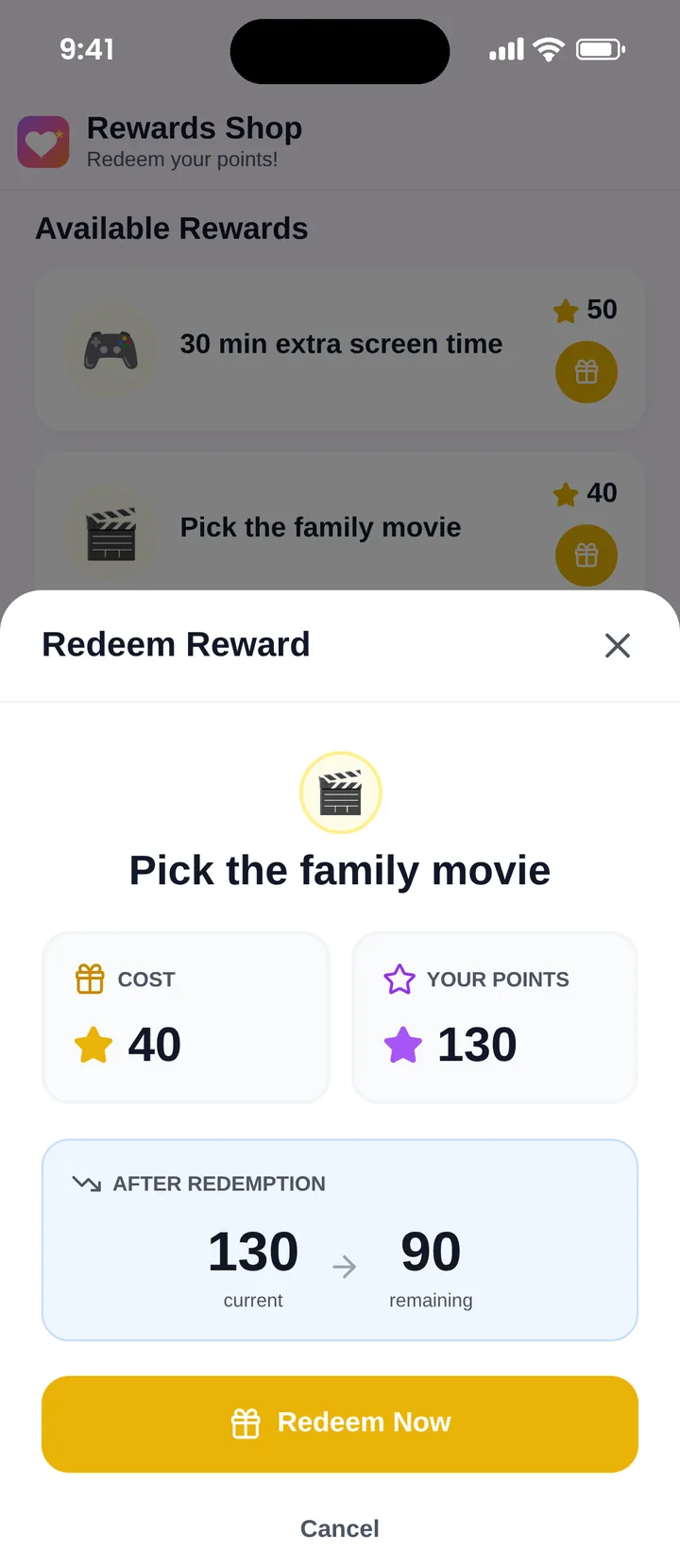
In the rewards shop you set each reward's price in points, how many are available and when. Kids redeem from their own phone and see how many points they will have left, which makes saving for a bigger prize visible.
Our list of the best reward chart apps for kids lists more options.
Start with one book your child picks
Take your child to the library this week, let them choose without comment, and read together for 10 minutes tonight.
Frequently asked questions
How long should kids read each day?
There is no single magic number. Starting with 10 to 20 minutes a day is realistic for most school-age kids, and it is better to read a little every day than a lot once a week. Let the time grow as the habit does.
Should I reward my child for reading?
Small rewards can help a reluctant reader get started, especially if they reward the habit (reading each day) and not the volume. Avoid rewards that make reading feel like a chore, and fade them once your child is reading by choice.
Does reading aloud still matter for older kids?
Yes. The American Academy of Pediatrics encourages reading aloud from infancy, and many families keep it up long after kids can read alone. A shared chapter book at bedtime builds vocabulary, closeness and interest in the next book.
Do comics and audiobooks count as reading?
For building the habit, yes. Comics, graphic novels, magazines and audiobooks all build vocabulary, story sense and enjoyment. They can be a bridge for a child who finds long chapter books intimidating, and many readers move on to novels on their own.
Try Famiyo With Your Family
Chores with points, a rewards shop for kids and one shared family calendar. Set it up in a couple of minutes.



Free to download • No credit card required • Available on iOS & Android