Do Most Kids Get Paid for Chores? What Families Do
Do most kids get paid for chores? There is no single answer: families split between pay, no pay and a mix. Here is how each works and how to choose for yours.
By Famiyo Editorial Team4 min read
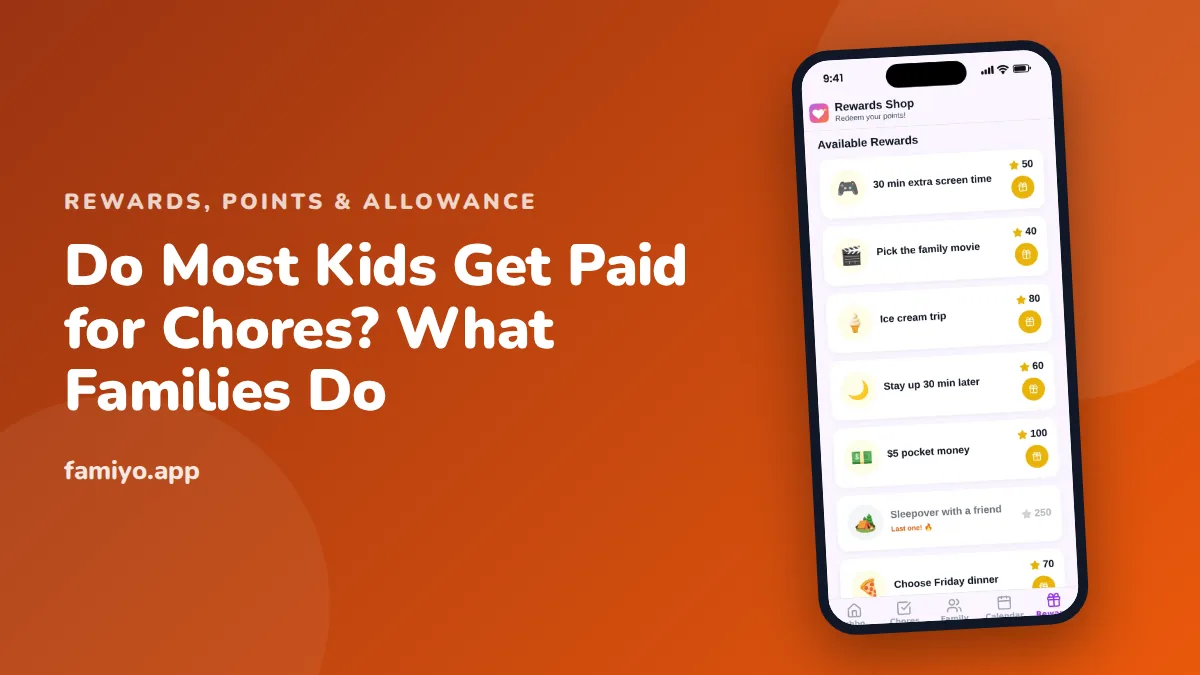
You are at the school pickup line and another parent says her kids earn $5 a week for emptying the dishwasher. Another says her kids get nothing and "it's just life." Now you wonder what is normal. Here is the straight answer, plus how the main approaches work in practice.
What the numbers actually say
No official count exists of how many American kids get paid for chores. Surveys by banks, parenting sites and money-education groups come out all over the place, mostly because they ask different questions. "Do your kids get an allowance?" gets one answer, "Do your kids get paid for doing chores?" gets another, and the two are often mixed up in headlines.
So be wary of any single percentage you see quoted. What stays consistent from one source to the next is the shape: a large group pays something, a large group does not, and a big middle does a bit of both. If you feel like you are the odd one out, you almost certainly are not.
The three common setups
Most families end up in one of these.
| Setup | How it works | Typical amount | Best for |
|---|---|---|---|
| Allowance, no link to chores | Fixed weekly money for learning to manage it; chores are just part of living there | $3 to $7 at ages 5-7, $7 to $10 at 8-10, $10 to $15 at 11-13, $15 to $25 at 14+ | Teaching budgeting and saving |
| Pay for every chore | Each job has a price; no job, no money | Small tasks pennies to a dollar, big ones a few dollars | Kids who respond to clear trades |
| Mixed | Basic chores unpaid; extras paid | $0.25 to $1 small, $2 to $5 big | Most families |
The rule of thumb many families use for allowance is $1 per week for each year of age, so an 8-year-old would get $8. It is a starting point, not a standard. Our guides to allowance for a 10-year-old and a 12-year-old break amounts down further.
Why families choose to pay, or not
Parents who pay usually say it teaches that money is earned, and it gives kids something to manage. Parents who do not pay usually say that helping the household is part of being in the family, and that paying for everything teaches kids to bargain.
Both have a point. The thing that tends to go wrong is not the money, it is the mix-up between "chores that keep the house running" and "work that earns a bonus." If a 9-year-old gets $2 for setting the table, she may reasonably decline when the table needs setting and she does not need $2. A cleaner split avoids this:
- Unpaid: making your bed, clearing your plate, tidying your room, feeding your own pet.
- Paid: washing the car, raking the whole yard, deep-cleaning the garage, a big project that is above normal expectations.
The first group is what you do because you live here. The second is work you could have hired someone for.
What to do if you are undecided
Try a four-week experiment rather than a permanent rule.
- Write down the 4 to 6 jobs you expect from your kid every week without payment.
- List 3 to 5 extra jobs that would be paid, each with a price.
- Decide whether you also want a separate allowance (many families do).
- Run it for four weeks, then change what is not working.
That is enough time to see whether the kids ask "how much for this?" before every request. If they do, tighten the unpaid list. If they never take extras, check your prices.
If your child is a teen, the numbers shift. Our guide to how much allowance a teenager should get covers what an older kid's money should actually cover.
Points, real money, or both
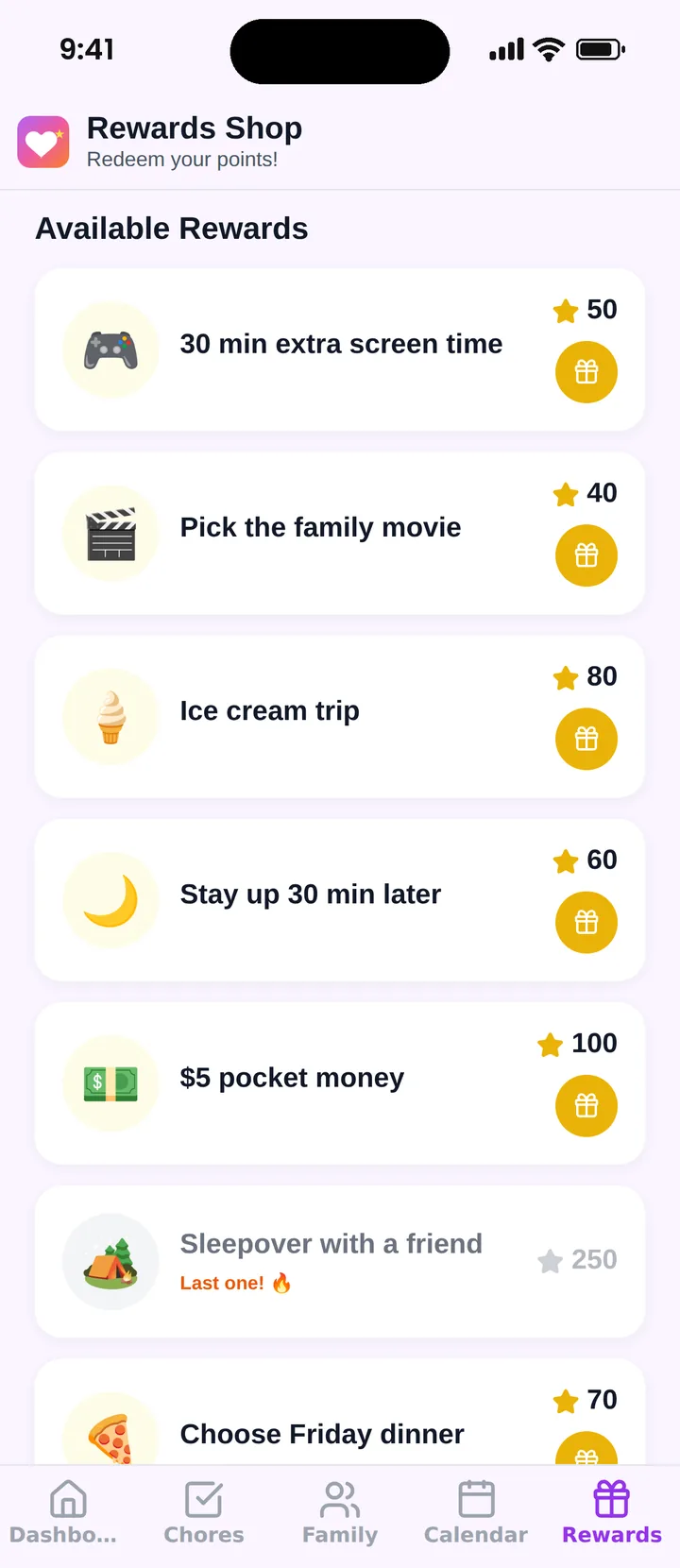
A lot of families skip cash entirely and use points, which kids spend on things like extra screen time, picking dinner or a day out. Points are flexible, they do not run out of your wallet, and you can change the price of a reward later without a fight. Some families convert points to money at a fixed rate when the child wants cash. Famiyo's default suggestion is 100 points for $1.
If your child is saving up, our article on teaching kids about money has simple activities that make saving visible.
Doing this in Famiyo
Famiyo is a free family app for iPhone and Android that combines a shared family calendar, chores with points and a rewards shop; kids join with a code, no email needed. You give each chore a point value, and kids exchange points for rewards you set up. Pocket money can be one of those rewards: you create it in the shop with a price in points, and your child redeems it from their own phone. The money itself changes hands outside the app.
For a side-by-side look at tools, see our list of the best allowance apps for kids.
The short version for your next pickup line chat
Some pay, some do not, many do both. What matters more than the headline number is that your rules are clear, the same each week, and fit what you want your child to learn.
Frequently asked questions
Do most kids get paid for chores?
No single answer fits. Surveys of parents come out differently depending on how they ask, so treat any exact percentage with caution. What you can say is that families fall into three camps: pay for everything, pay for extras only, or no money at all.
How much do kids usually get paid for chores?
A typical range is $0.25 to $1 for a small extra job and $2 to $5 for a big one. Allowance runs separately, often around $1 a week for each year of age as a rough starting point.
Is it bad to pay kids for chores?
Not automatically. The risk is that kids start asking what they will get for every request. Keeping basic family chores unpaid and paying only for extras avoids most of that problem.
Can kids earn points instead of money?
Yes. Points can be spent on rewards you choose, like screen time, a movie pick or an outing. Some families let points convert to cash at a fixed rate, such as 100 points for $1, and hand the money over outside the app.
Try Famiyo With Your Family
Chores with points, a rewards shop for kids and one shared family calendar. Set it up in a couple of minutes.



Free to download • No credit card required • Available on iOS & Android