How Much Allowance for an 11-Year-Old? Typical Amounts
Most 11-year-olds get $10 to $15 a week. See how to pick an amount, what it should cover, and how to pay it in cash, a bank app or points.
By Famiyo Editorial Team4 min read
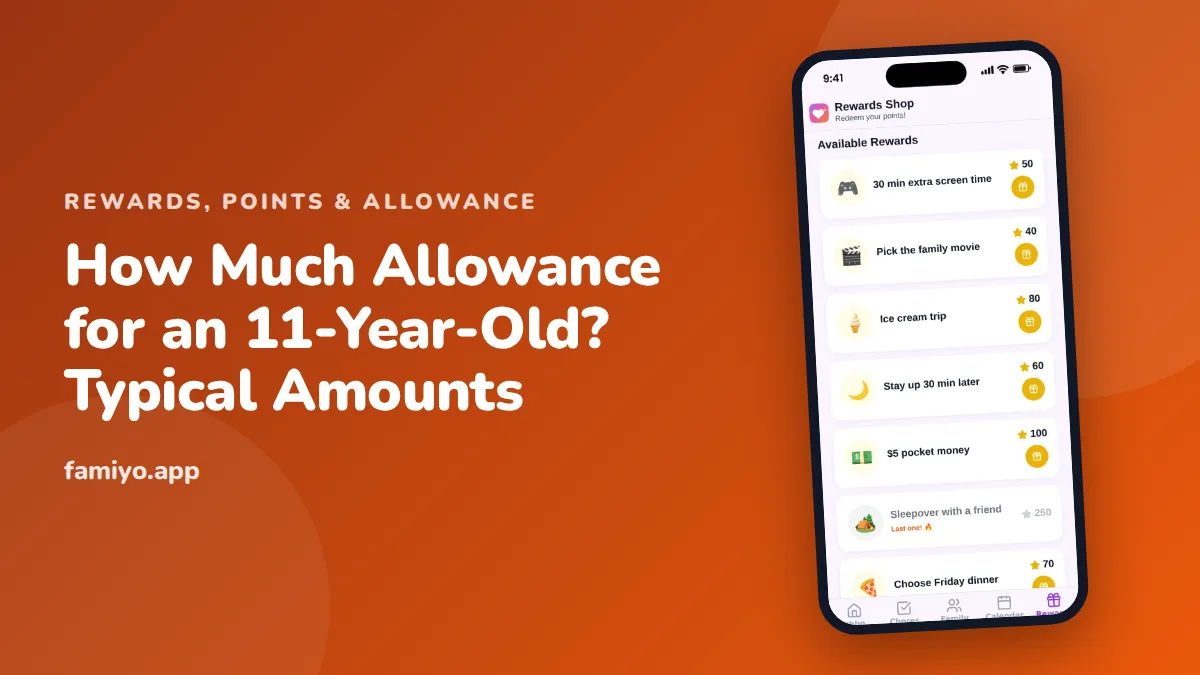
If you came here for a number: $10 to $15 a week is the usual range for an 11-year-old, and $11 if you follow the $1-per-year-of-age rule. Those are starting points, not standards. The right figure depends on what the allowance is supposed to cover and what your family can spend. Below is how to pick one, how to split it, and how to hand it out now that so much money lives on a phone.
Typical allowance amounts at 11
| Rule or range | Weekly amount at age 11 |
|---|---|
| $1 per year of age | $11 |
| Typical range for ages 11 to 13 | $10 to $15 |
| Typical range for ages 8 to 10 (for comparison) | $7 to $10 |
| Typical range for ages 14 and up | $15 to $25 |
An 11-year-old sits at the point where allowance stops being pocket change and starts being a small budget. If your child is a younger 11, look at our allowance for a 10-year-old guide. For an older kid, allowance for a 12-year-old shows where the next step usually lands.
How to decide on your number
Don't start with what other families pay. Start with what the allowance is for.
- List what it should cover. Snacks at school, a game every month, birthday gifts for friends, a trip to the movies. Add up a typical month.
- Compare to your budget. If the list adds up to $50 a month and you can spend $45, that is about $11 a week.
- Leave room to save. A child with $11 and $11 of expenses has nothing to practice saving with. Aim for some left over.
- Pick a number you can keep. Raising is easy, cutting is not. If in doubt, start low and raise it when responsibility goes up.
What the allowance should cover
An allowance without a job turns into free money. Give it a scope. At 11, a useful scope is "things you want, not things you need." So school lunches, clothes and shoes stay with you. Snacks out, games, apps, trading cards and gifts for friends come from the allowance. If you want more control, add one new item to the scope each year, such as their own phone plan.
Say it out loud: "This $11 covers your snacks and anything you want to buy. If you want something bigger, you save for it."
Should it be tied to chores?
Both approaches exist. The one most families find easier is to separate them. Basic chores like making the bed, setting the table and tidying their room are part of living in the house and go unpaid. The allowance is a teaching tool for money. If you want a work-for-pay element, add extras. A small extra job pays $0.25 to $1, and a big one such as washing the car or raking leaves pays $2 to $5. See whether most kids get paid for chores for what other families do.
Spend, save, give
A split makes the money a lesson. The simple version used for younger kids works for 11-year-olds too: 50% spend, 40% save, 10% give. On $11 a week, that is about $5.50, $4.40 and $1.10. Use three jars or a notebook with three columns.
By 11, kids can handle a bigger idea. Ask what they want to save for, how many weeks it will take, and let them decide. If they want a $60 game and save $4.40 a week, that is about 14 weeks. Seeing the math is the lesson, and no lecture does the same job.
Cash, bank app or points?
Money now often lives on a screen, and many 11-year-olds rarely touch cash. Options include:
- Cash in jars. Easiest for seeing money grow, and the least abstract.
- A kids' bank account or prepaid card. Good for online purchases and real banking habits, with fees and rules that vary by provider.
- Points exchanged for rewards. Works well when you want the allowance to also teach earning and choosing.
Famiyo does not hold or move money. It is a points and rewards tool, so any cash handoff happens outside the app.
Pocket money through points in Famiyo
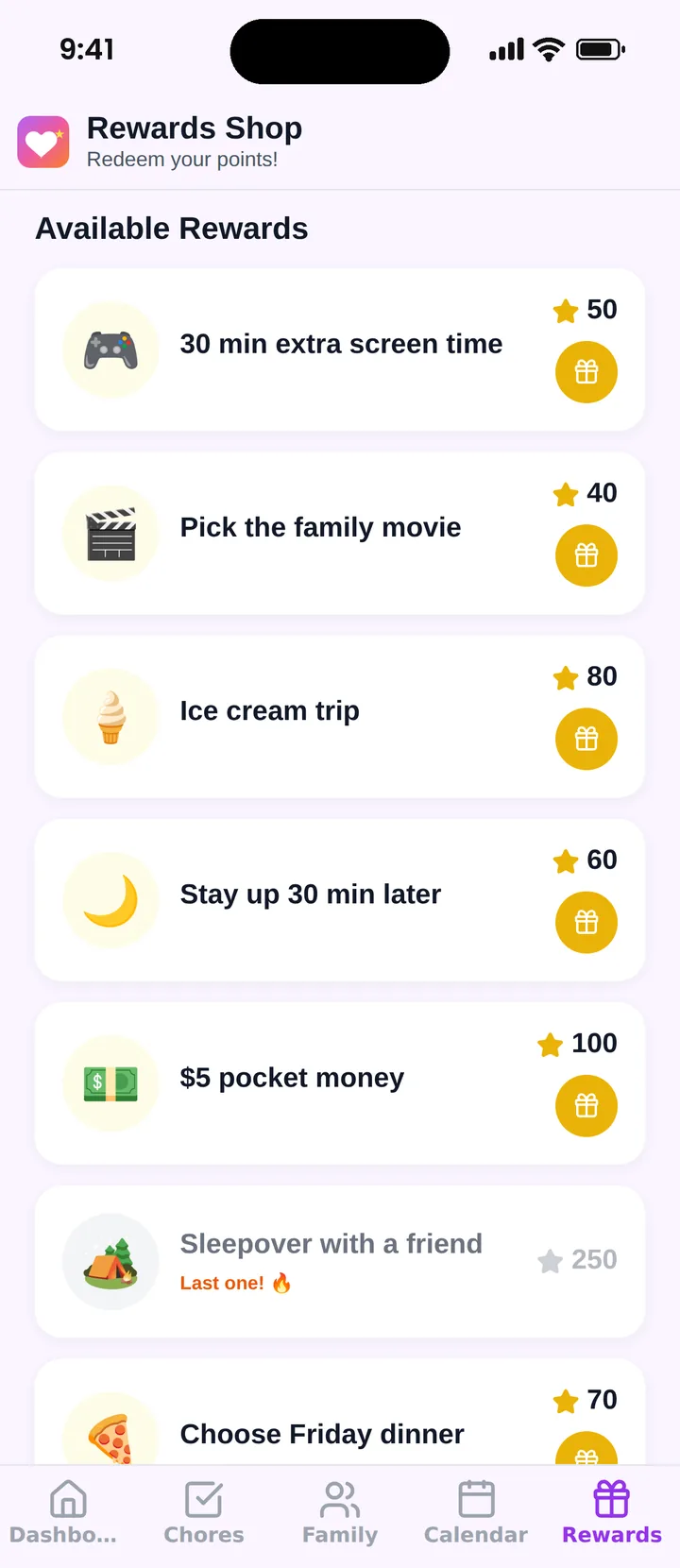
Famiyo is a free family app for iPhone and Android that combines a shared family calendar, chores with points and a rewards shop; kids join with a code, no email needed. Here is how it fits allowance. Chores earn points, and in the rewards shop you set a price in points for each reward, including pocket money. If you convert points to money, 100 points equals $1, so a $5 reward costs 500 points. Kids redeem from their own phone and see how many points they will have left. You get a notification, and you hand over the money yourself. If you want to compare tools, see our list of the best allowance apps for kids.
Raising and adjusting
Review the number once a year, around the birthday, or when you give the child a new responsibility. A rise from $11 to $13 when they start paying for their own games is easy to explain. Don't raise it because they asked three times. For a bit more on the next stage, see allowance for a 13-year-old.
Frequently asked questions
What is a fair weekly allowance for an 11-year-old?
For most families it falls between $10 and $15 a week. The $1 per year of age rule gives $11. Start near $10 to $11, decide what it covers, and raise it when you hand over a new responsibility, such as buying their own snacks or games.
Should allowance be tied to chores?
Many families keep them separate. Basic household chores are part of being in the family and go unpaid. Allowance teaches money skills. Extra jobs, like washing the car, can earn $2 to $5 on top, which keeps the two ideas distinct.
Should I pay allowance weekly or monthly?
Weekly works better at 11. A month is a long time to wait, and a child who spends everything in week one has three weeks of nothing. Monthly can suit a 13 or 14-year-old who is also learning to budget.
What should an 11-year-old spend allowance on?
Decide it together. Common choices are treats, small toys, in-app purchases, and gifts for friends. A saving split helps: for example 50% spend, 40% save, 10% give. Larger things like a game console should come from saving, not from you.
Try Famiyo With Your Family
Chores with points, a rewards shop for kids and one shared family calendar. Set it up in a couple of minutes.



Free to download • No credit card required • Available on iOS & Android