Allowance Ideas for a 10-Year-Old: Money, Points or Both?
Eight allowance ideas for a 10-year-old, from a flat $7 to $10 a week to points and hybrids, with a sample chart and what each setup teaches.
By Famiyo Editorial Team4 min read
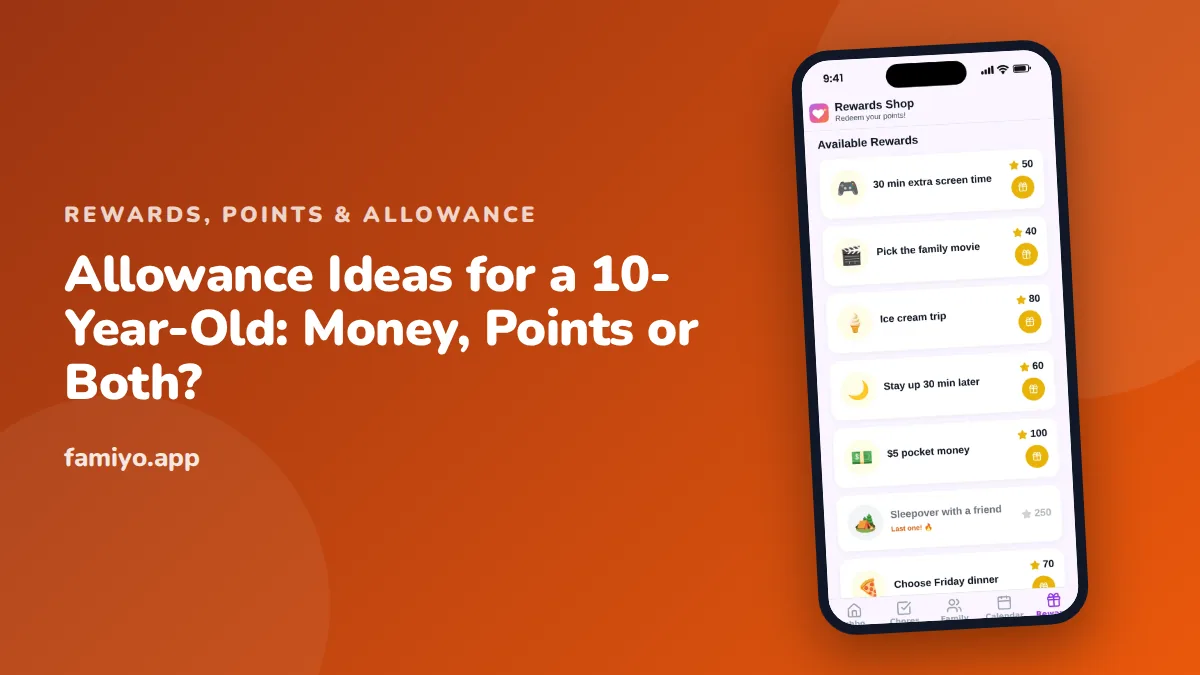
Ten is a sweet spot for money lessons. Kids can add and subtract in their heads, they want things that cost more than a candy bar, and they're old enough to wait a few weeks for something. The hard part for parents is picking a setup that fits the family without becoming a weekly negotiation. Below are eight allowance ideas for a 10-year-old, a sample chart, and a plain look at which kids each one suits. Boys and girls get the same options.
How much is a normal allowance at 10?
Typical weekly ranges for ages 8 to 10 are $7 to $10. The classic rule of $1 per year of age gives a 10-year-old $10 a week, which is the top of that range. It's a starting point, not a standard. What matters more is what the money is meant to cover.
If your child buys only the occasional small treat, $5 to $7 may be plenty. If they're saving for things like games, craft supplies or birthday presents for friends, $10 makes sense. Decide the purpose first, then the amount.
8 allowance ideas for a 10-year-old
1. The flat weekly allowance
A fixed amount on the same day each week, say $8 every Saturday, with no link to chores. It's predictable, and it gives a child steady practice planning. The downside: some kids see it as pay for doing nothing. Pair it with clear family chores that aren't tied to the money.
2. Pay for extra jobs only
Basic chores (bed, dishes, room) stay unpaid because they are part of living in the house. Extra work earns cash: $0.25 to $1 for a small job, $2 to $5 for a big one. Washing the car or raking the yard are typical. See the chore list for kids to earn money for jobs worth paying for.
3. Points converted to money
Every chore earns points (5 for a small task, 10 for a medium one, 20 for a big one, plus 2 if done without a reminder). On Sunday you convert at 100 points per $1. This teaches that output equals income. It needs care: at that rate, 200 points a week is only $2, so tune the point values or the exchange rate to your target amount.
4. Points for rewards, not cash
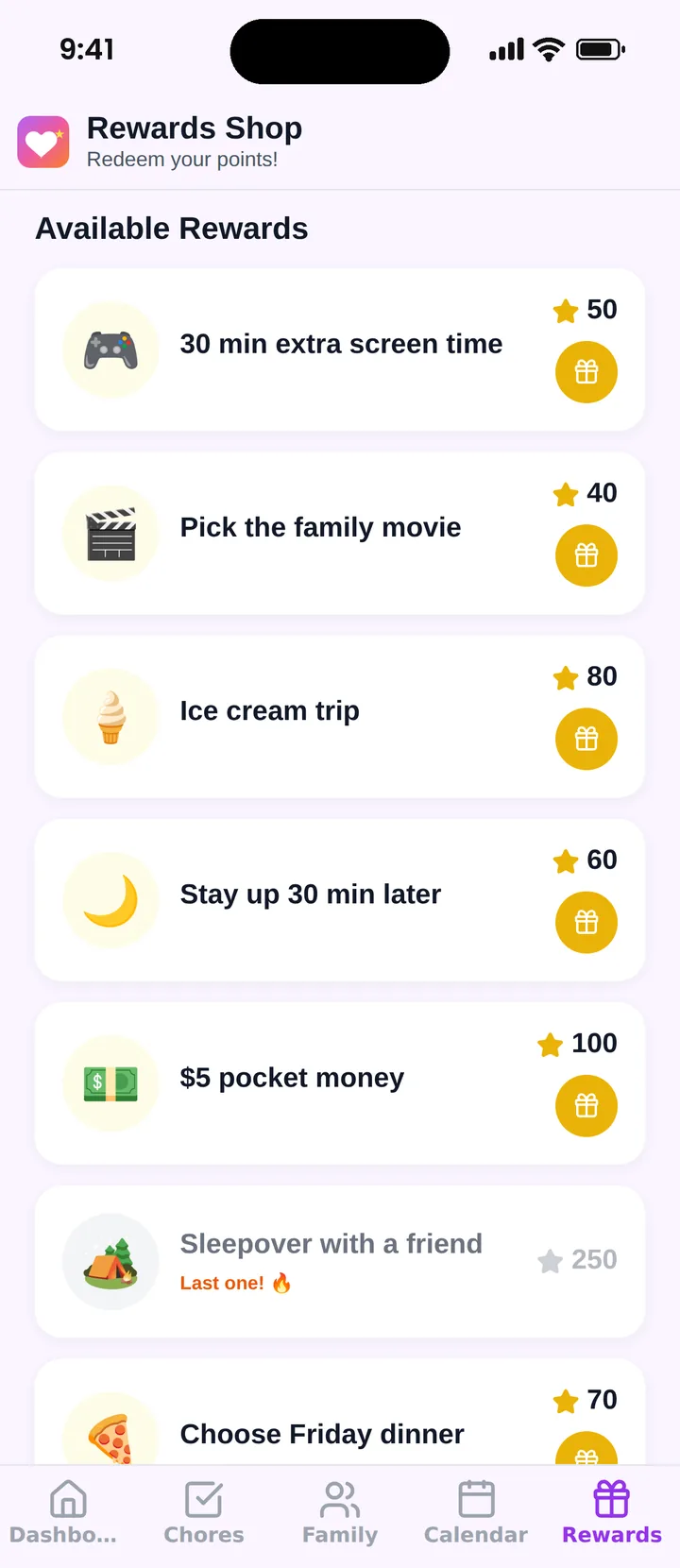
Skip the conversion and let points buy things you set: 30 to 50 points for 15 extra minutes of screen time, 100 for choosing the family movie, 300 to 500 for a day out. Pocket money can be one of the rewards, for example $5 for 500 points. This keeps money and effort separate. It also lets a child "save up" without a piggy bank.
5. Base plus bonus (the hybrid)
A smaller flat allowance, say $5, plus up to $5 more for finishing the weekly job list. It's the best fit for many families: predictable money to manage and a visible link to effort.
6. The spend, save, give split
Whatever the amount, divide it. A common split is 50% spend, 40% save, 10% give. On $10 that's $5, $4 and $1. Three labeled jars or envelopes make it visible. It's the single idea on this list that works on top of all the others.
7. A budget allowance
Instead of weekly cash, a larger monthly amount that covers things the child usually asks you to buy: snacks out, small toys, in-game purchases. When it's gone, it's gone. This is more work to start, and it's the strongest lesson in trade-offs. Try it for one category before you use it for all of them.
8. A matched savings goal
You pick a goal together, and the child saves toward it with you adding a match (say $1 for every $4 they save). It rewards patience and gives a reason to stop spending. Use it alongside, not instead of, one of the setups above.
Sample allowance chart for a 10-year-old
| Day | Daily jobs (unpaid) | Extra job (optional) | Note |
|---|---|---|---|
| Mon | Make bed, empty dishwasher | ||
| Tue | Make bed, feed pet | Take out recycling ($1) | |
| Wed | Make bed, set table | ||
| Thu | Make bed, empty dishwasher | ||
| Fri | Make bed, feed pet | Vacuum one room ($2) | |
| Sat | Make bed, tidy room | Wash the car ($4) | Allowance day |
| Sun | Make bed | Spend, save, give |
Notice how the paid jobs are optional. If they don't happen, the child just earns less that week. Why some families skip chore pay altogether is covered in why kids should not get paid for chores.
Choosing between money, points or both
Fit the setup to the child. A kid who needs to feel the link between work and results does well with idea 3 or 5. A kid who spends everything the moment it arrives may need idea 6 or 8. A child who hoards might need idea 4, where rewards are experiences. And a parent who dislikes tracking should pick the flat allowance and move on.
Whichever you choose, write the rules down and keep them boring: what day, how much, what it covers, and what happens when the money runs out (nothing, no loans). For the bigger picture of teaching money habits, see how to teach kids financial responsibility.
Running points and pocket money in Famiyo
Famiyo is a free family app for iPhone and Android that combines a shared family calendar, chores with points and a rewards shop; kids join with a code, no email needed. For the points ideas above, add each chore with its points, and each child earns their own total. In the rewards shop you create what points can buy, with a price, how many are available and when. Pocket money can be a reward, such as $5 for 500 points, but the cash itself changes hands outside the app. Compare options in our list of the best allowance apps for kids.
Pick one and run it for a month
Choose the idea that matches your child, agree on the rules at the kitchen table, and keep it unchanged for four weeks before you tweak anything.
Frequently asked questions
How much allowance should a 10-year-old get?
Most families land between $7 and $10 a week. The old rule of $1 per year of age gives $10. Treat it as a starting point and adjust to what you expect the money to cover. If it covers nothing, go lower; if it covers treats and small gifts, go higher.
Should a 10-year-old's allowance depend on chores?
It can, but many parents keep basic family chores unpaid and tie money to extra jobs. A flat allowance for money practice plus paid extras is a common split. The right answer is the one you will apply consistently, and explain without arguing each week.
Is allowance different for a 10-year-old boy or girl?
No. Allowance should follow age, responsibility and what the money covers, not gender. Use the same amount, the same expectations and the same chore list for a 10-year-old boy and a 10-year-old girl.
Can a 10-year-old earn points instead of cash?
Yes. Points work well as a middle step: a child earns them for jobs and spends them in a family rewards list. If you want points to equal money, 100 points per $1 is an easy conversion. The cash itself still changes hands outside any app.
Try Famiyo With Your Family
Chores with points, a rewards shop for kids and one shared family calendar. Set it up in a couple of minutes.



Free to download • No credit card required • Available on iOS & Android