Token System for Kids With Autism: How to Set One Up
How a token system works for autistic children: pick the tokens, choose rewards your child actually wants, start with quick wins, and fade it over time.
By Famiyo Editorial Team6 min read
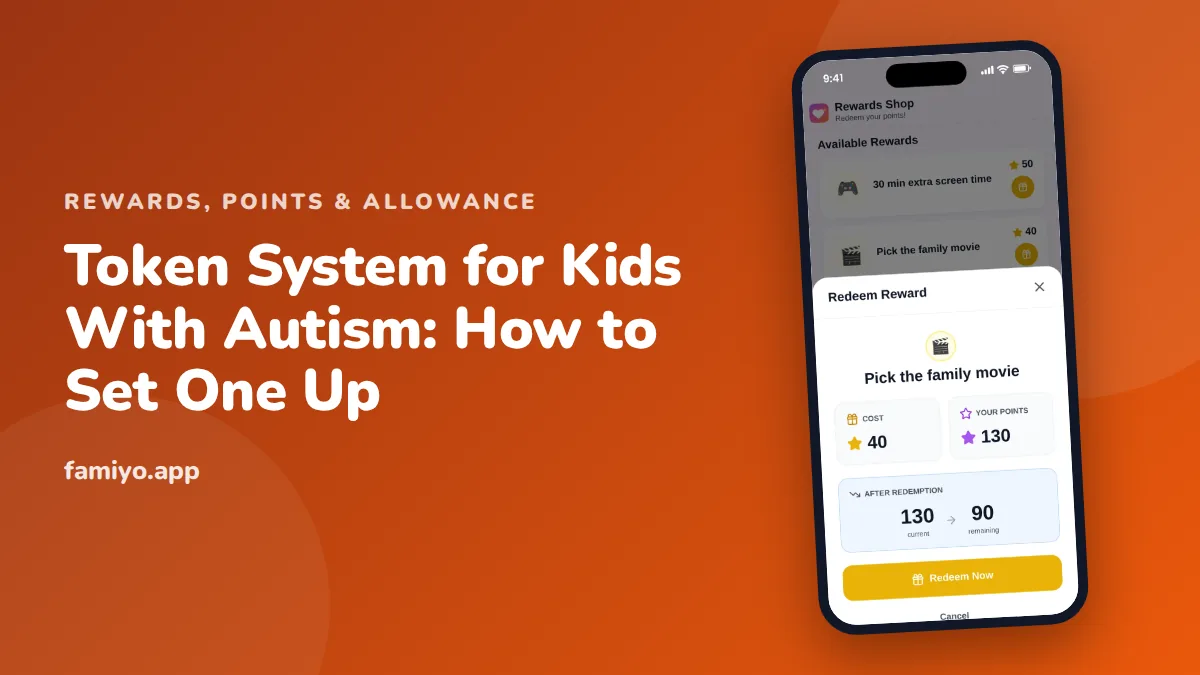
A token system is one of the most widely used reward tools for autistic children, partly because it makes an abstract promise ("be good and something nice will happen") concrete and visible. This guide explains how it works, how to build one at home, and where it tends to break. It is general parenting information, not treatment, so if your child has a therapy team, share your plan with them.
What a token system is, and why it suits many autistic children
A token system has three parts: a target behavior, a token the child earns for it, and a backup reward the child can trade tokens for. A star sticker, a magnet or a coin counts as the token. The token itself is not the prize. It is a visible marker that a prize is on the way.
This matters because many autistic children find waiting, vague rules and unpredictable outcomes hard. A token board shows what is expected, how far along they are and exactly what happens next. Token economies grew out of behavioral research, and they are a standard feature of applied behavior analysis programs. That does not mean every child needs one, or that the same format fits every child. Some children love the board. Some ignore it. Watch your own child.
The American Academy of Pediatrics and the CDC both describe positive, predictable support as the foundation of helping children with autism learn new skills. A token system is one way of building that, but it works best as one tool among several, alongside visual schedules, clear routines and plenty of plain praise.
Before you start: choose three things
One behavior
Pick a single, observable thing. "Be good" is too wide. "Put shoes in the basket" or "sit at the table for the first two bites" can be seen and counted. Starting with one behavior your child can already do, at least some of the time, gives you early successes to build on.
The token and the board
Choose a token that suits your child's senses and interests. It could be:
- A star sticker on a printed row.
- A magnet or Velcro piece on a board.
- A coin or a small bead dropped in a jar.
- A character picture that matches a favorite show.
Whatever you pick, it should be easy to give in one second, easy to see, and not something your child can lose or knock over. Many families make a board with 3 to 5 spaces and a picture of the reward at the end.
A reward your child has chosen
A reward only works if your child wants it at that moment. Offer two or three options with pictures and let them pick, or watch what they choose freely over a few days. Rewards can be an activity, a favorite snack, a few minutes of a preferred item, or time with you doing something they love. Rotate them, because even a favorite loses its pull if it appears every day.
The setup, step by step
- Show the board and the reward before you start. Let your child touch it. Say it plainly: "Shoes in the basket. Then a star. Three stars. Then the trains."
- Give the token at once, within a second or two of the behavior. Delay weakens the link, and for many children it breaks it.
- Pair the token with a few words of specific praise. "You put your shoes away." Keep it calm and short.
- When the board is full, deliver the reward right away, with no extra conditions. No "but first clean up."
- Reset the board and start again.
A common mistake is to explain too much. If your child has limited language, use pictures and gestures, and let the sequence teach itself by repeating it.
How many tokens, and how to grow the ratio
Most families begin with one token for one reward. That sounds silly until you see how much it helps a new system click. Increase slowly, and only after your child has been successful for several days in a row.
| Stage | Tokens to earn | When to move on |
|---|---|---|
| 1 | 1 token, then reward | 3 to 5 successful days |
| 2 | 2 tokens | A few successful days with no distress |
| 3 | 3 tokens | Same |
| 4 | 4 to 5 tokens | Same, and across several behaviors |
| 5 | Tokens across a day or week | Same, with a longer-term reward |
If your child stops trying, gets upset, or loses interest, you have probably gone up too fast. Step back one stage and stay there longer. Going back is not failing, it is how the plan adjusts to your child.
Common problems and fixes
Autistic children differ a lot, so treat these as starting points and not rules.
- The child doesn't care about the reward. Re-check preferences. What was exciting last month may be boring now. Ask your child, show options, or watch what they pick.
- The token causes a meltdown. Some children find the board overwhelming or dislike a specific token. Try a smaller board, a different token, or giving the token into their hand.
- The system works at home and not at school (or the reverse). Share the board and the words with teachers and therapists so the rules match.
- The child earns tokens but won't trade them. The reward may not be motivating, or the process of trading is unclear. Practice the trade with a very short row.
- Everything becomes a bargain. Keep tokens for specific skills, not for every request. Basic care and comfort are never earned.
A sample first week
Say your 6-year-old rarely puts shoes away at the door. Here is how a first week might look, with a board of one space and then two.
| Day | Target | Tokens needed | What you say |
|---|---|---|---|
| Mon | Shoes in the basket | 1 | "Shoes in the basket. Star. Trains." |
| Tue | Same | 1 | Same words, same order |
| Wed | Same | 1 | Same words, add a quick "You did it" |
| Thu | Same | 2 | "Two stars, then trains." Show the second space first |
| Fri | Same | 2 | Keep the words the same, let your child place the star |
The sameness is deliberate. Predictable wording, order and place make the system easy to read, and your child can focus on the behavior.
Fading it out over time
The goal of most token systems is not to run forever. As a behavior becomes routine, you can lengthen the time between rewards, then move to praise and natural consequences. A sensible sequence is: more tokens per reward, then one reward in the evening instead of straight away, then tokens only for newer skills while older ones run on routine. If your child still enjoys the board and it causes no problems, there is no rush to remove it. Follow your child's pace and your therapist's advice.
For comparison with other approaches, see our guides to the reward system for kids with autism and the broader token economy for kids. If ADHD is also part of your picture, the token system for kids with ADHD covers what changes.
Setting up the rewards side in Famiyo
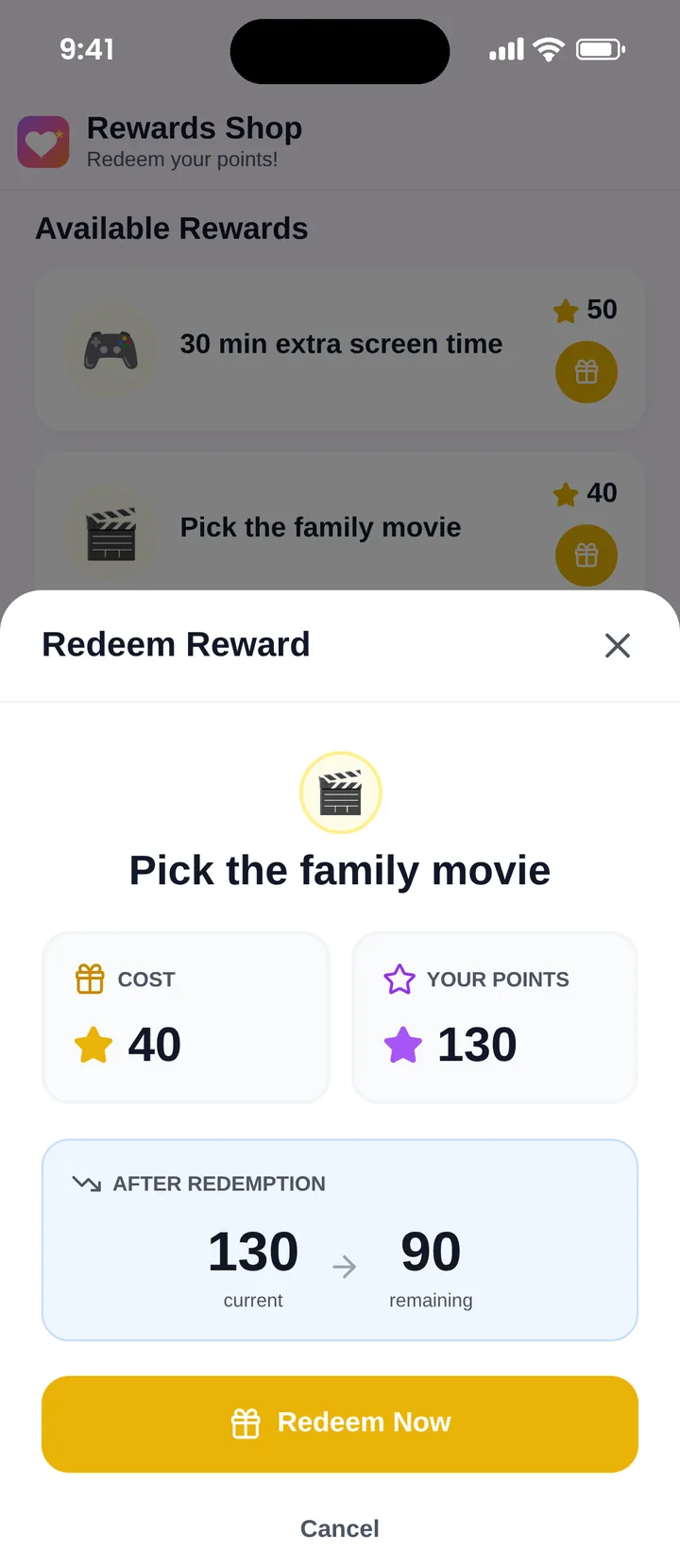
Famiyo is a free family app for iPhone and Android that combines a shared family calendar, chores with points and a rewards shop; kids join with a code, no email needed. For an older child who can use a phone, the rewards shop covers the "trade" part of the system: you create rewards, such as "10 minutes of trains" or "pick the movie", set a price in points, decide how many are available and when, and your child redeems from their own phone, where they can see how many points they will have left. That makes the price and the wait visible. Younger children often do better with a physical board alongside. See our list of the best reward chart apps for kids.
Start with one behavior, one token and a reward after the first one. Keep it that simple for a week and let your child show you the next step.
Frequently asked questions
What is a token board for autism?
A token board is a visual card with a row of empty spaces, often 3 to 5. The child puts on a star or other token for each target behavior, and when the row is full they get a reward they already know is coming.
How many tokens should a child need before a reward?
Begin with one to three so the reward comes fast. Raise the number only after your child succeeds a few days in a row. If they lose interest or melt down, you moved too quickly, so go back one step.
Can tokens ever be taken away?
Many professionals advise against removing earned tokens, because it can feel like a punishment for something unrelated to the task. Keep the system about earning. Ask your child's therapist before using any token loss.
Do tokens replace therapy or professional advice?
No. A home token system is a practical tool, not treatment. If your child works with a behavior analyst, occupational therapist or teacher, ask them to match the home system to what they use, so your child sees the same rules everywhere.
Try Famiyo With Your Family
Chores with points, a rewards shop for kids and one shared family calendar. Set it up in a couple of minutes.



Free to download • No credit card required • Available on iOS & Android