How to Motivate a Teenager Who Doesn't Care: 6 Reasons and Fixes
When a teen shrugs at grades, chores and consequences, the cause matters. Learn six common reasons they stop caring and what to say and do for each.
By Famiyo Editorial Team4 min read
"I don't care" is one of the most frustrating things a teenager can say, because it shuts the door on every lever you have. You can't bargain with someone who says nothing matters. The way through is to work out what that phrase is covering for, then pick a fix that fits. This page walks through six common reasons, with exact words to say.
What "I don't care" often means
For many teens the phrase is armor. It is safer to look indifferent than to try hard and fail in front of people. Sometimes it is exhaustion, and sometimes the teen simply doesn't see what you see in the task.
It is worth checking the basics before you assume the worst. The AAP and AASM recommend 8 to 10 hours of sleep for ages 13 to 18, and a teen who gets far less will look flat and irritable. A short list of things to rule out: sleep, hunger, a conflict with a friend, a subject or teacher they're struggling with, and too many commitments.
Six reasons and what to do about each
| What you hear or see | What may be behind it | What to try |
|---|---|---|
| "It doesn't matter." | Fear of failing, so they avoid trying | Shrink the task. Ask for 15 minutes, not "finish it" |
| Stays up late, sleeps in, drags | Not enough sleep | Agree on a device curfew and talk about sleep first |
| "You can't make me." | Feeling controlled | Offer two or three options and let them choose |
| "I'll never use this anyway." | No link to their own goals | Connect it to something they want, like a job or a trip |
| "Whatever, I'll just fail." | Discouragement after setbacks | Name one thing that went well, ask what would help |
| Flat for weeks, loses interest in friends | Possible low mood | Talk to your pediatrician |
Read the table as a guide, not a diagnosis. A teen may match two rows. Start with the one that is easiest to test.
What to say
Timing matters more than wording. Raise it when no one is rushing, ideally side by side in a car, on a walk or while cooking, rather than across a table.
- Open with an observation, not a charge. "You've seemed worn out lately" beats "What is wrong with you?"
- Ask one open question. "What feels hardest about this right now?"
- Wait. Count to ten in your head if you have to.
- Reflect back what you heard. "So you feel like it's pointless because the grade won't change."
- Ask what would help before you suggest anything. "What's one thing that would make this week easier?"
Avoid "when I was your age" and avoid asking "why" repeatedly, which sounds like an accusation. If the conversation blows up, stop and try again tomorrow.
Let the real world do some of the teaching
A teen who truly doesn't care about your reminders may still care about the result. Natural consequences are quiet and fair: if the laundry isn't in the hamper, the favorite shirt isn't clean. If they miss the bus, they work out another way to school, within safe limits you set.
Keep a few things non-negotiable regardless of motivation: safety, sleep basics, respect and school attendance. Everything else can be a choice with an agreed outcome. Be ready to follow through, and to let them struggle a little. Rescuing them every time confirms that effort is optional.
Rewards for a teen who wants money, freedom or status
Teens rarely care about stickers. They do care about independence, money and time with friends. Offer rewards that match, and let them name the first one.
| Goal | Possible reward | Price in points |
|---|---|---|
| Extra screen time | 15 minutes on a school night | 30 to 50 |
| Social time | A later curfew on a weekend by 30 minutes | 100 |
| Autonomy | Choose the family dinner or movie | 100 |
| Money | Pocket money, if points convert at 100 points to $1 | Your call |
| A bigger goal | A day out, or something around $20 | 300 to 500 |
Be honest that this is a trade, not a bribe for being a good person. Say: "These are things you earn on top of the basics. Which one do you want first?" If money is the motivator, our guide to allowance for kids explains how to set it up, and ways for kids to make money in the neighborhood gives them a route to earn outside the house.
Using the reward shop in Famiyo
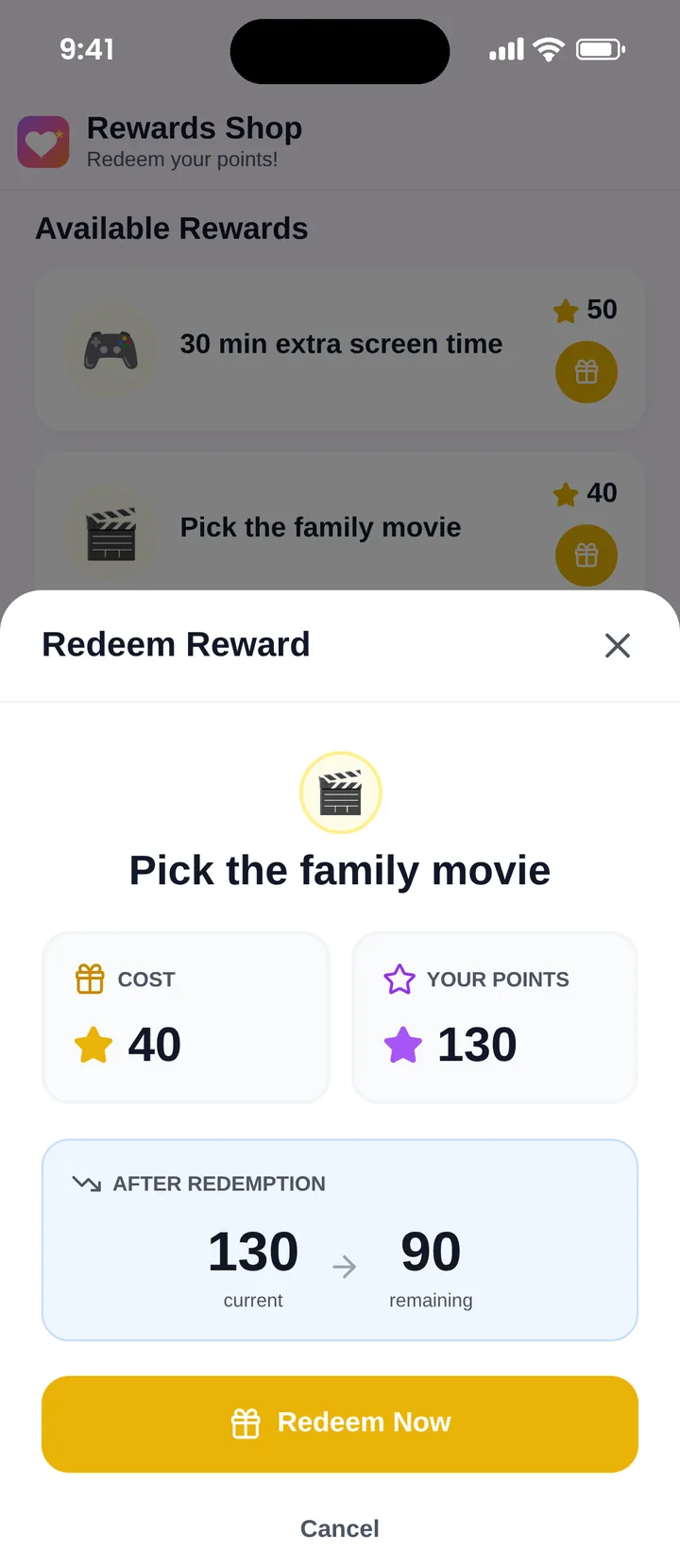
Famiyo is a free family app for iPhone and Android that combines a shared family calendar, chores with points and a rewards shop; kids join with a code, no email needed. For a teen who says nothing matters, let them build the shop with you: you set each reward's price in points, how many are available and when, and your teen redeems from their own phone, seeing how many points they will have left. Tasks can carry different points for different family members, and you can decide whether they check off their own work. You get a notification when they redeem something.
See our list of the best reward chart apps for kids if you want to compare options.
When to ask for outside help
Ask your pediatrician or a school counselor for support if the flatness lasts several weeks, grades drop sharply, they stop seeing friends, or they seem hopeless. If your teen ever talks about hurting themselves, get help immediately by calling or texting 988 in the US.
For the general approach, see how to motivate a teenager, and if school is the main battle, read how to motivate a teenager who hates school.
Frequently asked questions
Why does my teenager not care about anything?
Common causes include too little sleep, fear of failing, feeling controlled, a mismatch between what you value and what they value, and sometimes low mood. Ask without judging, and look at sleep, stress and friendships before assuming it is attitude.
Should I take away my teen's phone to motivate them?
Removing the phone as punishment can cut off a main source of connection and rarely builds motivation. A clear, agreed trade works better, such as earning extra screen time by finishing agreed tasks, while basic limits stay in place.
When is a teen's lack of motivation a sign of something serious?
Talk to your pediatrician if low energy and loss of interest last more than a couple of weeks, or come with changes in sleep or appetite, withdrawal from friends, or talk of hopelessness. If your teen mentions self-harm, seek help right away.
Do consequences work on a teen who doesn't care?
Natural consequences work best, because the teen experiences them without you as the villain. A missed practice or a late fee can teach more than a lecture. Keep consequences predictable, brief and unrelated to your mood.
Try Famiyo With Your Family
Chores with points, a rewards shop for kids and one shared family calendar. Set it up in a couple of minutes.



Free to download • No credit card required • Available on iOS & Android