How Much Allowance for a 13-Year-Old? Typical Amounts
Most 13-year-olds get $10 to $15 a week, and some $15 or more. Here is how to choose an amount, what it should cover and how to pay it.
By Famiyo Editorial Team3 min read
Thirteen is a turning point for money. Your teen has more places to be, more friends to buy things with, and a phone that makes spending a two-tap affair. Allowance is the cheapest classroom you will get for what comes next.
What is a typical allowance at 13?
Typical weekly ranges by age, as a starting point and not a rule:
| Age group | Typical weekly allowance |
|---|---|
| 8 to 10 | $7 to $10 |
| 11 to 13 | $10 to $15 |
| 14 and up | $15 to $25 |
At 13 you sit at the top of the middle band and just below the next one. The classic $1 per year of age rule gives $13. Families whose teens manage their own entertainment and snack budget often drift toward $15, and teens who also cover some clothing tend to move into the 14+ range early.
For neighbors in this series, see how much allowance for a 12-year-old and how much allowance for an 11-year-old.
What should a 13-year-old's allowance cover?
Whatever you pick, spell out the line between "my money" and "family money." Here is a way to split it.
| Teen's money | Family's money |
|---|---|
| Snacks and drinks out | Food at home |
| Movies, arcade, hangouts | School supplies |
| Game purchases and app extras | Basic clothes and shoes |
| Gifts for friends | Phone plan |
| Wants beyond the basic version | Medical needs |
The more of the left column you hand over, the more the weekly number should rise. A teen who pays for outings and in-game items out of $10 will feel tight. At $15 they have room to choose.
Weekly or monthly?
Weekly keeps the stakes small. A 13-year-old who blows $12 on Monday learns something at low cost. Monthly rewards planning but makes a mistake last four weeks. Many families start weekly and move to biweekly or monthly once the teen shows they can stretch a budget. Whichever you choose, pay on the same day every time, because irregular payment turns into nagging.
How do chores fit in?
Keep basic chores separate. A 13-year-old can do their own laundry start to finish, cook a simple meal and help with younger siblings, and none of that should be a transaction. Allowance can then be a steady budget, with extra jobs earning extra money. Our guide to how to reward kids for chores covers the options, and what really drives kids explains why mixing pay and duty can backfire.
Cash, card or points?
A tech-minded parent has more choices now than a generation ago.
- Cash teaches that money runs out. It is easy to lose, though, and many teens barely handle it.
- A kids' debit card or bank app suits online purchases and lets a teen see the balance. It is also easier to overspend.
- Points are useful when you want to set the price of things yourself. At the default scale of 100 points to $1, a $13 weekly allowance equals 1,300 points. You decide what a reward costs and what stays free.
You can compare options in our list of the best allowance apps for kids, including ones that move real money and ones that only track it.
Using points for allowance in Famiyo
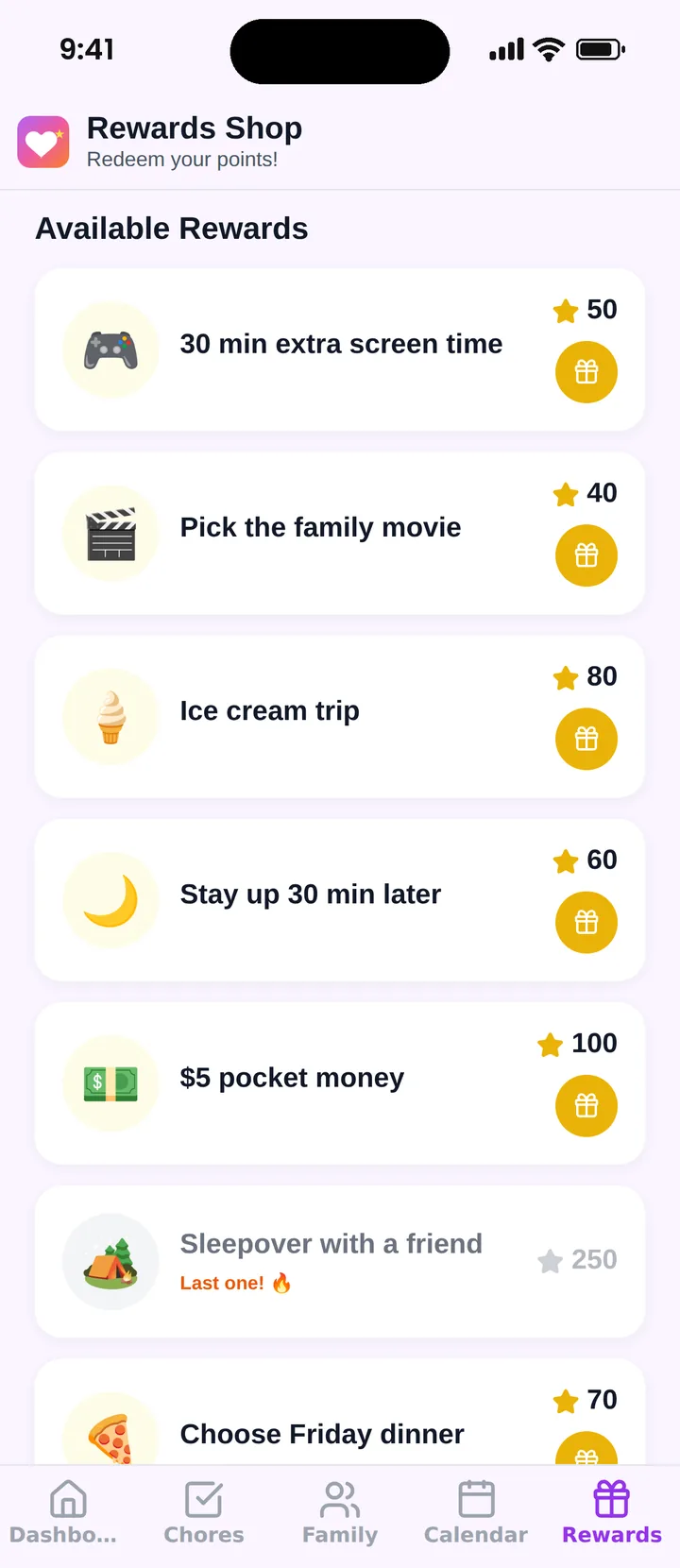
Famiyo is a free family app for iPhone and Android that combines a shared family calendar, chores with points and a rewards shop; kids join with a code, no email needed. For a 13-year-old, the idea is to set up "pocket money" as a reward in the rewards shop at a price in points, with a limit on how many your teen can claim and when. Your teen earns points from chores and extra jobs, redeems from their own phone and sees how many points they will have left. You get a notification when they redeem. The money itself passes between you outside the app.
When to raise it
Revisit the amount each birthday. If your teen has proven they can budget, add $1 to $2 or hand over another category, like a share of clothing. For teens who ask for a lot more, our piece on how much allowance a teenager should get looks at the older ages.
Frequently asked questions
How much allowance should a 13-year-old get?
Typical amounts run $10 to $15 a week, with some families at $15 or more. The $1-per-year-of-age rule gives $13. The right number depends on what your teen pays for out of it and on your budget, not on a national average.
How much allowance per month for a 13-year-old?
Four weeks at $10 to $15 is about $40 to $60 a month. A monthly payment suits a 13-year-old who is ready to plan, while a weekly one works better if money disappears quickly. Pick one and stay consistent.
Should a 13-year-old do chores for allowance?
Basic chores like laundry, dishes and keeping their room tidy are part of living in the family. Allowance is better treated as a budget your teen learns to manage, with extra pay for bigger jobs like mowing the lawn.
What should a 13-year-old buy with their own money?
Typical choices are snacks, outings with friends, game purchases, music or streaming extras and small gifts. Some families add clothing wants beyond the basics. Decide the list together and write it down so there is no argument at the register.
Is it OK to give a 13-year-old allowance through an app?
Yes, as long as your teen can see the balance and make their own choices. Kids' debit cards suit online spending, and points in a family app suit setting prices on rewards. Cash still works for teaching how it feels to run out.
Try Famiyo With Your Family
Chores with points, a rewards shop for kids and one shared family calendar. Set it up in a couple of minutes.



Free to download • No credit card required • Available on iOS & Android