How to Reward Kids for Chores: What Works and What Backfires
How to reward kids for chores without bribing them: when to use praise, points, privileges or money, how big rewards should be, and how to phase them out.
By Famiyo Editorial Team5 min read
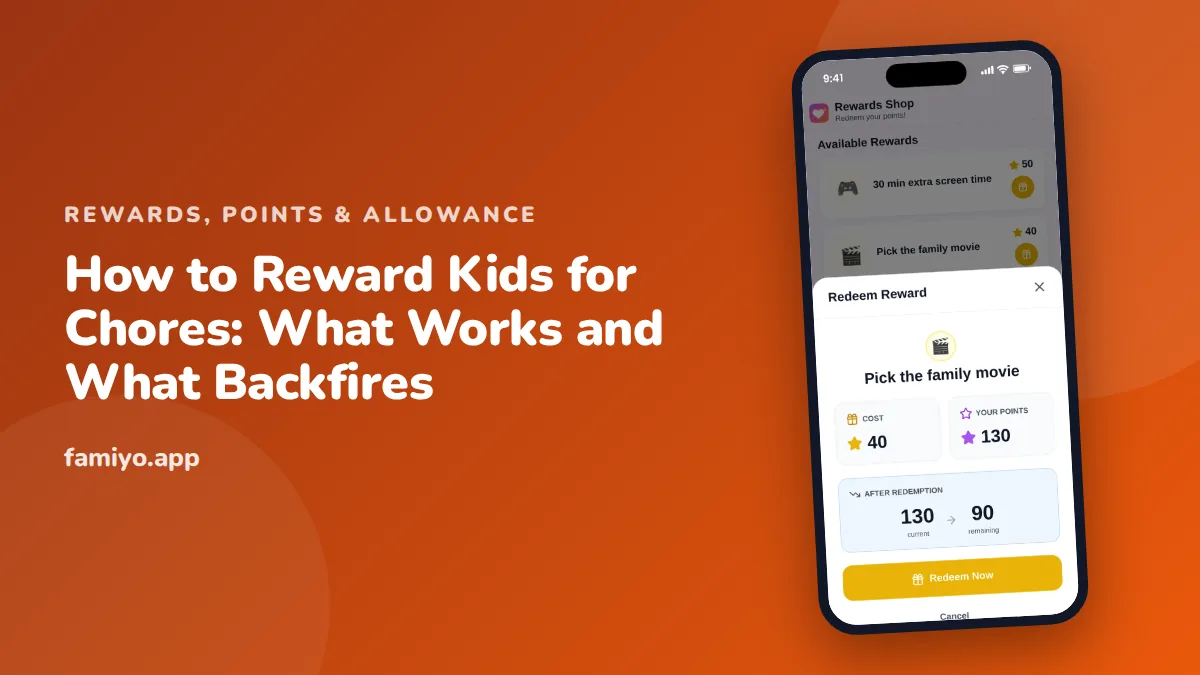
Parents tend to land in one of two camps on this: rewards are a bribe, or rewards are the only thing that works. The research on motivation, which educators and pediatric groups such as the American Academy of Pediatrics discuss at length, is more nuanced. Rewards can start a habit. Used badly, they can also make a child care about the prize more than the job. This page covers how to reward kids for chores so the first outcome is more likely than the second.
Start with what the reward is for
Before picking a prize, decide what you are rewarding. Three things behave very differently:
- A routine task the whole family does, such as clearing a plate.
- An effortful task a child finds hard, such as cleaning a room for the first time.
- An extra job beyond the usual, such as washing the car.
Routine tasks are best supported by praise and a regular schedule. Effortful tasks deserve a visible reward while the skill is new. Extra jobs are fair game for a bigger prize, including money. If you give a prize for everything, the child learns that nothing is worth doing for free.
Reward types, from best to worst bet
| Reward | Example | When it works | Watch out for |
|---|---|---|---|
| Specific praise | "You wiped the whole counter, and you got the corners." | Always, for every age | Vague praise ("good job") does little |
| Time with you | A game night, a walk, baking together | Younger kids, and teens too | Needs to be real attention, not multitasking |
| Privileges | Choose the movie, stay up 30 minutes later | School-age and up | Keep them reasonable and non-negotiable once earned |
| Points toward a prize | 5 points per small task, trade for a reward | Ages 5 and up | Needs a clear price list |
| Small treats | Dessert choice, a sticker | Preschoolers | Food rewards can make eating complicated |
| Money | $0.25 to $1 for a small extra job, $2 to $5 for a big one | Ages 8 and up, extra jobs | Works poorly for basic family chores |
Praise sits at the top because it costs nothing, arrives instantly and fits every age. Put effort in the praise: "You kept going even though it was boring" says more than "Great".
A step-by-step way to set rewards up
- Choose the target chores. Two or three, to start. A good number for preschoolers is 2 to 3 daily tasks and for school-age kids 3 to 4.
- Pick a point value for each. A simple scale: small task (2 to 5 minutes) is 5 points, medium (10 to 15 minutes) is 10, big (30 minutes or more) is 20, plus 2 for doing it without a reminder.
- Set the prices. A small reward such as 15 extra minutes of screen time costs 30 to 50 points. A medium reward such as picking the family movie costs 100. A big reward, like a day out, costs 300 to 500.
- Check the pace. A child should be able to afford something small every 2 to 3 days and something big every 3 to 4 weeks. If it takes longer, kids give up. If it is faster, rewards lose their meaning.
- Announce the plan when everyone is calm, not mid-argument. "Starting Monday, chores earn points, and here is the menu."
- Review in three weeks and adjust prices or tasks together.
How big should a chore reward be?
Smaller than you think. A reward is a signal, and a huge one changes the question from "am I helping?" to "what do I get?" Keep rewards in proportion to the effort, and cheap in money terms. Most of the best ones are free: later bedtime on a weekend, picking dinner, a choice of the car music. See our list of free rewards for kids if you are running low on ideas.
Mistakes that make rewards backfire
Bribing in the moment. "If you clean your room right now I'll give you a cookie" teaches negotiation. Set the rule beforehand.
Taking rewards back. If points were earned, they stay earned, even after a bad afternoon. Using them as punishment makes the whole system feel unsafe.
Rewarding outcomes the child can't control. Reward the steps they do, such as checking off the list, rather than whether you consider the bathroom spotless.
Never fading them out. After the habit is steady, stretch the gaps, give more praise and fewer prizes, and keep rewards for new or harder jobs.
For related questions, see how to reward your child without spoiling them and should kids get paid for chores.
How kids redeem rewards in Famiyo
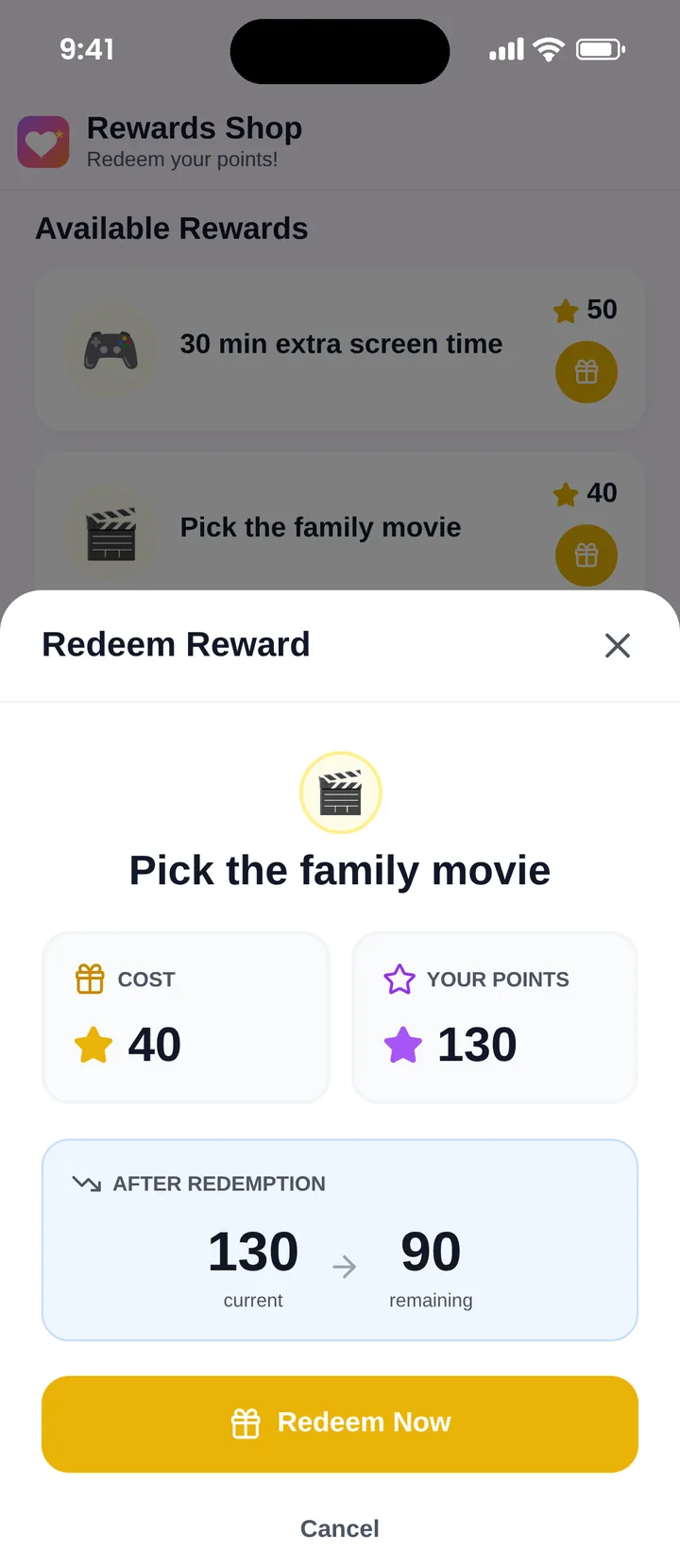
Famiyo is a free family app for iPhone and Android that combines a shared family calendar, chores with points and a rewards shop; kids join with a code, no email needed. The rewards shop is built for exactly this. You add rewards with a price in points, how many are available and when, for example "Pick the family movie, 100 points, once a week". Kids redeem from their own phone and see how many points they will have left, and you get a notification when one is redeemed. The prices and limits stop the argument, because the menu is the same for everyone. For more options, browse our list of the best reward chart apps for kids.
What to say when a child asks "What do I get?"
It will come up. A calm answer helps: "You get the points on the chart, and you get a house that works. Clearing the table is part of living here, and the points are a bonus." Say it once, kindly, and don't add a surprise prize to end the conversation. If the child is asking about a job outside the usual list, that is a fair time to name a price: "Washing the car is an extra job, so it's 20 points."
Children differ here. Some respond strongly to a visible tally, while others barely notice it and prefer your attention. Watch which one you have and lean that way, since the same system will not suit every child in the house.
Fading rewards over time
After 4 to 6 weeks, look at what has become automatic. A chore your child does without a reminder can drop from 5 points to praise only. Keep a few points for new tasks and bigger jobs. The aim is a child who helps because the house is theirs too, with rewards as the extra rather than the engine.
Frequently asked questions
What is the best reward for kids doing chores?
The best reward is one the child actually wants, that costs you little, and that arrives soon after the task. Specific praise comes first, then small privileges such as choosing dinner, extra screen time or a family movie pick. Money can work for bigger extra jobs.
Should I reward kids for every chore?
Not forever. Rewards help a new habit start, but daily basics should become expected over time. Reward extra jobs, streaks or new responsibilities, and let the everyday ones move toward praise only once the habit is steady.
Will rewarding chores make kids only help for a prize?
It can, if the reward is large, constant or promised as a bribe mid-argument. Keep rewards small, announce the plan in advance rather than in a fight, and keep pairing them with praise so the child links helping with belonging.
How often should kids get rewards for chores?
Often at the start, then less often. A child should be able to afford a small reward every 2 to 3 days and a big one every 3 to 4 weeks. After a few weeks, stretch the gaps so the habit stands on its own.
Try Famiyo With Your Family
Chores with points, a rewards shop for kids and one shared family calendar. Set it up in a couple of minutes.



Free to download • No credit card required • Available on iOS & Android