How to Motivate Kids to Learn: What Actually Works
How to motivate kids to learn: build curiosity, choice and early wins first, then use small rewards for the dull parts. What the research says, by age.
By Famiyo Editorial Team4 min read
A child who loves dinosaurs will memorize forty species before breakfast. The same child will stare at a worksheet for 30 minutes without writing a word. Kids aren't unmotivated. They're motivated by different things than the ones adults assign. This article looks at what researchers and pediatric guidance say drives learning, how that changes by age, and where a reward system fits in without wrecking curiosity.
What the research says about motivation
Psychologists separate two kinds of motivation. Intrinsic motivation is doing something because it's interesting or satisfying. Extrinsic motivation is doing it for an outcome such as a prize, a grade or a warning avoided. Both are normal, and children use both.
A long line of work on self-determination theory points to three needs that feed intrinsic motivation: autonomy (some say in what and how), competence (a feeling of getting better) and relatedness (feeling connected to the people around you). When those are met, kids lean in. When they're missing, kids check out or comply with resentment.
The tricky part is that outside pressure can crowd out inner interest. Studies of what is often called the overjustification effect found that rewarding an activity children already enjoyed could make them less keen on it later. This depends on the child and how the reward is framed, so treat it as a caution, not a law. The practical lesson: don't pay for curiosity.
Start with autonomy, competence and company
You can build each need into an ordinary week.
| Need | What it looks like at home | What to say |
|---|---|---|
| Autonomy | Choose the order of tasks, the book, the project topic, the spot to work | "Math or reading first? Your call." |
| Competence | Work that is slightly hard but doable, progress they can see | "Last week this took 20 minutes. Today it took 12." |
| Relatedness | You sit nearby, ask real questions, share what you are learning | "I never knew that. Tell me how you worked it out." |
Competence deserves extra attention. Kids who feel stuck for too long conclude they're bad at it. Kids who always succeed get bored. Aim for the middle: tasks that take effort and end in a win.
Praise the work, not the child
The wording of your praise tells a child what you value. Comments about ability ("You're so smart") can leave kids afraid to try something that might prove otherwise. Comments about effort and method keep the door open.
- "You tried three ways before that one worked."
- "You reread the question and caught your mistake."
- "That paragraph is clearer than your last one. What did you change?"
Keep it honest. Children notice empty praise quickly, and a flat "good job" on a sloppy page teaches them to discount you.
Match your approach to the age
| Age | What drives learning | What helps |
|---|---|---|
| 3-5 | Play and curiosity | Questions, books together, hands-on projects. No drills. |
| 6-9 | Mastery and approval | Short sessions, visible progress, a reading habit. See how to motivate kids to read. |
| 10-12 | Competence and peers | Choice of topics, goals they set, real-world uses |
| 13+ | Autonomy and purpose | Ownership of their schedule, a reason that matters to them |
For the specific case of nightly assignments, how to motivate kids to do homework goes deeper. And if attention or executive function makes work harder than it looks, how to motivate a child with ADHD has strategies built for that.
What to do when a child says "I'm just bad at this"
That sentence is usually about competence, not ability. A child who has failed a few times at fractions or spelling decides the subject isn't for them, and then avoids it. Don't argue with the feeling. Agree that it's hard, then shrink the task until success is likely: five problems instead of twenty, one page instead of a chapter. Note the progress in writing, even if it's small, so they can see the line moving. Pediatric and school guidance generally points the same way, toward steady support and realistic goals. If the struggle is long-lasting, talk to the teacher or your child's pediatrician about whether something else, such as vision, attention or a learning difference, is in the way.
When a reward makes sense
Rewards earn their place when the task is necessary, dull and not something a child would choose: multiplication tables, spelling lists, a daily 15-minute reading block for a kid who dislikes reading. Used this way, a reward acts as a bridge until the skill gets easier and the habit holds.
A few rules keep it from backfiring:
- Reward effort and routine (the 15 minutes done), not scores.
- Make it small and near. Young kids need a payoff within 2 to 3 days.
- Agree on it before the work, so it's a deal, not a bribe in the middle of a meltdown.
- Don't attach it to topics they already love.
- Plan to fade it out after a few weeks as the habit forms.
If you want the full setup, see how to create a reward system for kids in 5 steps.
Using the Famiyo rewards shop for the dull parts
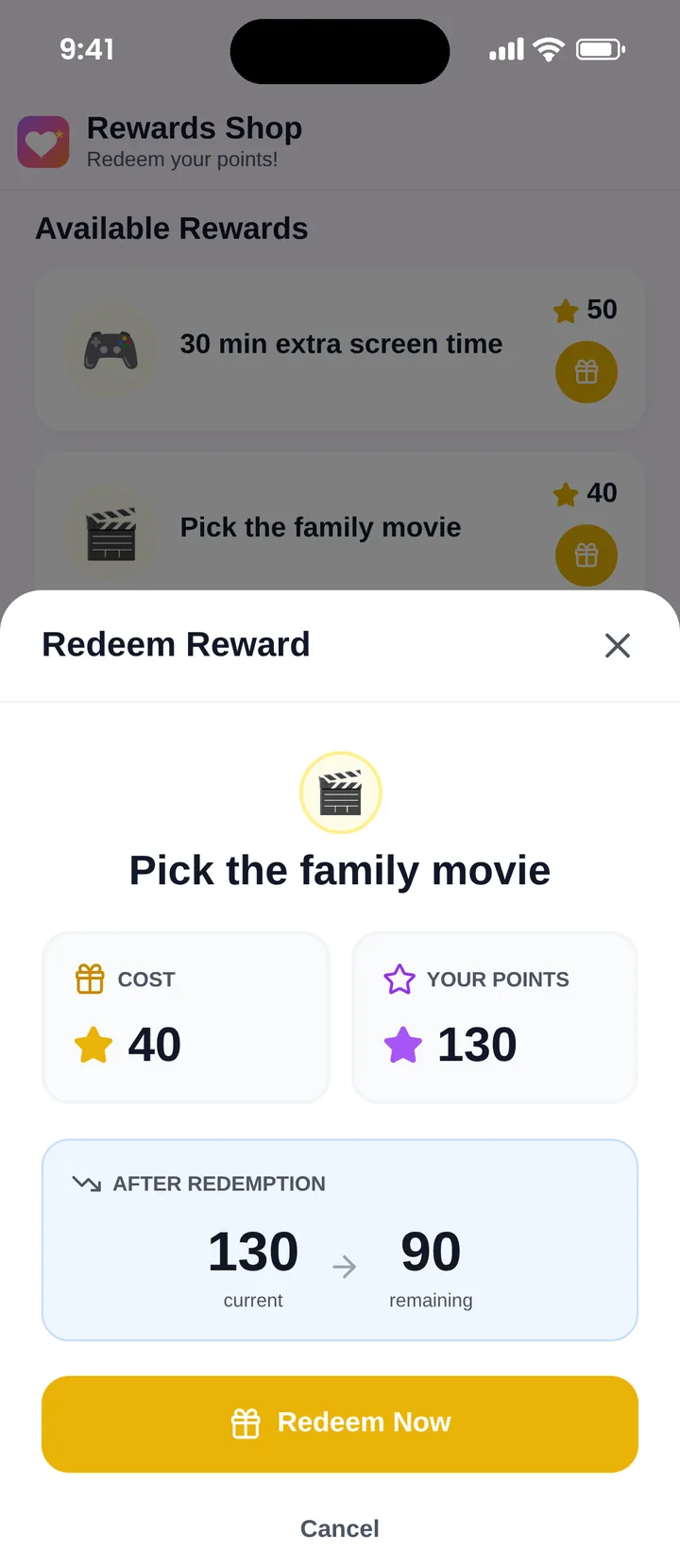
Famiyo is a free family app for iPhone and Android that combines a shared family calendar, chores with points and a rewards shop; kids join with a code, no email needed. Study tasks can be worth points like any chore, so a 20-minute reading block might earn 10 points. In the rewards shop you set each reward with a price in points, how many are available and when. A child picks a reward on their own phone and sees how many points they'll have left. Starter prices from the app: 30 to 50 points for a small treat, 100 for a medium one. See the best reward chart apps for kids for how the options compare.
A realistic first step
Choose one subject where motivation is lowest. Give your child two choices about how they tackle it, sit with them for the first 10 minutes for a week, and praise one specific thing each day. Add a small reward only if that isn't enough after two weeks.
Frequently asked questions
How do I motivate a child who doesn't want to learn?
Start by finding out why. The work may be too hard, too easy, or boring, and each needs a different fix. Offer a choice, break the task into a 10-minute piece, and connect it to something the child already cares about before adding any reward.
Do rewards help kids learn?
Short-term rewards can help with dull practice such as spelling lists or math facts. Research on motivation also suggests that rewarding something a child already enjoys can reduce that enjoyment. So reward the grind, not the curiosity, and fade rewards as the habit forms.
Should I praise my child for being smart?
Praise what they did instead: the effort, the strategy, the way they stuck with a hard problem. Telling kids they are smart can make them avoid challenges for fear of looking otherwise. Specific comments about the work keep them willing to try hard things.
How much should I help with schoolwork?
Be available, not in charge. Set up a regular time and place, ask questions, and let them struggle a little before you step in. Doing the work for a child, even to speed things up, tells them they can't do it alone.
Try Famiyo With Your Family
Chores with points, a rewards shop for kids and one shared family calendar. Set it up in a couple of minutes.



Free to download • No credit card required • Available on iOS & Android