Chore Cards for Kids: Free Printable Set and How to Use It
Free printable chore cards for kids: 12 cut-out cards, three ways to use them (pick a card, daily deck, trade), and tips for keeping the deck fresh.
By Famiyo Editorial Team4 min read
Free printable
Chore Cards for Kids
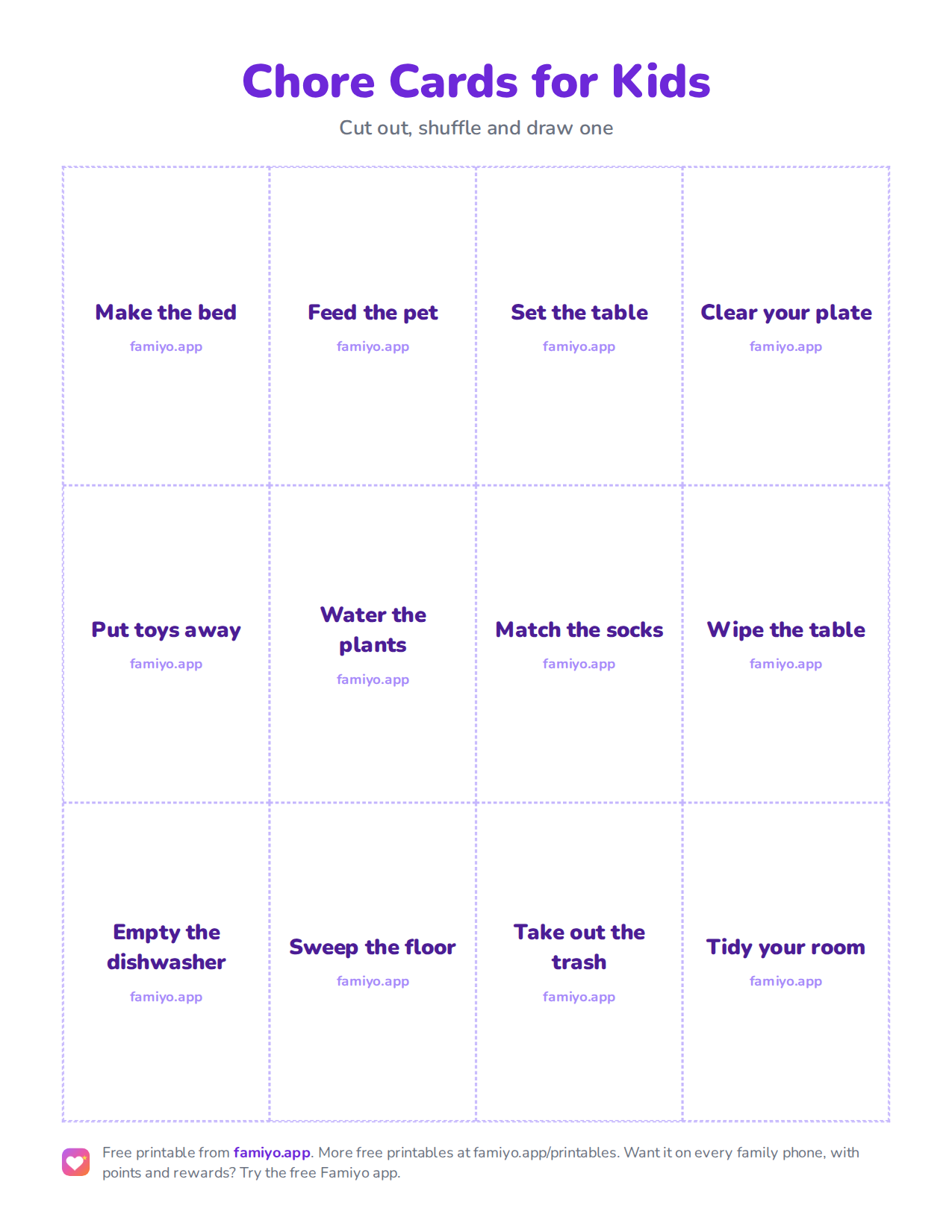
A set of cut-out cards on one US Letter page. Download the PDF to print it, or save the image to use it on a tablet or in a document.
Free for home, classroom and nonprofit use, see the license. More free printables.
A list on the fridge is easy to ignore. A card in your hand is harder to ignore, and a little more fun. Chore cards break the house work into single jobs that a child can draw, flip over and finish. This page gives you a free printable set of 12 cards and three ways to run them, so you can pick the one that matches how your family already works.
What chore cards are and why they work
Each card names one job and nothing else. That is the whole idea. Instead of facing a list of eight tasks, a child faces one clear thing: "Water the plants." The card is small enough to carry to the job and, when it is finished, easy to flip over or drop in a "done" pile.
Cards suit families for a few practical reasons. They give kids a bit of say in what they do, since a draw or a pick is a choice. They are easy to rearrange, so you can swap one job out without redrawing a whole chart. And for children who are not reading yet, a card with a picture works better than any table.
If you want to compare formats, chore bingo for kids uses a similar game feel, and our page on chore charts that actually work covers what any system needs to survive past week two.
The printable chore cards
The printable below has 12 cut-out cards covering the everyday jobs most families share: make the bed, feed the pet, set the table, clear your plate, put toys away, water the plants, match the socks, wipe the table, empty the dishwasher, sweep the floor, take out the trash and tidy your room.
It suits kids from roughly age 4 to 12. Younger children take the first six cards, and older kids can handle the full deck. Print on cardstock if you can, cut along the lines, and laminate or tape them if the deck will be handled daily.
Blank space on the back is a good place to write a name or a point value. Make your own cards for anything the set leaves out, such as "feed the fish" or "bring in the recycling bin."
Three ways to use chore cards
Pick one system and run it for two weeks before you change anything.
Pick-a-card (best for ages 4 to 8)
- Lay the deck face down each morning.
- Each child draws two or three cards.
- They do those jobs before dinner and drop each card into a "done" bowl.
- Reshuffle in the evening.
The random draw ends a lot of "that's not fair" arguments, because the cards decided, not you.
The morning deck (best for ages 6 to 10)
Make a smaller deck of fixed daily jobs and one larger deck of weekly extras. Each child keeps a personal stack of three daily cards on the fridge. They flip a card when it is finished. Each evening the cards flip back. This version is closer to a routine than a game, and it is good for kids who like predictability.
Weekly trade (best for ages 9 and up)
On Sunday evening, deal out the week's jobs. Each child gets a hand and may trade one card with a sibling or parent before Monday. Trades must be agreed by both sides, and no one gets only the easy cards. This gives older kids a sense of negotiating their own load and mirrors what adult households do informally.
Setting up your deck
Some small choices make a big difference.
| Choice | A good default |
|---|---|
| Cards per child per day | 2 to 3 for preschoolers, 3 to 4 for school-age kids |
| Easy and hard mix | Draw at least one easy and one harder job |
| Weekly big job | Add one card from about age 8 (bathroom, vacuum, trash) |
| Rewards | Optional: a token or point value on the back |
| Refresh | Retire or swap a card every few weeks |
Keep the daily basics few and clear. Jobs for each age are in our weekly chores for kids plan, so you can pick cards that fit your child's age instead of guessing.
Tips to keep the deck working
- Show each job once. Walk through it together and let the child try, before a card is expected to do the job alone.
- Keep wording short and concrete. "Put shoes on the rack" beats "tidy the entryway."
- Add a picture for early readers. A quick drawing is enough.
- Do not use cards as punishment. A card that arrives with a lecture will be resented fast.
- Rotate the deck. If a card is always done well and without a fuss, it may be time to graduate to a bigger job.
- Make the "done" pile visible. Watching the pile grow gives children a satisfying sense of progress.
When paper cards start to wear out
Cards are great at the start. They get lost, bent, and forgotten in backpacks, and keeping track of who owes what on a Thursday is tedious. Families who like the card idea but want less paper often move the system into an app.
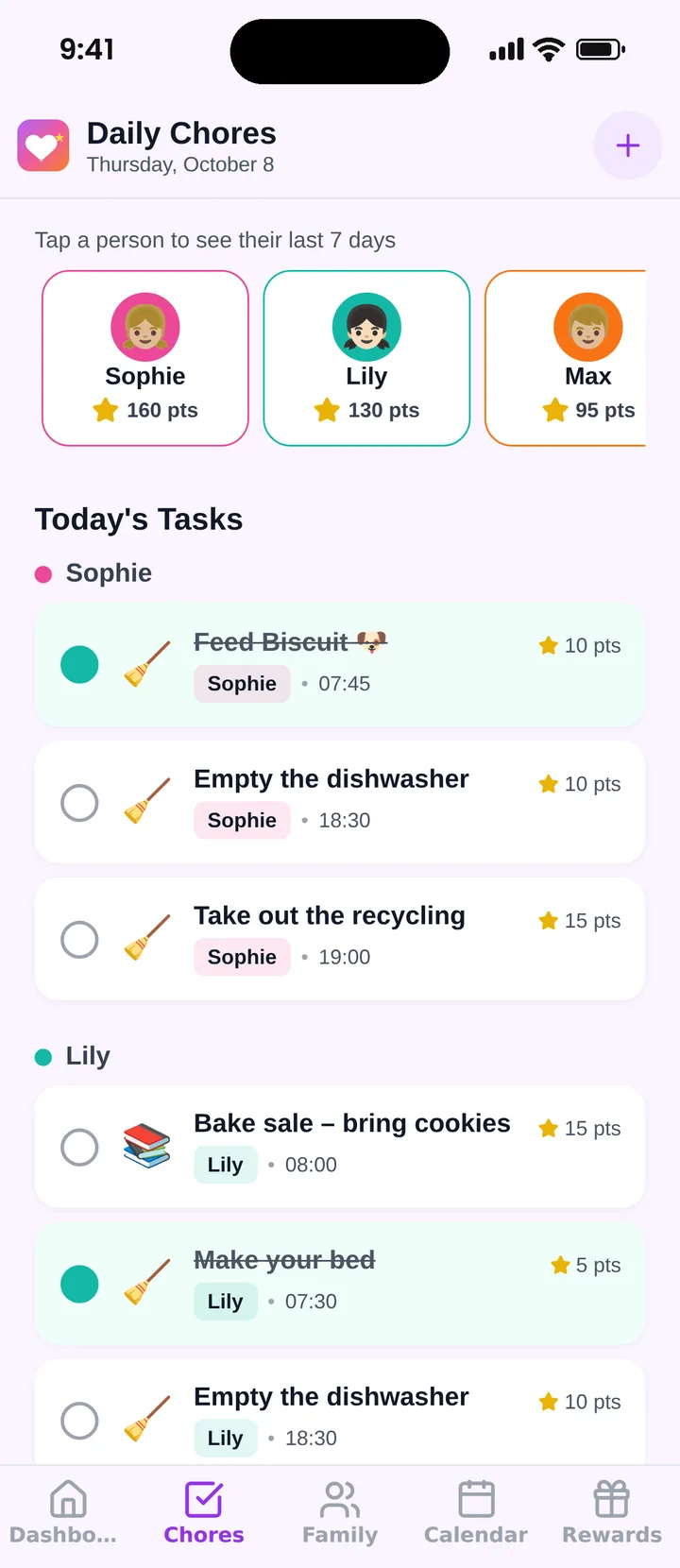
Famiyo is a free family app for iPhone and Android that combines a shared family calendar, chores with points and a rewards shop; kids join with a code, no email needed. It replaces the paper chart: chores repeat on the days you choose, each child sees their own tasks with points, and everyone's phone updates live. Kids hear about new tasks by push notification, and you hear when a chore is done.
For a closer look at the options, see our list of the best chore chart apps.
Print the set and try it this week
Print the 12 cards, choose pick-a-card for the first week, and give each child just two cards a day. Adjust from there.
Frequently asked questions
What are chore cards for kids?
Chore cards are cut-out cards, each naming one job, such as feed the pet or wipe the table. Kids draw or choose a card instead of reading a long list, which makes chores feel like a quick game and gives them a little control.
How many chore cards should a child get each day?
Two to three cards a day suits preschoolers and three to four suits school-age kids. Fewer, clearer jobs get done more reliably than a pile, and you can always add a weekly big job from about age 8.
Can chore cards work for kids who can't read yet?
Yes. Add a simple drawing or photo next to each job, or ask a young child to match the card to a picture of the task. Read the card aloud the first few times, then let them take over.
How do I stop kids from always picking the easy cards?
Sort the deck into easy and harder piles and require one from each. You can also draw randomly, or let kids trade a card once a week. Choice stays, but nobody gets only the quick jobs.
Try Famiyo With Your Family
Chores with points, a rewards shop for kids and one shared family calendar. Set it up in a couple of minutes.



Free to download • No credit card required • Available on iOS & Android