Weekly Chores for Kids: A Balanced Plan by Age
A balanced weekly chore plan for kids by age, from 2 to 17, with daily and weekly jobs, time per day, a sample week and how to rotate jobs fairly.
By Famiyo Editorial Team4 min read

A weekly plan is easier to live with than a daily scramble. It spreads the work across seven days, lets small jobs repeat so they become habits, and puts the bigger jobs on days when there's time. Below is a plan by age, with the time each age can reasonably give, a sample week you can copy, and a few ways to keep it fair between siblings.
The shape of a balanced week
Think in two layers. Daily tasks are short and steady: they happen every day, so kids build routine. Weekly jobs are bigger and happen once, often on a weekend, so they teach longer tasks and finishing.
The rule of thumb we use: start with 2 to 3 daily tasks for preschoolers, 3 to 4 for school-age kids, and add one weekly big job from age 8. Time per day grows with age, and it should stay in a range your child can complete without tears.
| Age | Daily time | Daily tasks | One weekly job |
|---|---|---|---|
| 2 to 3 | 5 to 10 minutes | Toys in a bin, clothes in the hamper, wipe up spills | None (join you for one) |
| 4 to 5 | 10 to 15 minutes | Make the bed (roughly), set and clear their place, feed a pet | Water plants, match socks |
| 6 to 7 | 15 to 20 minutes | Tidy room, pack school bag, empty unbreakable dishes | Sort laundry by color, sweep |
| 8 to 9 | 20 to 30 minutes | Load dishwasher, make bed, take out trash | Vacuum one room, fold laundry |
| 10 to 12 | 30 minutes | Dishes, pet care, room | Clean the bathroom sink and toilet, change bed sheets |
| 13+ | 30 to 45 minutes | Dinner help, room, own dishes | Do own laundry start to finish, mow the lawn |
Weekly chores by age group
Ages 2 to 5
At this age, the goal is the habit of helping, not the result. A toddler puts toys in a bin. A 4-year-old wipes the table and feeds the cat. Keep each job under five minutes and work alongside them. Our guide to daily chores for kids by age shows what the everyday version looks like.
Ages 6 to 7
Children now follow a short list and start owning their room. Weekly extras: sorting laundry by color, sweeping the kitchen, helping set up for a family game night. Reminders are still normal at this age.
Ages 8 to 9
This is when the weekly big job joins the list. Vacuuming a room, folding and putting away a basket of laundry, or washing the table after dinner. They can start working with fewer reminders, and the bonus of finishing without being told fits well here.
Ages 10 to 12
Real responsibility: cleaning a bathroom sink and toilet, changing bed sheets, cooking a simple meal with an adult nearby, washing the car. Our guide to chores for tweens goes deeper on this stage.
Ages 13 to 17
Teens can run their own laundry start to finish, cook a family dinner, shop from a list, mow the lawn and help younger siblings. For teen-specific jobs, see weekly chores for teenagers.
A sample week for two kids (age 7 and age 10)
Here's how it looks when two children share a house. Daily tasks stay put, and the weekly jobs are spread across days.
| Day | 7-year-old | 10-year-old |
|---|---|---|
| Mon | Tidy room, pack bag | Dishes, pet care |
| Tue | Tidy room, set the table | Dishes, take out recycling |
| Wed | Tidy room, pack bag | Dishes, pet care |
| Thu | Tidy room, sort laundry | Dishes, pack bag |
| Fri | Tidy room, set the table | Dishes, wipe kitchen counters |
| Sat | Sweep the kitchen (weekly job) | Clean bathroom sink and toilet (weekly job) |
| Sun | Light day, put away laundry | Change bed sheets |
Everything fits in the age ranges above, with Saturday as the heavier day because school is out. If a day is very busy, drop the daily list to two tasks and keep the weekend jobs.
Points make the week visible
If you use points, the default suggestion is 5 for a small task, 10 for a medium one and 20 for a big one, with +2 when it's done without a reminder. A 10-year-old who does five daily tasks and the Saturday bathroom could earn about 45 to 70 points in a week. At 30 to 50 points for a small reward, they'll reach a treat every few days, which is about the right pace. For the full approach, see how to motivate kids to do chores.
Keeping it fair between siblings
Rotate the weekly jobs. If your 10-year-old always gets the bathroom and your 8-year-old always sweeps, resentment builds quickly. Swap every week or month, and match the job to the child's age rather than their gender. Our piece on chores for boys and girls explains why the same list matters.
When one child has a game or recital, adjust their day. Tell them early ("Thursday's game night, so take the dishwasher on Friday") and keep the total roughly equal across the week. Fairness is about the week, not each day.
Setting the week up in Famiyo
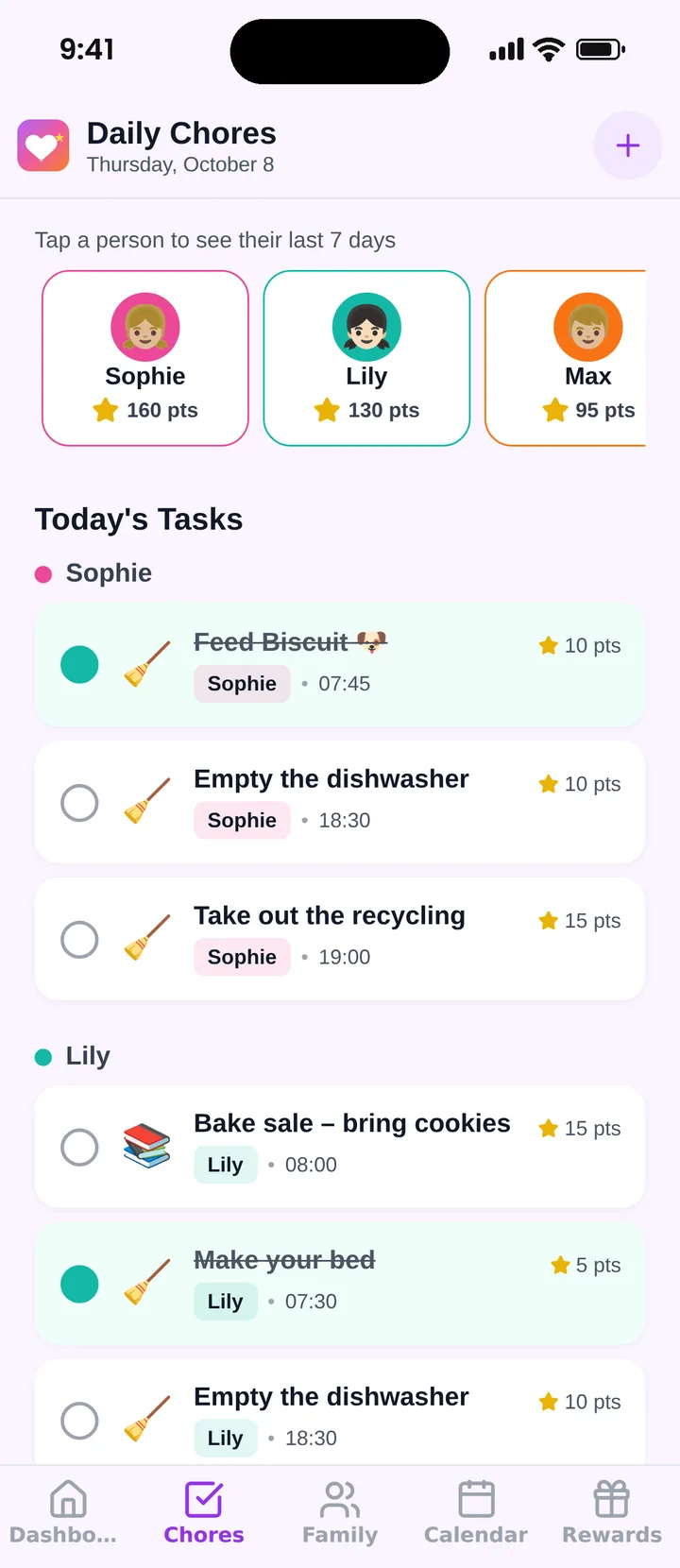
Famiyo is a free family app for iPhone and Android that combines a shared family calendar, chores with points and a rewards shop; kids join with a code, no email needed. Create each chore once, pick who does it and how many points it's worth (each child can get their own number of points for the same task), and set it to repeat. Kids see their jobs on their own phone and check them off, or you approve them. The screen below shows a day's chores for each child. Browse more options in our list of the best chore apps for kids.
Start with one column
You don't have to fill the whole table tonight. Pick one child, choose their daily tasks from the right row, add the weekly job on Saturday, and run it for two weeks before changing anything. For monthly projects once the weekly rhythm holds, see monthly chores for kids.
Frequently asked questions
How many chores should a child do each week?
A preschooler needs 2 to 3 daily tasks. A school-age child can handle 3 to 4 daily tasks, and from age 8 you can add one bigger weekly job. That is enough to build a habit without crowding out homework and play.
How much time should weekly chores take?
About 5 to 10 minutes a day for ages 2 to 3, 10 to 15 for ages 4 to 5, 15 to 20 for ages 6 to 7, 20 to 30 for ages 8 to 9, 30 for ages 10 to 12, and 30 to 45 for teens. Weekend jobs can run longer.
Should chores be the same every week?
Daily tasks should stay steady so they become habits. Weekly big jobs can rotate between siblings every week or month so nobody is stuck with the worst one, and so each child learns different skills.
What if my child has sports or lots of homework?
Lighten the load on busy days instead of dropping chores. A two-minute task on Tuesday and a longer job on Saturday keeps the habit going. Move the weekly big job to a lighter day and tell your child the plan ahead of time.
Try Famiyo With Your Family
Chores with points, a rewards shop for kids and one shared family calendar. Set it up in a couple of minutes.



Free to download • No credit card required • Available on iOS & Android