Chore Chart for 2 Kids: A Fair Setup and Free Printable
A chore chart for 2 kids that keeps the load fair: how to split jobs for different ages, a sample week, a weekly rotation and a free printable to start today.
By Famiyo Editorial Team4 min read
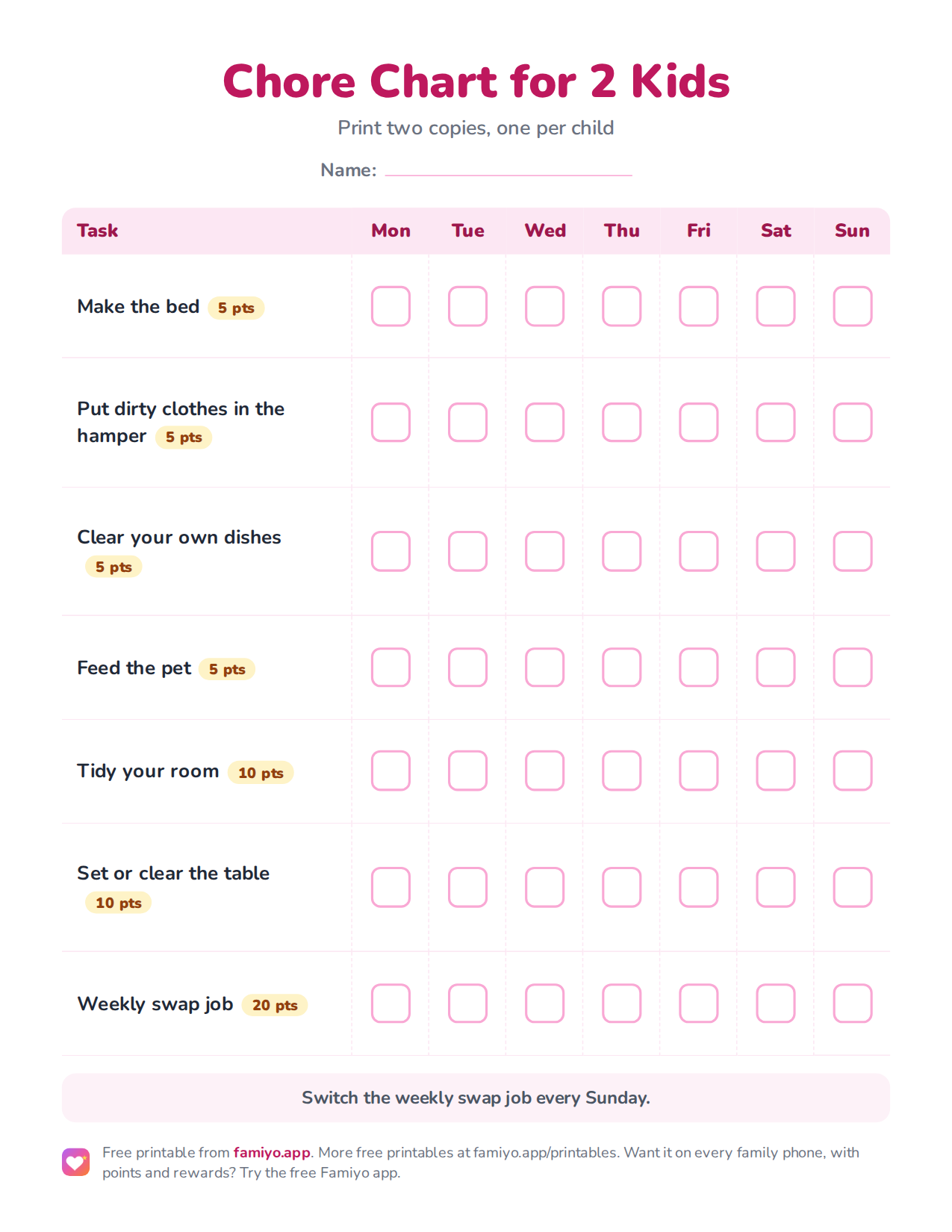
Free printable
Chore Chart for 2 Kids
A weekly chart on one US Letter page. Download the PDF to print it, or save the image to use it on a tablet or in a document.
Free for home, classroom and nonprofit use, see the license. More free printables.
Two kids is a sweet spot for a chore chart, and also where fairness complaints start. "Why does she get the easy one?" is a sentence you will hear. This page shows a layout that heads most of that off, with a sample week for two ages, a simple rotation, and a printable you can use tonight.
How to split chores between 2 kids
Fair does not mean identical. A 5-year-old and a 9-year-old can both have an equal load if you balance by minutes, not by number of tasks.
Start with the typical time per day: roughly 10 to 15 minutes for ages 4 to 5, 15 to 20 minutes for ages 6 to 7, and 20 to 30 minutes for ages 8 to 9. Then divide into three groups.
- Personal jobs. Things each child does for their own stuff: make the bed, clothes in the hamper, pack the school bag. These stay with the child.
- Age-matched family jobs. Each child gets jobs that fit their age, such as feeding the pet (younger) or loading the dishwasher (older).
- One rotating job. A shared job, like taking out the trash or setting the table, that swaps weekly.
The rotating job is what keeps the peace, since neither child owns the unpopular task forever.
Sample week for a 5-year-old and a 9-year-old
Here is a chart for two kids at those ages. Points use the standard sizing: 5 for a small job, 10 for a medium one, 20 for a big one.
| Task | Younger (5) | Older (9) | Days |
|---|---|---|---|
| Make the bed | 5 | 5 | Daily |
| Clothes in the hamper | 5 | 5 | Daily |
| Clear own dishes | 5 | 5 | Daily |
| Feed the pet | 5 | Daily | |
| Load the dishwasher | 10 | Daily | |
| Tidy room | 10 | 10 | Mon, Thu |
| Rotating job (trash or table) | 10 | 10 | Swap weekly |
| Weekly big job | 20 | Saturday |
The younger child ends up with about 10 to 15 minutes a day, the older with 20 to 30. Point values differ in the same way, so each earns a similar share of the same rewards.
If your children are closer in age, drop the weekly big job and give both the same table. When you have three or more, see our guide to a chore chart for multiple kids.
A rotation that nobody can argue with
Write the rotating job on the chart and change it on a set day. A simple two-week pattern:
| Week | Child A | Child B |
|---|---|---|
| 1 | Set the table, trash | Clear the table, feed the pet |
| 2 | Clear the table, feed the pet | Set the table, trash |
Hang the chart where both can see it. When the page says it is Week 2, there is nothing to discuss. If someone complains, point to the paper and say "That's what the chart says, we swap on Sunday." Do not renegotiate on Wednesday. The sibling who wanted a trade can ask at the Sunday review.
Reward both kids from the same menu. A small reward for 30 to 50 points, a medium one at 100, a big one at 300 to 500. They can save or spend at their own pace, but the prices stay the same. That keeps comparison to a minimum.
When siblings compare
You will hear "it's not fair" within the first week. Two things help. First, explain once, calmly, that the jobs match each child's age and that the older one does more because they can. Second, give the younger child a few jobs the older one cannot do or no longer does, like feeding the hamster, so they have something that is theirs. For younger ones, chores for preschoolers has more ideas, and for sharing a list across a wider age range see chore cards for kids.
Running the chart in Famiyo
Famiyo is a free family app for iPhone and Android that combines a shared family calendar, chores with points and a rewards shop; kids join with a code, no email needed. For two kids, the useful part is that each child gets their own number of points for the same task, so the 5-year-old and the 9-year-old can share "Set the table" at different values. Chores can repeat daily or weekly, so you set them once. Both children see only their own list, and you see everyone's on one screen, with points earned so far.
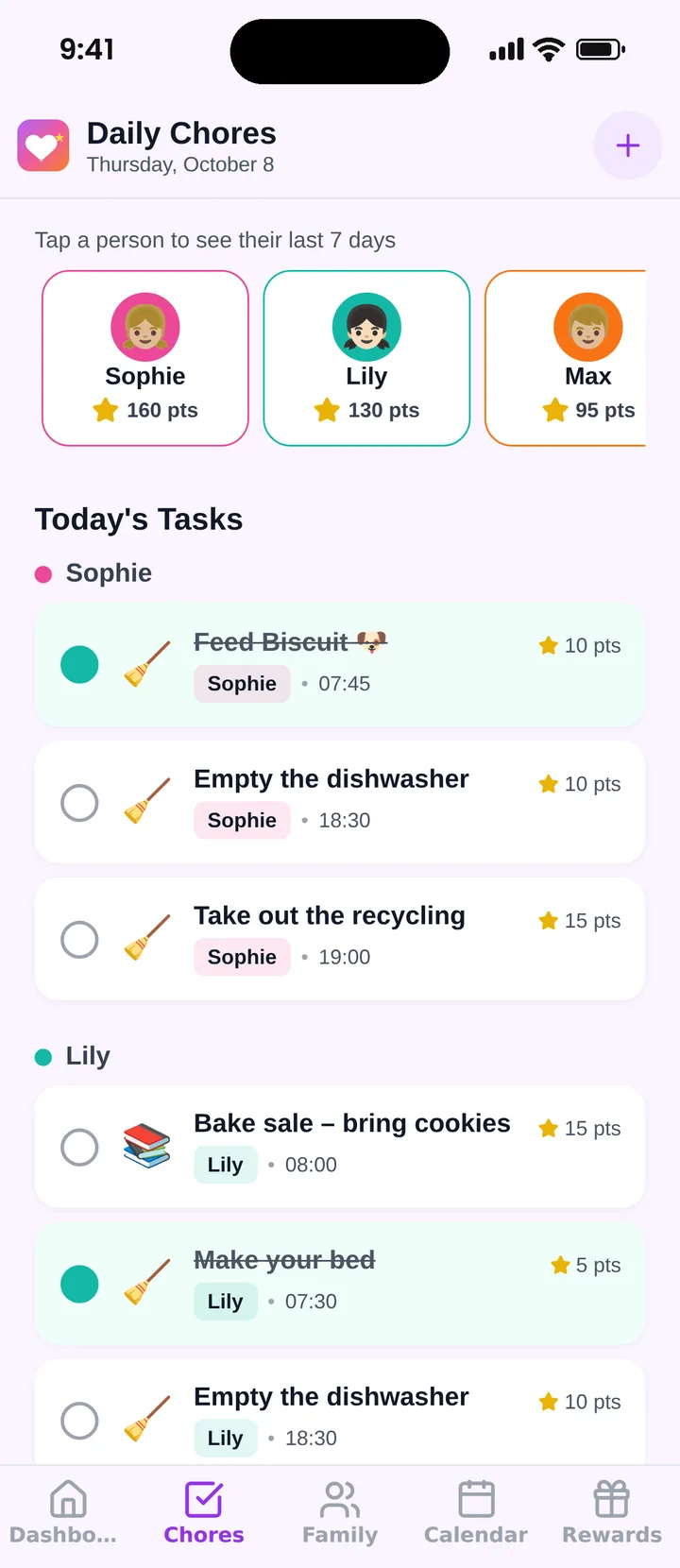
The free plan covers up to 3 family members and 1 repeating task, so a two-kid family with one parent fits. Compare options in our list of the best chore chart apps.
The printable below works as is: print two copies, one per child, and add or swap rows to match their ages. If you also want a spreadsheet version, try our chore chart template for Google Sheets.
Frequently asked questions
How do I make a chore chart fair for 2 kids of different ages?
Match jobs to age, then balance by time and effort, not task count. A 9-year-old doing 25 minutes and a 5-year-old doing 12 can both be fair. Let each child earn the same type of reward, even with different point values.
How many chores should 2 kids have each?
Two to 3 daily tasks for preschoolers and 3 to 4 for school-age kids. Add one weekly bigger job from about age 8. Fewer is better early on. Add a task only after the first ones are done steadily for 2 to 3 weeks.
Should siblings share the same chore chart?
One page with two columns works well because each child sees the other is also working. Keep separate point totals so there is no pooling. If comparing causes fights, use two separate charts instead.
How do I stop siblings arguing about whose turn it is?
Rotate jobs on a fixed day and write the rotation on the chart so it is never a debate. A weekly switch, such as Sunday, works for most families. When the chart says it is her turn, there is nothing to negotiate.
Try Famiyo With Your Family
Chores with points, a rewards shop for kids and one shared family calendar. Set it up in a couple of minutes.



Free to download • No credit card required • Available on iOS & Android