Monthly Chores for Kids: Bigger Jobs Worth Bigger Rewards
Monthly chores for kids by age: the once-a-month jobs that suit ages 4 to 17, how long each takes, how many points to give, and how to make them stick.
By Famiyo Editorial Team5 min read
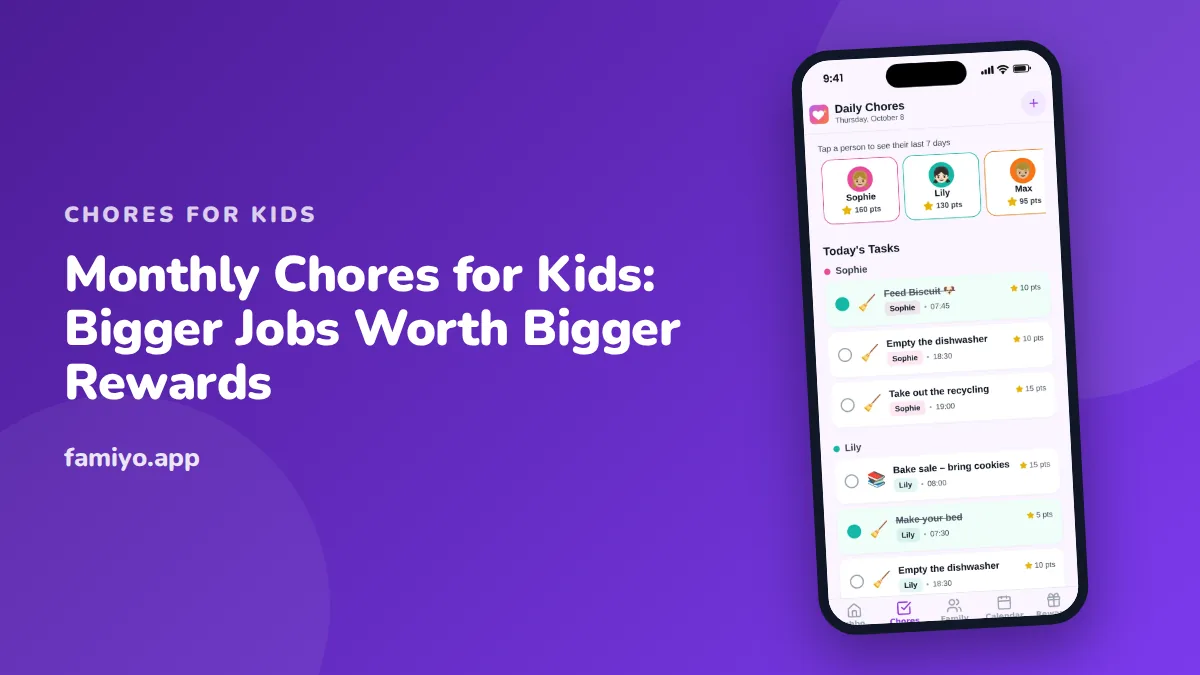
Daily chores keep the house running, but some jobs only come up once a month: the windows, the closets, the car, the toy purge. Those are perfect for kids, because they are big enough to feel important and infrequent enough to stay fresh. Below are monthly jobs by age, how to teach them, how many points to give, and a simple way to keep them from vanishing.
Why monthly chores are worth giving
Daily chores build habits. Monthly chores build something different: the ability to plan, stick with a larger job and see it through to a visible result. Developmentally, that is a step up. A 9-year-old who makes a bed every morning has a routine. A 9-year-old who clears and wipes a whole closet has tackled a project, with a beginning, a middle and an end.
They also fit well into the gaps. A child who only handles a monthly job is not overloaded, and a family that rotates monthly jobs spreads the workload fairly. If your child's daily list is already full, see our guide to daily chores for kids by age to check you are not asking for too much first.
Monthly chores by age
Match the job to what the child can finish with a little help. These times are for the child working, with an adult nearby for younger kids.
| Age | Monthly jobs | Time | Points |
|---|---|---|---|
| 4 to 5 | Sort the toy bin and set aside toys to give away; wipe low shelves; water and wipe plant leaves | 15 to 20 min | 10 |
| 6 to 7 | Tidy and wipe one drawer or shelf; wipe baseboards in one room; wash the inside of the car windows with help | 20 to 30 min | 10 to 20 |
| 8 to 9 | Clear and wipe the shoe rack or closet floor; wash windows on one level; clean the pet's bed and bowls | 30 to 40 min | 20 |
| 10 to 12 | Clean the bathroom tub and mirror; wash the car; wipe cabinet fronts; clean out the fridge shelf | 30 to 45 min | 20 |
| 13 to 17 | Deep clean the kitchen; mow and edge the lawn; wash the car inside and out; clear out the garage shelf | 45 to 60 min | 20 or more |
Keep earlier jobs in the mix. A 12-year-old can still sort the toy bin when a younger sibling needs help, and the older child gets to teach it.
A sample month for a 9-year-old
| Week | Job | Time |
|---|---|---|
| 1 | Wipe baseboards in the bedroom and hall | 25 min |
| 2 | Clear and wipe the closet floor | 30 min |
| 3 | Clean the pet's bed and bowls | 20 min |
| 4 | Wash windows on the ground floor | 35 min |
Spreading them across the month helps. A single weekend marathon turns a manageable job into a punishment.
How to teach a monthly job so it works
Because monthly jobs come up rarely, children forget the steps. Build in these supports.
- Show it first, then do it together, then let them try alone. This is the standard "I do, we do, you do" sequence.
- Write or draw the steps. Three to five steps on a card. "Take everything out. Wipe the shelf. Put back what you want to keep."
- Define "done". "The floor is empty and wiped, and nothing is on top of the shelf."
- Check once and say something specific. "The corners are clean" is more useful than "good job".
- Do not redo it in front of them. If it needs a touch-up, do it later.
Safety first. Chemical cleaners, ladders, power tools and the lawn mower need clear rules and supervision, and what is safe depends on your child. Water and a cloth go a long way for younger kids.
What they should earn
Big jobs deserve bigger rewards. Under the default suggestion, a big task of 30 minutes or more is worth 20 points, a medium one 10, and a small one 5. Add 2 bonus points if the child does it without a reminder. A child earning 20 points for a monthly job should be able to put them toward a big reward over a few weeks: a small reward costs 30 to 50 points, a medium one 100, and a big one 300 to 500.
If you pay money, extra jobs like these are the right place for it: $0.25 to $1 for a small extra job and $2 to $5 for a big one. Keep everyday family chores, such as making the bed and clearing plates, unpaid. For more on that line, our room-by-room list of household chores for kids by age is a good place to sort jobs into "everyone does this" and "extra".
Making monthly chores stick
The risk with monthly jobs is simple: nobody remembers them. A few small fixes work.
- Pin the job to a date. "First Saturday of the month" is easier than "sometime this month".
- Put it on the family calendar so the whole house can see it coming.
- Pair it with something pleasant, such as music or a snack afterward.
- Rotate who does what, so no child is stuck with the same job forever.
- Look at what tweens can take on. Our guide to chores for tweens shows how to build up.
When a job gets skipped, do not hold a lecture. Move it to next week and keep the date. Teenagers can take on larger monthly projects, and our list of chores for teenagers has more ideas.
Setting monthly jobs in Famiyo
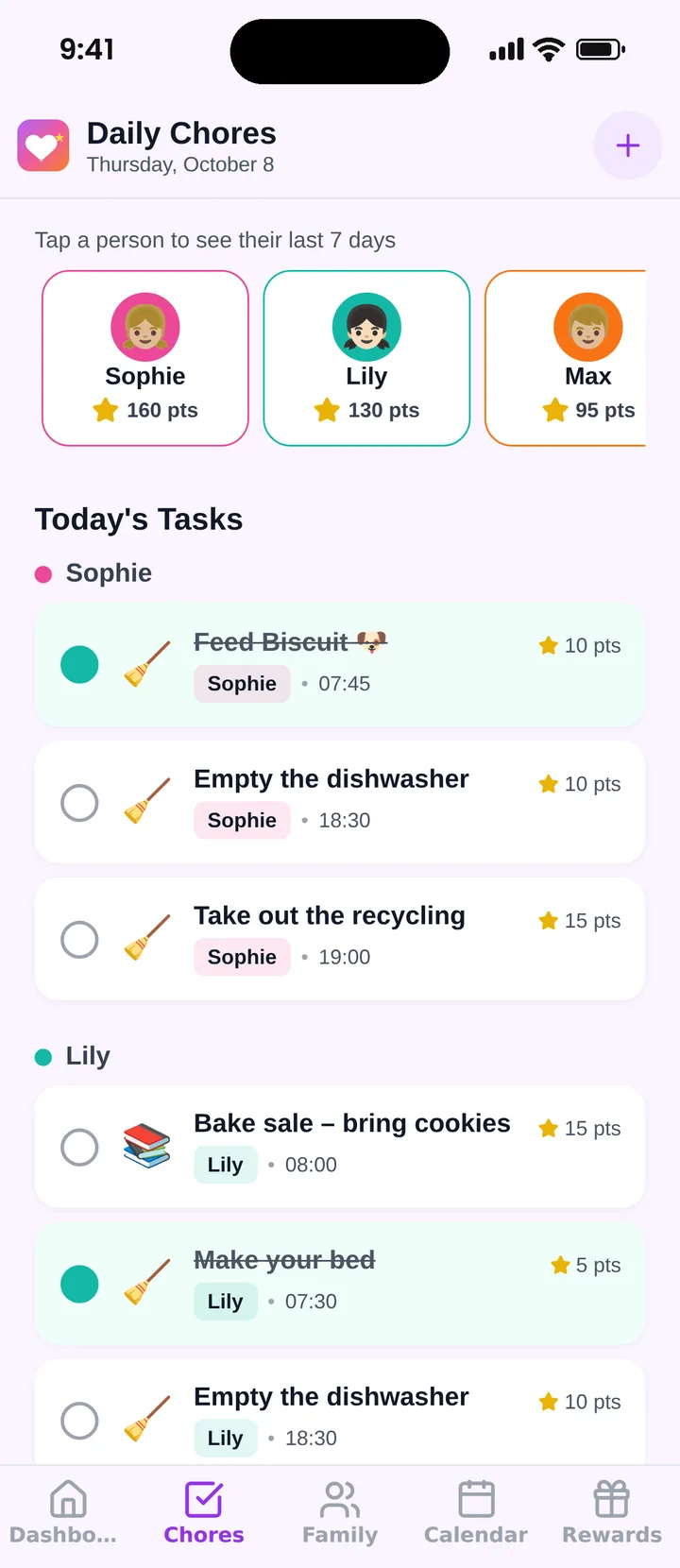
Famiyo is a free family app for iPhone and Android that combines a shared family calendar, chores with points and a rewards shop; kids join with a code, no email needed. To set a monthly job, add it as a chore, pick the child, and give it points, such as 20 for a big one. Each child can have their own number of points for the same task. The child gets a push notification about the new task, checks it off on their own phone (or you approve it, your choice), and you are notified when it is done. Points go toward rewards in the shop. See our list of the best chore apps for kids.
Choose one monthly job per child this week, write the steps on a card, and put the date on the calendar.
Frequently asked questions
What is a monthly chore for a kid?
A monthly chore is a larger job done about once a month, like sorting a toy bin, cleaning the bathroom mirror and tub, wiping baseboards or washing the car. It is separate from daily jobs such as making the bed.
How many monthly chores should a child have?
One or two a month is enough for most children, and one is plenty for ages 4 to 6. Pick the job by size, not by number. A single 30-minute job that is done well teaches more than five half-finished ones.
Should monthly chores earn more points or money?
Yes, bigger jobs usually deserve a bigger reward. A common guide is 20 points for a big job of 30 minutes or more, against 5 to 10 for daily tasks. If you pay money, a big extra job might be worth $2 to $5.
What age can kids start monthly chores?
From about age 4, with an adult working alongside. Wiping low shelves or sorting a drawer works as a first job. By 8 or 9 most children can take on a full monthly job with a short checklist and one check-in.
Try Famiyo With Your Family
Chores with points, a rewards shop for kids and one shared family calendar. Set it up in a couple of minutes.



Free to download • No credit card required • Available on iOS & Android