Summer Chores for Kids by Age: Keep Them Busy and Helpful
Summer chores for kids by age, from 2 to 14: what each age can do, how long it takes, and a simple weekly rhythm that keeps summer fun and the house running.
By Famiyo Editorial Team5 min read
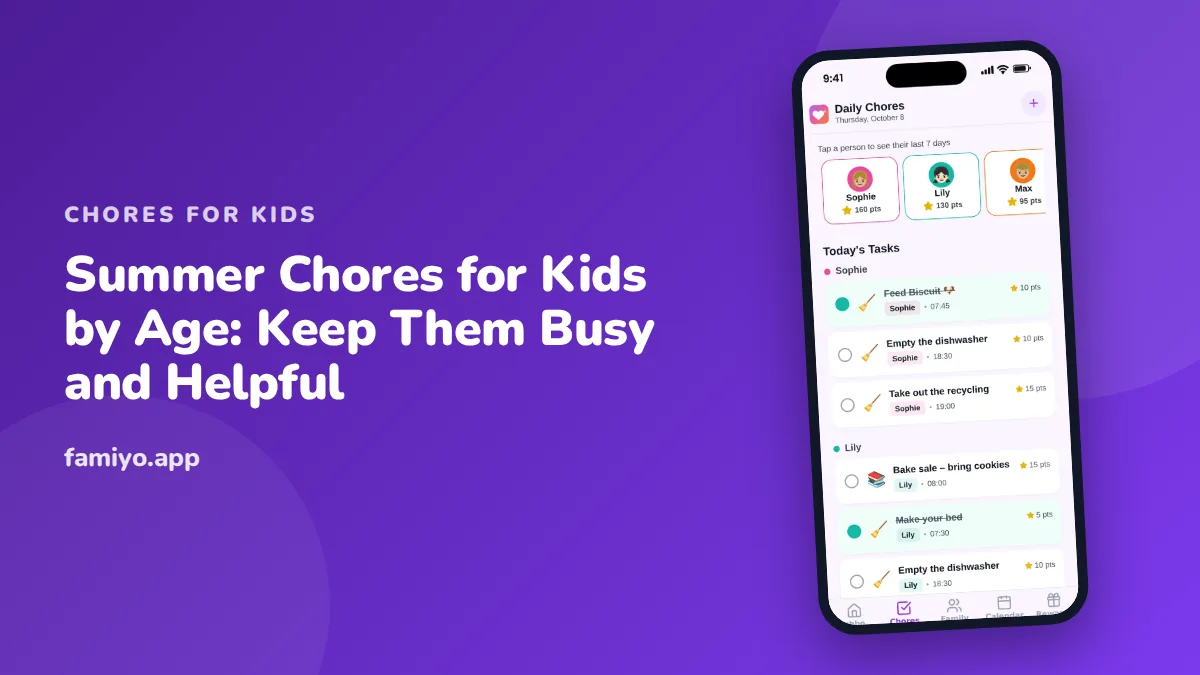
School ends, the routine disappears, and by day four someone is bored and someone else is eating cereal for dinner. Summer is a good moment to bring in chores, because there are more hours in the day and kids can take on jobs that school mornings never allowed.
Below is what each age group can reasonably do, how long it takes, and how to fit it into a week without ruining the vacation. Ages follow the usual developmental pattern: skills build on each other, so older kids keep the earlier jobs and add to them.
Chores for ages 2 to 5: small helpers
Little ones want to help, and summer gives them plenty of material. Time per day is about 5 to 10 minutes at ages 2 to 3 and 10 to 15 at 4 to 5. Keep jobs to a single step or two.
Ages 2 to 3
- Put toys back in a bin, including outdoor toys
- Put dirty clothes in the hamper (swimsuits and wet towels)
- Wipe up spills, including water from the sprinkler or a drink
- Help feed a pet, with your hand over theirs
Ages 4 to 5
- Water plants with a small can
- Set and clear their own place at the table
- Match socks and sort laundry by color
- Make the bed, roughly
- Carry their own bag and shoes to the door before an outing
- Feed a pet with measured food
Start with 2 or 3 tasks. If a 3-year-old struggles with tidying, our how to get a 3-year-old to clean up toys page gives a script.
Chores for ages 6 to 9: building independence
These kids can handle tasks with a clear finish line. Time per day is about 15 to 20 minutes at ages 6 to 7 and 20 to 30 at 8 to 9. From age 8, add one bigger weekly job.
Ages 6 to 7
- Sweep the porch or kitchen floor
- Empty unbreakable dishes from the dishwasher
- Sort laundry by color
- Tidy their room
- Water the garden and pick up fallen toys and sports gear
- Pack a bag for the pool or park the night before
Ages 8 to 9
- Load the dishwasher
- Fold and put away laundry
- Vacuum one room
- Make a simple snack
- Take out the trash and recycling
- Walk the dog with an adult or in a safe area
- Weekly big job: wash the outdoor furniture, clean the patio or pull weeds in one bed
For a deeper list, see our room-by-room guide to household chores for kids by age.
Chores for ages 10 to 12: real responsibility
Tweens can run a task from beginning to end. Time per day is about 30 minutes.
- Clean the bathroom sink and toilet
- Cook a simple meal with an adult nearby (pasta, tacos, eggs)
- Change their own bed sheets
- Wash the car, inside and out
- Wash their own swimsuits and towels, start to finish
- Care for a pet daily, including water and clean-up
- Rake, weed or water the whole garden
Summer is also a good time to let a tween run one dinner a week. Planning it, helping to shop and cooking it with an adult nearby gives a kind of confidence that a bathroom scrub never will. Our guide to chores for tweens goes further.
Chores for ages 13 and up: bigger jobs
Teens can handle most household work. Time per day is about 30 to 45 minutes.
- Do their own laundry from start to finish
- Cook a family meal
- Shop from a list
- Mow the lawn, with training and safety rules for the equipment
- Help with younger siblings
- Take on a larger project: paint a fence, clear the garage, organize the shed
Teens also have summer jobs, sports and sleeping in, so be realistic. Agree on a small fixed list and a time of day. Our daily chores for teenagers page covers it.
A sample summer week
Here is a simple rhythm. The aim is that jobs are done by about 10 a.m., and the rest of the day belongs to the kids.
| Day | Morning job (all ages, scaled by age) | Extra |
|---|---|---|
| Monday | Tidy room, feed pets | Water the garden |
| Tuesday | Tidy room, feed pets | Laundry day: sort, wash, fold |
| Wednesday | Tidy room, feed pets | Wipe down outdoor toys and table |
| Thursday | Tidy room, feed pets | Help plan and cook one dinner |
| Friday | Tidy room, feed pets | Wash the car or clean the porch |
| Saturday | Quick reset of shared spaces | Family yard time |
| Sunday | Rest, light tidy | Plan next week |
Set one rule that never changes: chores first, then play. It is easier to hold than a mood-based rule.
How to keep it going all summer
Most summer chore plans fade by the third week. A few things help.
- Start in the first week of vacation. The habit is hardest to start once the days have no shape.
- Write the list down. Put it where everyone sees it, or in an app.
- Keep it short. Cut the list rather than let it lapse.
- Pair chores with something kids like. "After chores, we go to the pool."
- Rotate big jobs. A summer project each week keeps it from feeling the same.
- Praise specifically. "The porch looks great, you got right into the corners."
A shared plan across the family also helps. See our chore schedule for the family for one way to set it up.
Doing summer chores with Famiyo
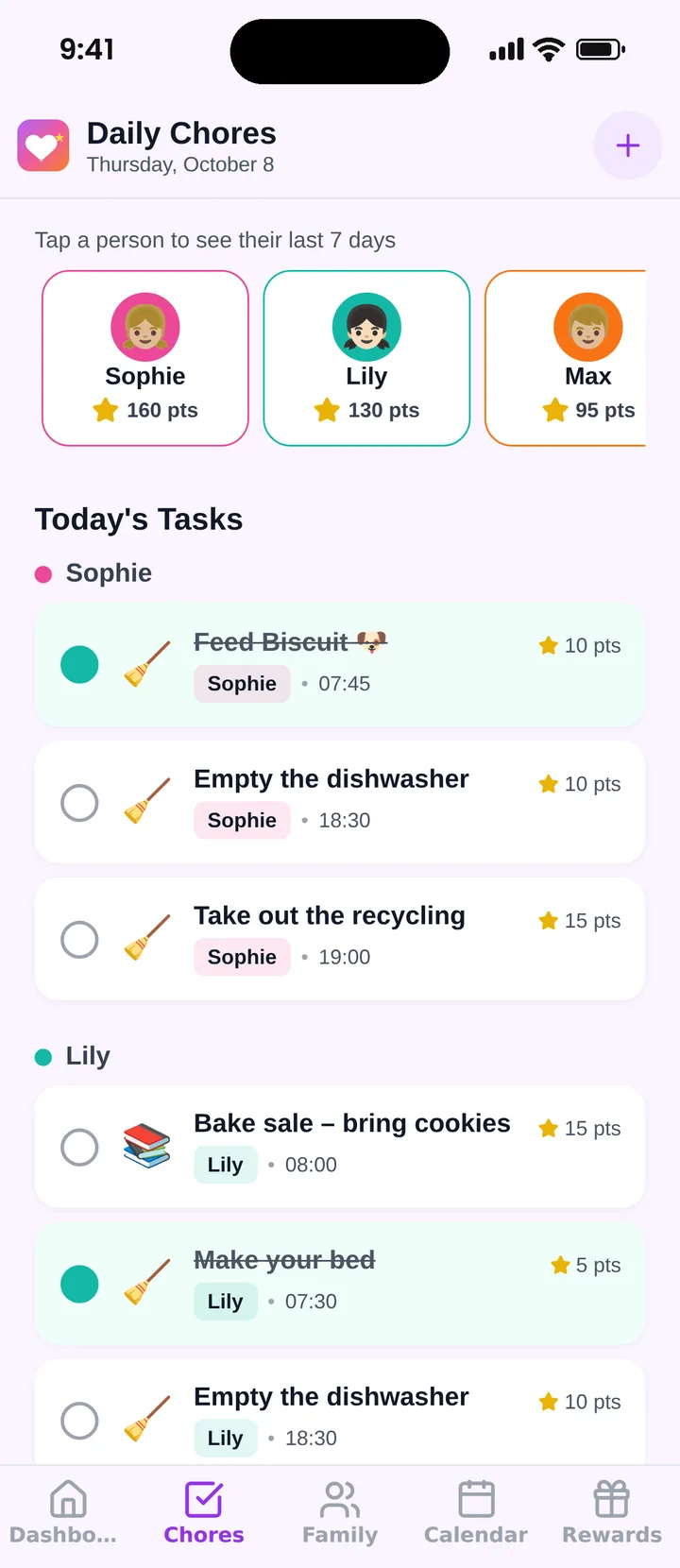
Famiyo is a free family app for iPhone and Android that combines a shared family calendar, chores with points and a rewards shop; kids join with a code, no email needed. You assign age-right chores to each child, set the points for each one and decide whether kids check them off themselves or a parent approves. Each child sees their own list on their own phone and hears about new tasks through push notifications, while you see when a chore is done. Points can go toward summer rewards you set, like a pool day or a family movie pick. Our list of the best chore apps for kids compares the options.
Pick your list tonight
Choose three jobs per child from the right age group above, set a start time before the day gets going, and tell them what happens after the last job is done. Run it for two weeks and adjust.
Frequently asked questions
How many chores should kids have in summer?
Use the same amount as the school year, based on age: 2 to 3 daily tasks for preschoolers and 3 to 4 for school-age kids, plus one bigger weekly job from age 8. Summer gives more time, but it is not a reason to add many more.
What are good outdoor summer chores for kids?
Watering plants, picking up toys and sports gear, sweeping the porch, weeding a small bed, washing the car, raking and, for older kids, mowing the lawn. Match the tool and the job to the child, and supervise anything with blades or chemicals.
When in the day should summer chores happen?
Mornings work best, before the heat and before screens or friends. A simple rule, such as 'chores first, then play', keeps it short. Fifteen to forty-five minutes covers most ages.
Should kids get paid for summer chores?
Keep daily jobs unpaid and consider small payments only for clearly extra summer projects, such as washing the car or clearing the garage. Typical amounts are $0.25 to $1 for small extras and $2 to $5 for big ones.
How do I keep summer chores from turning into daily arguments?
Fix the time and the order, write the list down, and stay the same every day. Fewer, clearer jobs beat long lists. If chores slide by week three, shorten the list instead of dropping it.
Try Famiyo With Your Family
Chores with points, a rewards shop for kids and one shared family calendar. Set it up in a couple of minutes.



Free to download • No credit card required • Available on iOS & Android