Montessori Chores by Age: Practical Life at Home
Montessori chores by age from 2 to 12: what a child can do alone, the child-sized tools that make it possible, and how to teach each task without nagging.
By Famiyo Editorial Team5 min read
Montessori chores sound lovely on paper. A toddler pours water from a tiny glass pitcher, a six-year-old folds napkins, everyone is calm. In real homes the pitcher breaks and somebody is hungry. This page gives you the age-by-age list and the practical setup behind it, including what to expect when the plan meets your Wednesday.
What makes a chore "Montessori"
Three ideas do most of the work. The task is real (a real broom, a real sponge, real carrots). The tools are sized for the child, so a small hand can succeed. And the adult teaches the steps once, slowly, then gets out of the way.
That last part is the hard part. If you hover and correct the corners of the bed, the child learns that the job is yours. Montessori calls this area practical life, and it covers caring for yourself, caring for the space you live in, preparing food, and basic courtesy. The list below follows those four areas.
Montessori chores by age
Ages are a guide. A child who has done pouring for a year is ready for more than a child who just started. The time per day figures are typical for each age group.
| Age | Care of self | Care of the home | Food | Time per day |
|---|---|---|---|---|
| 2 to 3 | Put clothes in the hamper, wash hands, try pulling on pants | Put toys in a bin, wipe up spills, water a plant with a small can | Carry a plate to the counter, pour from a small pitcher, spread soft butter | 5 to 10 minutes |
| 4 to 5 | Dress with minimal help, brush hair, make the bed roughly | Dust low shelves, sweep with a child broom, match socks, feed a pet | Set and clear their own place, wash vegetables, peel a banana or mandarin | 10 to 15 minutes |
| 6 to 7 | Pack the school bag, tidy their own room | Sort laundry by color, empty unbreakable dishes, sweep and use a dustpan | Make a simple snack, cut soft foods with a blunt knife | 15 to 20 minutes |
| 8 to 9 | Pick their own clothes, change their sheets with help | Load the dishwasher, fold and put away laundry, vacuum one room, take out the trash | Make a simple snack alone, help with a family meal | 20 to 30 minutes |
| 10 to 12 | Manage a weekly plan for homework and activities | Clean the bathroom sink and toilet, wash the car, change bed sheets | Cook a simple meal with an adult nearby | 30 minutes |
If your child is in the toddler stage, our guide to Montessori chores for toddlers goes deeper on setup for ages 1 to 3.
The setup does half the teaching
A prepared environment just means the child can reach what they need. You do not need a Montessori shelf from a catalog. A few changes cover most of it:
- A low hook for the coat and a low bin for shoes.
- A step stool at the sink, so hand washing is possible without a lift.
- A small broom, dustpan and sponge kept where the child can grab them.
- Cups and plates at their height in a lower drawer or on a low shelf.
- A small pitcher or jug for water, and a cloth that stays within reach.
Nothing here costs much. A cheap hand broom works as well as a branded one.
How to present a new task
Montessori teachers show a task before they ask for it. It works at home too.
- Pick a calm moment, not the minute before you leave.
- Gather the tools together and say the name of the job once.
- Do the task slowly and silently, one step at a time, so the child watches your hands and not your face.
- Invite them to try. Give no instructions unless they ask.
- Let the mistakes stand. Water on the floor is a task they can handle with the cloth.
- Show it again a few days later if they lose the thread.
Silence feels odd at first. It does make a difference, because kids copy hands better than they follow words.
What the honest version looks like
Some days a four-year-old will happily sweep for ten minutes. Other days the whole plan collapses at 5:30 pm because everyone is tired and hungry. That is normal. Keep the jobs small, do the same ones at the same time (after breakfast, before dinner), and drop to one task on rough days.
Do not expect Montessori kids to be eager every day. They are still kids. What the method gives you is a child who knows how, has the tools, and sees chores as part of living there. For older children the expectations build, and our guide on kids' responsibilities at home shows what to ask for by age. Teenagers move to a different gear, which we cover in household chores for teenagers.
Tracking without turning it into a reward chart
Pure Montessori skips stickers and prizes. Many families still want a simple record, especially once there are three or four jobs. A small checklist is enough, and it works best when it shows the job rather than a prize: a picture of a broom, a box to tick. If you want to set up a visual routine, see our daily chore chart for kids. Keep it light, and stop using it if it starts to feel like a contest.
Where an app can help with the reminding
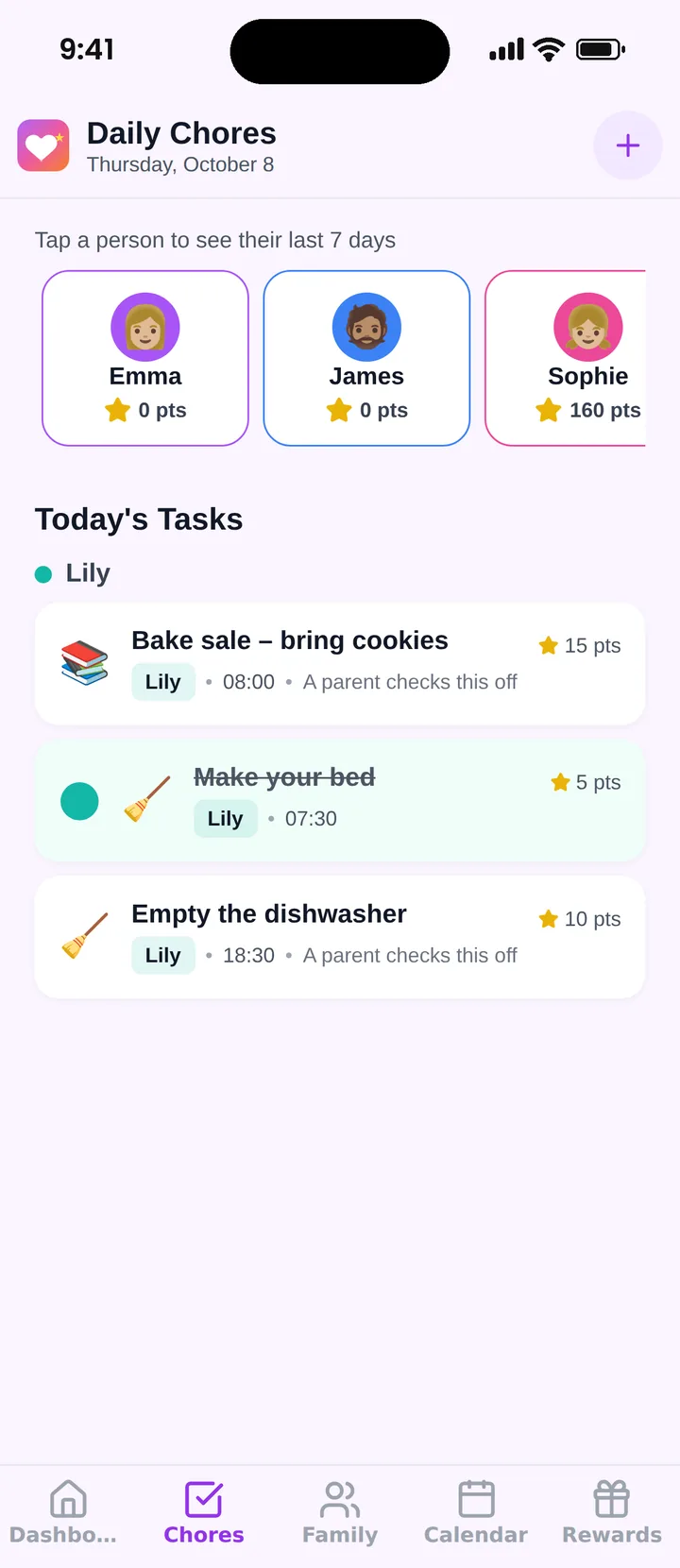
Famiyo is a free family app for iPhone and Android that combines a shared family calendar, chores with points and a rewards shop; kids join with a code, no email needed. Once a child is old enough for a phone, each chore you set up repeats on its own, and the child hears about new tasks through a push notification instead of hearing it from you again. They see only their own jobs and check them off themselves, or you can choose to approve them. Points are optional, so you can leave them out if you prefer the Montessori approach. See the best chore apps for kids for how the options compare.
Pick one job from the table that matches your child's age and teach it this week. Add the second one when the first no longer needs you in the room.
Frequently asked questions
What is practical life in Montessori?
Practical life means everyday tasks like pouring, washing, sweeping, dressing and preparing food. Children do them with real, child-sized tools. The goal is independence and concentration, so the job matters more than the polish of the result.
Do Montessori kids get rewards for chores?
Traditionally, no. Montessori holds that helping is its own reward and that children want to contribute. Many families still add a light tracking system for older kids, and that works fine as long as the task stays meaningful.
How do I start Montessori chores at home?
Pick one job, put the tools where your child can reach them, then show the task slowly without talking. Let them try, step back and resist fixing it. Add a second job only after the first one feels routine.
Should a Montessori child be made to do chores?
Montessori leans on invitation and a prepared environment rather than force. In practice, most families also set clear expectations: some jobs are simply part of the day. Calm routines and easy access do most of the work.
Try Famiyo With Your Family
Chores with points, a rewards shop for kids and one shared family calendar. Set it up in a couple of minutes.



Free to download • No credit card required • Available on iOS & Android