Daily Chore Chart for Kids: Free Printable by Age
A free printable daily chore chart for kids, with sample daily routines for ages 4 to 13, point values, and how to keep it going past the first week.
By Famiyo Editorial Team4 min read
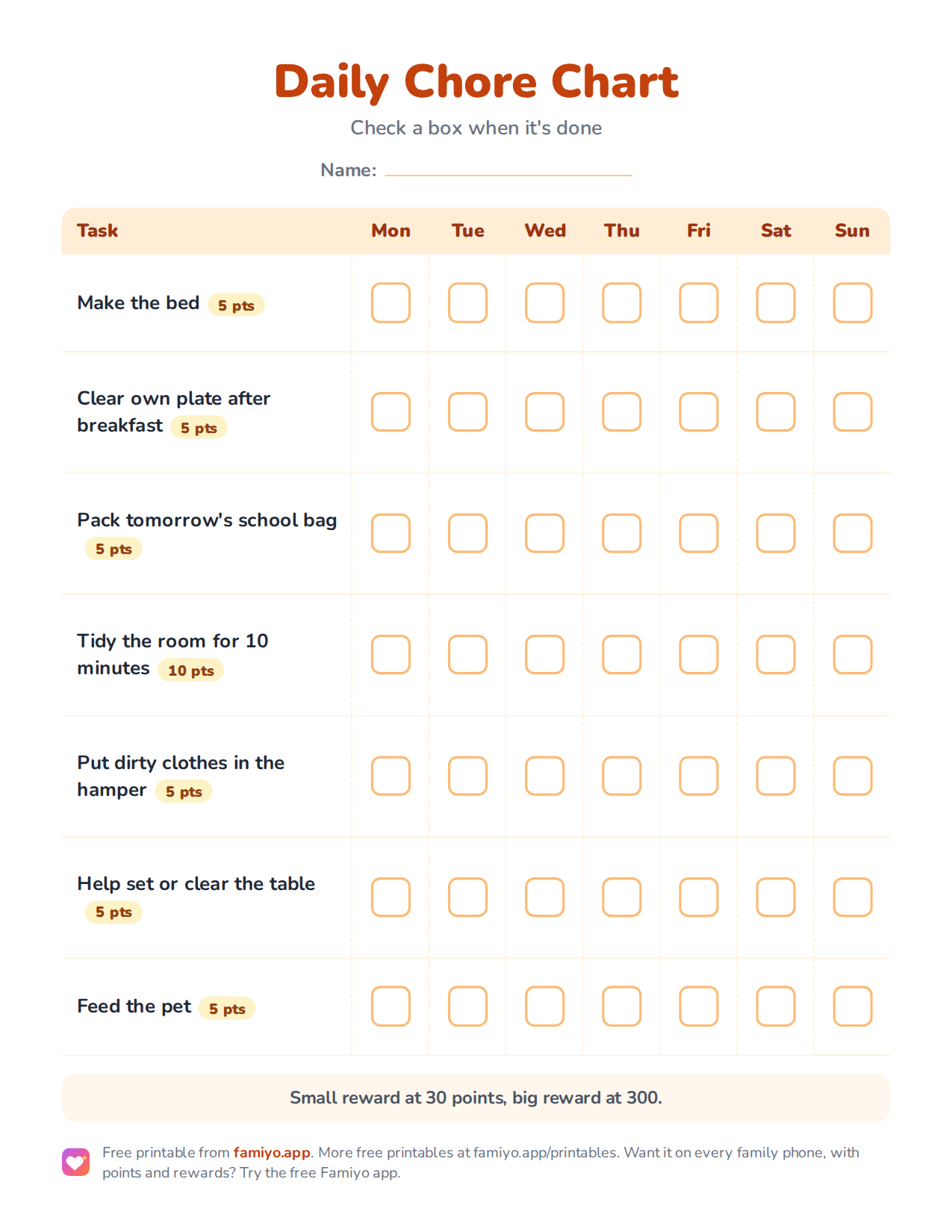
Free printable
Daily Chore Chart
A weekly chart on one US Letter page. Download the PDF to print it, or save the image to use it on a tablet or in a document.
Free for home, classroom and nonprofit use, see the license. More free printables.
A daily chore chart only works when it is small and boring enough to repeat. Below you will find a printable grid, sample daily routines for four age groups, and a simple way to attach points. Take what fits your child and delete the rest.
What a good daily chart looks like
It is short. It is visible. It repeats the same tasks, at the same time, in the same order. That predictability is the whole trick, since a child who knows the sequence stops asking "what do I have to do now?"
A few rules keep a chart workable:
- Two to three tasks for preschoolers, three to four for school-age kids.
- Total time within the range for their age (see the table below).
- One anchor per task, such as "after breakfast" or "before screens".
- Weekly jobs live elsewhere. Our daily, weekly and monthly chore checklist shows how to separate them.
Daily chart ideas by age
The time column is the total you should expect per day. Points use the default scale of 5 for a small task, 10 for a medium one and 20 for a big one.
| Age | Daily tasks | Points per day | Time |
|---|---|---|---|
| 4-5 | Make the bed (roughly), clear own plate, feed the pet | 15 | 10 to 15 minutes |
| 6-7 | Make the bed, pack the school bag, tidy the room, set the table | 25 | 15 to 20 minutes |
| 8-9 | Make the bed, empty the dishwasher, take out the trash, homework space tidy | 30 | 20 to 30 minutes |
| 10-12 | Make the bed, load the dishwasher, 10-minute room reset, one house job | 35 | 30 minutes |
Teens can run a chart too, but a shorter list works better. Two jobs that they own completely beat six that they argue about.
A sample day for a 7-year-old
This is how the same chart looks when you hang it on a day.
- Wake up, make the bed (5 points)
- After breakfast, put the bowl in the dishwasher (5 points)
- After school, pack tomorrow's school bag (5 points)
- Before dinner, tidy the room for 10 minutes (10 points)
- After dinner, clear the table with a parent (5 points)
That is 30 points and about 20 minutes. Notice there is nothing on it a 7-year-old cannot do alone once shown. If a task needs you standing nearby every time, it belongs on the weekly list for now.
The printable chart
The printable below has chore rows and a box for every day from Monday to Sunday, with a point value next to each task. It suits ages 5 to 9 as written. Cross out and rewrite the tasks for older or younger kids, and print a fresh one each week so there is no guilt about a messy old page.
Post it at the child's eye level near where the tasks happen, often the kitchen or the bedroom door. If your kids need pictures instead of words, our editable chore chart for kids lets you change every item.
How to keep a daily chart going
Charts usually die in week two. A few habits help.
Check it together at the same time each evening, for under a minute. Say "Show me what's checked," not "Did you do your chores?" Skip the lecture on unchecked boxes. Say "That one's still open, you can finish it before dinner tomorrow" and move on.
Start with fewer tasks than you think. You can always add one in week three. If you are fighting daily, step back and read how to get kids to do chores without yelling before changing the chart.
Give a bonus of 2 points for a task done without a reminder. It rewards the behavior you really want.
Running the daily chart in Famiyo
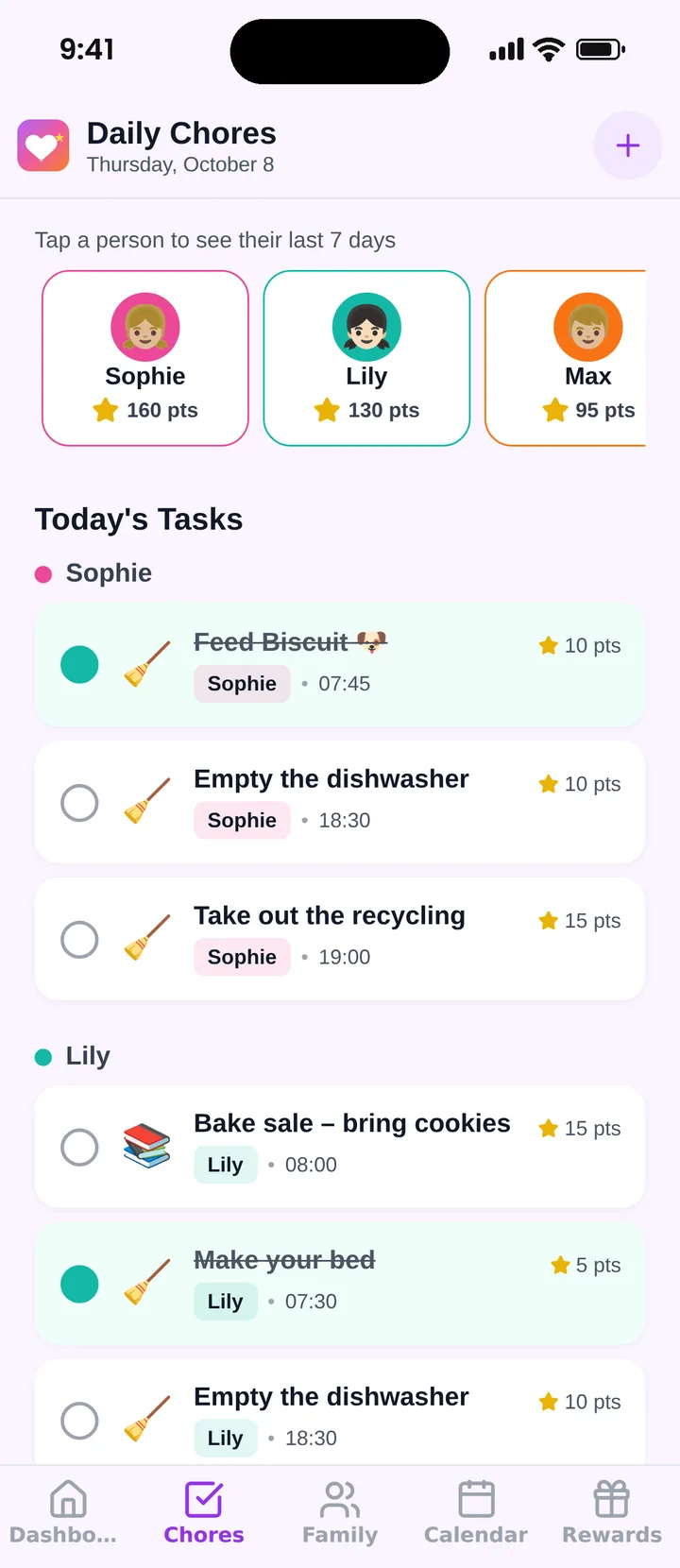
Famiyo is a free family app for iPhone and Android that combines a shared family calendar, chores with points and a rewards shop; kids join with a code, no email needed. A daily chart becomes a repeating chore: you create the task once, choose who does it and set the points, and it comes back every day. Each child sees their own list on their phone, and checks tasks off themselves, or you approve them first. Kids get a notification about new tasks, and you hear when one is done. The free plan includes 1 repeating task; Premium removes that limit. See how it compares in our list of the best chore chart apps.
Morning, after school and evening
If one long list feels heavy, split the day into three short blocks. Morning is for the bed and the clothes hamper. After school is for the bag, the snack plate and any pet care. Evening is for the table and a ten-minute tidy. Three blocks of two minutes feel lighter to a child than one list of seven items, even though the total is the same.
When to change the chart
If every box is ticked for three weeks, add one task or raise the time slightly. If boxes are blank on school days, the list is too long for the morning or the tasks have no anchor. Cut it in half before blaming the child.
Frequently asked questions
How many chores should be on a daily chore chart?
Two to three daily tasks for preschoolers and three to four for school-age kids is plenty. If the chart takes longer than the time listed for their age, it is too long, and kids stop checking it.
What should a daily chore chart include?
Include the tasks that happen every day: making the bed, putting clothes in the hamper, clearing their dish, tidying the room, and packing the school bag. Weekly jobs such as vacuuming belong on a separate weekly list.
Should a daily chore chart have rewards?
It helps for the first few weeks. Give each task a few points and let kids trade them for small rewards. A bonus of 2 points for finishing without a reminder rewards independence rather than just compliance.
What time of day should kids do their daily chores?
Tie chores to something that already happens at a fixed time, such as before breakfast or right after school snack. Fixed anchors beat a general promise to do it later, which usually turns into nagging.
Try Famiyo With Your Family
Chores with points, a rewards shop for kids and one shared family calendar. Set it up in a couple of minutes.



Free to download • No credit card required • Available on iOS & Android