How to Teach Kids to Do Chores Step by Step
How to teach kids to do chores in 7 steps: show it, do it together, define done, use a checklist, fix mistakes calmly, and let go. Scripts and examples included.
By Famiyo Editorial Team4 min read
Most chore battles aren't about attitude. They're about a child who was told to "clean the bathroom" and had no idea what that meant. Teaching a chore takes more time than doing it yourself, and the first week will test you. Here is the whole process in order, with words to say, followed by what to do when it all goes sideways on a Wednesday.
Step 1: Choose one chore your child can actually do
Start with a job at the right level, not the one that annoys you most. Our rule of thumb is 2 to 3 daily tasks for preschoolers and 3 to 4 for school-age kids.
| Age | Good first chores |
|---|---|
| 2-3 | Toys in a bin, clothes in the hamper, wipe a spill |
| 4-5 | Set and clear their place, water plants, feed a pet with you |
| 6-7 | Sort laundry by color, sweep, pack the school bag |
| 8-9 | Load the dishwasher, take out the trash, fold and put away laundry |
| 10-12 | Clean the bathroom sink and toilet, change bed sheets |
| 13+ | Do their own laundry start to finish, cook a family meal |
For laundry in particular, how to teach kids to do laundry breaks the skill into stages.
Step 2: Write down what done looks like
"Clean your room" is a fog. "Clothes in the hamper, toys in the bin, bed pulled up, books on the shelf" is a finish line. Kids can only hit a target they can see.
Keep the list to 3 to 5 items. For kids who can't read yet, take a photo of the room when it's right and tape it up. The photo settles the argument about "clean enough" before it begins.
Step 3: I do, you watch
Do the chore at normal speed, but out loud. "First I take everything off the table. Then I wipe with the damp cloth, side to side. Then I check the edges." Skip the sighs and the "this is so annoying" commentary. They learn that too.
Ten minutes of this beats a week of reminders. For young children, shorten the demonstration to one or two steps.
Step 4: We do it together
Now share the work. Your child does the easy parts, you do the tricky ones. Over three or four sessions, shift more of it to them. Hand over the cloth, then the whole table, then the whole kitchen.
Stay positive and specific. "You got the corners, that's the part most people miss" beats "good job." If you're tempted to grab the cloth and finish, count to five and sit on your hands.
Step 5: You do it, I stay close
This is the shaky stage. Let your child do the entire chore while you're in the next room, close enough to answer a question but not to take over. Don't hover. Don't fix anything the moment they finish.
When it's done, check it against the list from Step 2 and say two things: what was right, then one thing to adjust. "The bed looks great. One more try on the pillow, it's upside down." Then leave it. If the pillow stays upside down once, nothing bad happens.
Step 6: Fix mistakes without taking over
Mistakes are the lesson, so handle them with care.
- Say what went well first. Mean it.
- Show the single thing to change, once, with your hands if you can.
- Let them redo that part.
- If it's close, leave it. Good enough is the target at first.
- Never redo the chore while they watch. It tells them their work didn't count.
If a child fails the same step three times, don't conclude they're lazy. The job may be too big, or the steps unclear. Split it smaller. And for the kid who flatly won't start, see what to do when your child refuses to do chores.
Step 7: Make it routine, then add the next one
Chores stick when they're tied to a moment: after breakfast, before screens, right after school. Give a new chore two to three weeks of steady use before you add anything. Then add the next, with the same steps.
A few things keep the routine alive:
- Same time, same place, every day.
- A visible list or chart, not your memory.
- Thanks, and rewards if you use them, for regular jobs. Points and prizes are covered in how to motivate kids to do chores.
- Your own jobs done too. Kids notice who works.
For the attitude side, such as spontaneous kindness, see how to teach kids to be helpful.
What this looks like in a week
Say your 7-year-old is learning to empty the dishwasher. Monday and Tuesday you do it together, with you handing plates and naming where they go. Wednesday they do the bottom rack alone while you chop vegetables. Thursday, the entire thing, and you check it against three items: cups on the shelf, plates in the stack, forks in the drawer. Friday it's slightly off and you show one fix. By week two it's theirs, and you add feeding the dog.
Getting the app to do the reminding
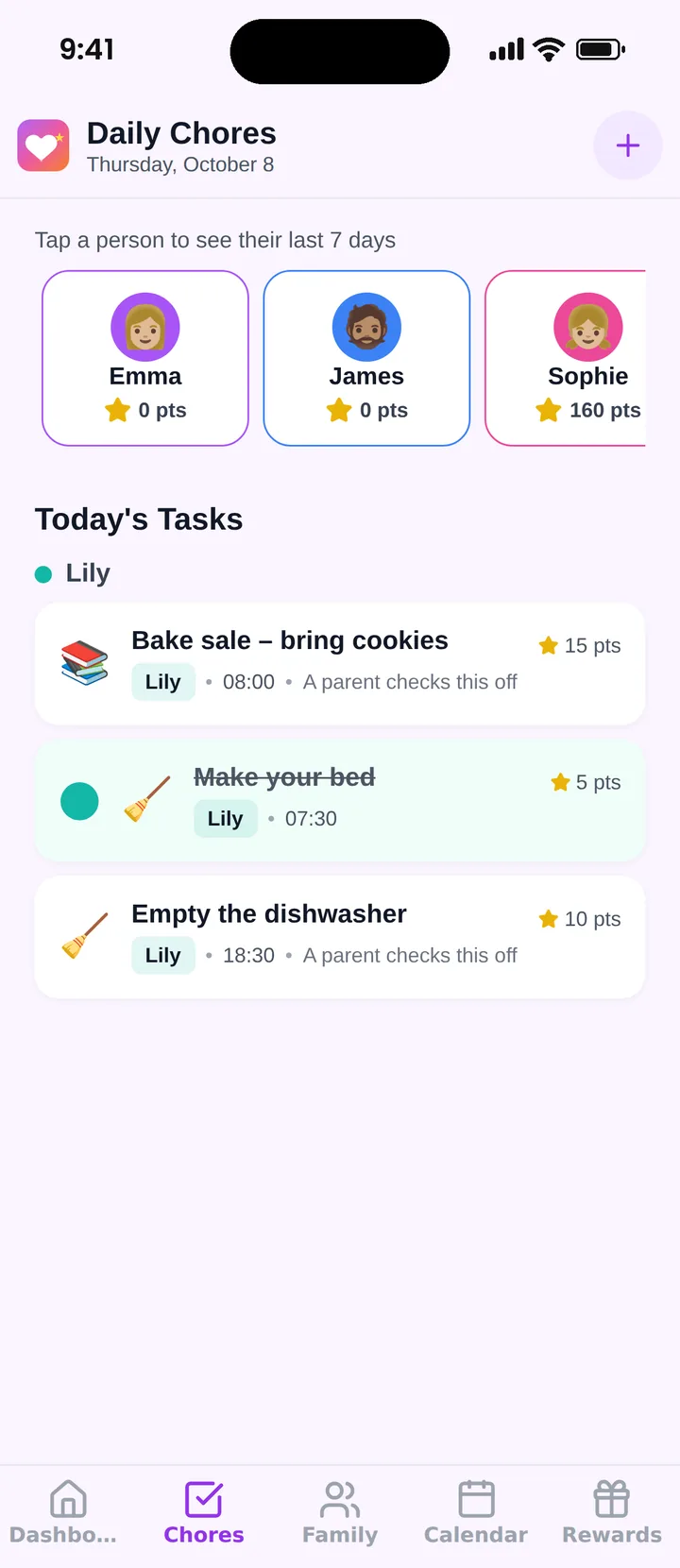
Famiyo is a free family app for iPhone and Android that combines a shared family calendar, chores with points and a rewards shop; kids join with a code, no email needed. Once a chore is taught, the reminder is what usually fails, and that's where it helps. Add the chore, set it to repeat, and give it points. Your child hears about each new task by push notification, checks it off on their own phone (or waits for you to approve it), and you hear when it's done. A bonus of 2 points for doing it without a reminder rewards independence. For comparisons, see our best chore apps for kids.
One thing to do tonight
Choose one chore, write three lines on what done looks like, and plan a 10-minute "I do" session for tomorrow.
Frequently asked questions
How do I teach my child a new chore?
Pick one chore and break it into steps. Do it while they watch, do it together, then let them try while you stand by. Say what done looks like in plain words, and thank them for the effort before you point out anything to fix.
How long does it take for a child to learn a chore?
Plan on about 2 to 3 weeks of regular practice for a simple job, longer for multi-step ones like laundry. Expect uneven results at first. A chore is learned when the child does it mostly right without you standing next to them.
How many chores should I teach at once?
One. Add the next only when the first is routine. Overall, aim for 2 to 3 daily tasks for preschoolers and 3 to 4 for school-age kids, then add a weekly bigger job from about age 8.
What do I do when my child does a chore badly?
Resist redoing it in front of them. Say what went well, then show the one thing to change, and let them fix it. If it's still off after a few tries, the job may be too hard or the steps unclear. Break it down further.
Try Famiyo With Your Family
Chores with points, a rewards shop for kids and one shared family calendar. Set it up in a couple of minutes.



Free to download • No credit card required • Available on iOS & Android