How to Get Toddlers to Help With Chores
Toddlers want to help, then suddenly don't. Here is how to use that window: tiny real jobs, the right tools, exact words to say, and what to do when they refuse.
By Famiyo Editorial Team5 min read

Around the age of two, many children suddenly insist on holding the broom, pushing the vacuum and carrying the groceries. Then, somewhere near the third birthday, the same child lies on the kitchen floor because you asked for a sock. Same kid, same job. The difference is mostly timing and setup, and you can change both. Here is what toddlers can do, a way to ask that works, and what to do when it doesn't.
Use the helper window while it's open
Between roughly 18 months and 3 years, helping is a game to your child, because it means doing what you do. That is the easiest moment you will ever have to build the habit. It is also messy. The floor will get wetter, the laundry will get wrinkled, and a job that takes you 20 seconds will take them four minutes.
So lower the bar first. The goal at this age is not a clean house. The goal is a child who thinks "we all pitch in here" is normal. If you can live with a slightly crooked set of napkins, you are already doing this right.
Jobs a toddler can do, with the tool to hand over
Pick jobs that are real, visible and over quickly. Toddlers lose interest in anything with no clear end. A tool their size makes a big difference.
| Job | What they do | Give them |
|---|---|---|
| Laundry | Drop clothes in the hamper, move damp towels to the dryer | A low hamper or open basket |
| Spills | Wipe the table or floor after a spill | A small cloth, not a paper towel |
| Dishes | Put plastic cups and spoons away, carry their own plate | A low drawer they can reach |
| Pets | Scoop dry food with you, fill the water bowl a little | A small cup with a line drawn on it |
| Plants | Water one plant | A small watering can, filled by you |
| Groceries | Carry a light item, put a box on a low shelf | A cloth bag of their own |
| Mail and trash | Carry the paper to the recycling bin | A small bin at their height |
Two or three of these in a day is plenty. For the toy side of tidying, which has its own tricks, see how to get toddlers to clean up their toys.
How to ask so a toddler says yes
A toddler hears "Can you help me?" and answers truthfully: no. Try a different pattern.
- Do the job yourself first, in front of them, and narrate it in a few words. "Spoons go in here."
- Hold out the object and name the one action. "Spoons in the drawer, please."
- Stay beside them. Your presence is half the motivation.
- Let them finish, even if it is wrong. Do not move the spoons while they watch.
- Name what they did. "You put every spoon in. That helped."
The sentence matters less than the shape. Short, one action, said as a plain statement and not a question. A choice also helps when you hit a wall: "Do you want to carry the towels or the socks?" Both options are the chore, and both end the same way.
What backfires
A few habits quietly kill a toddler's interest.
- Redoing it in front of them. If the cup goes in the wrong spot, move it later when they are asleep or busy.
- Making it a lesson. "This is how a good helper does it" is too much talk for a two-year-old.
- Turning it into a deal. "Help me now and you can have a cookie" teaches them that help costs something.
- Starting at the wrong time. A job right before lunch or nap is a job during a meltdown.
- Asking for a long task. Fifteen minutes of folding is a toddler's idea of punishment.
It will still go wrong on some days. A child who helped fine on Monday may flatly refuse on Wednesday, and nothing you did caused it. That is normal for the age.
Tie each job to something that already happens
Toddlers run on routine. A job that happens right after something they already know needs no argument, because it is just what comes next.
- After breakfast, the plate goes to the counter.
- After a bath, the towel goes in the hamper.
- Before the bedtime story, the pajamas come out of the drawer with you.
- When you get home, shoes go on the mat.
Pick two anchors and keep them for two to three weeks before adding a third. Say the same words each time. After a while the sentence itself becomes the prompt, and you will catch yourself with a child who walks to the hamper before you open your mouth.
When your toddler says no
Start by checking the boring causes: hungry, tired, or pulled away from something they love. If the answer is yes to any of those, drop the job and try tomorrow.
If they are simply refusing, keep calm and keep it small.
- Offer the two-job choice once. If that fails, do the job yourself and say, "That's okay. We'll do it together tomorrow."
- Never pull a screaming child through the job. They learn that chores mean a fight.
- Narrow it. "Just one sock" is a job a toddler can win.
- Let them watch. A child who sees you do the task while they sit nearby is still learning it.
If this is a pattern, not a bad Wednesday, look at how many jobs you have asked for and whether any of them are too hard. Most of the time the cure is fewer jobs, not firmer ones. Once your child is around 4, you can add more; our list of chores for 4-year-olds shows what to add and in what order.
When a toddler needs a reminder that isn't you
For a 2-year-old, you are the reminder. By 4 or 5 you probably want a prompt that isn't your voice, because nagging is the thing that turns chores into a fight. That is where a chart or an app can help, and our guide to a kids chore tracker explains how.
Doing this with Famiyo
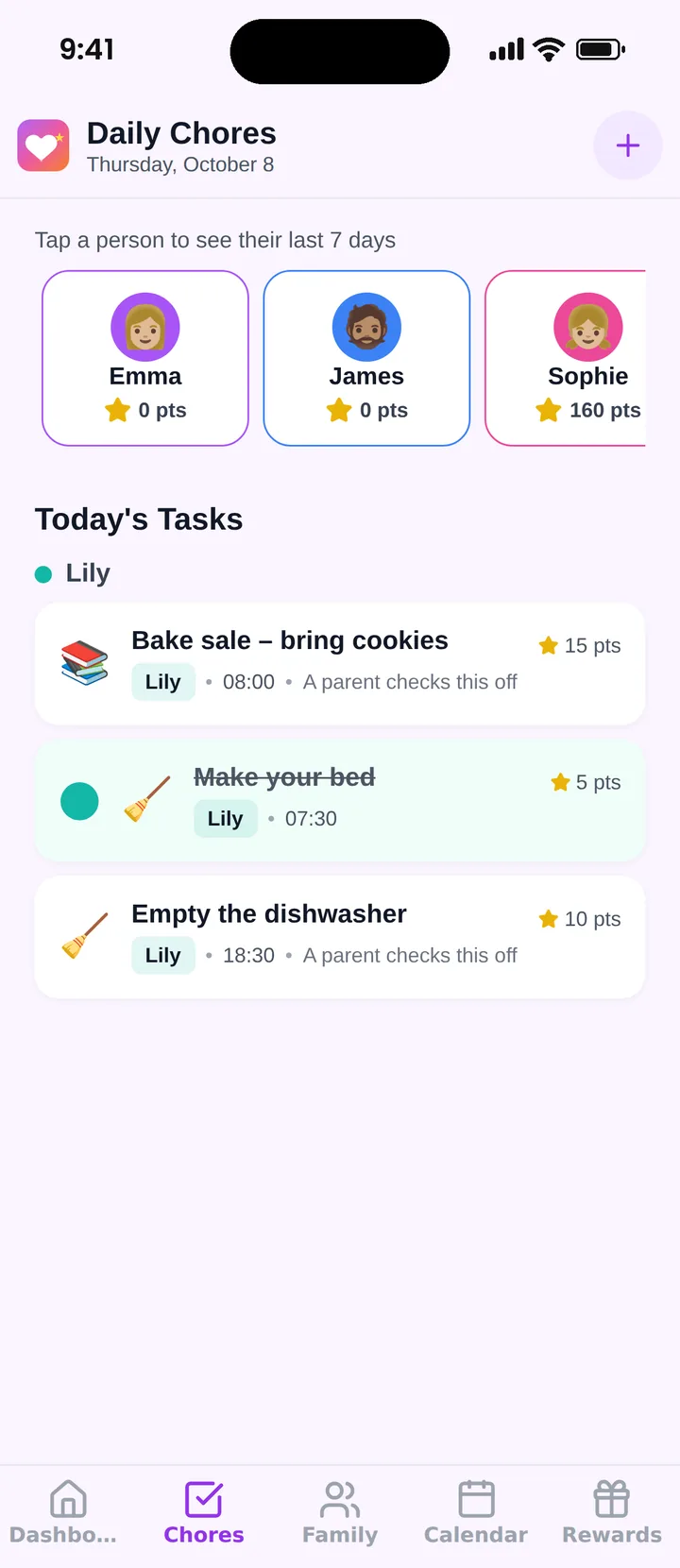
Famiyo is a free family app for iPhone and Android that combines a shared family calendar, chores with points and a rewards shop; kids join with a code, no email needed. For an older toddler or young preschooler, you can add one daily repeating chore, such as "towel in the hamper", and give it a few points. The app sends a push notification to your child's phone when the task comes up, so the reminder comes from the phone and not from you, and you get a notification when it is checked off. You choose whether your child ticks it or you approve it. See our list of the best chore apps for kids.
Before then, none of this needs an app. Pick one job and one anchor moment, and start tomorrow.
Frequently asked questions
What age can toddlers start helping with chores?
Many children want to help from around 18 months, and they can carry a cloth, drop laundry in a hamper or put a spoon in a drawer. Treat it as practice with you beside them, not as a job you can hand off.
Why does my toddler help one day and refuse the next?
Toddlers are testing independence, and their mood, hunger and sleep change fast. A flat no is often about being told, not about the task. Offer a choice between two jobs, and let the refusal go on the days it will not budge.
Should I pay or reward a toddler for chores?
Not at this age. Specific thanks and a predictable next thing, like a book or a snack, do the work. Points and rewards start to mean something closer to ages 4 and 5, when a child can wait a few days for a prize.
How long should a toddler help with chores each day?
About 5 to 10 minutes in total for ages 2 to 3, split into two or three tiny jobs. If you are past 10 minutes and the mood is sinking, stop. Short and successful beats long and fought over.
Try Famiyo With Your Family
Chores with points, a rewards shop for kids and one shared family calendar. Set it up in a couple of minutes.



Free to download • No credit card required • Available on iOS & Android