Family Chore Chart: One Chart for Everyone (Free Printable)
A free family chore chart for the whole household, parents included: how to set it up, a sample week for four people and a printable weekly grid.
By Famiyo Editorial Team4 min read
Free printable
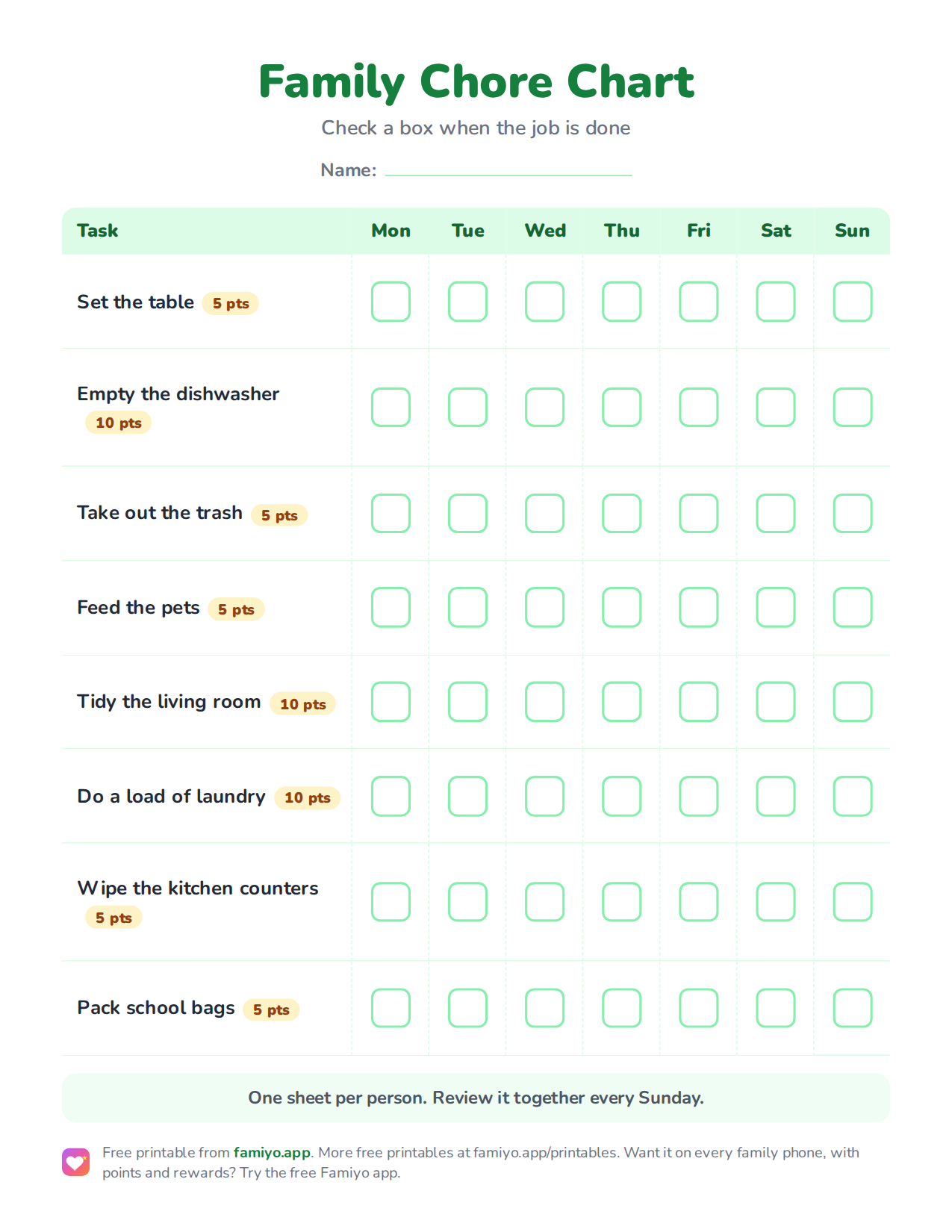
Family Chore Chart
A weekly chart on one US Letter page. Download the PDF to print it, or save the image to use it on a tablet or in a document.
Free for home, classroom and nonprofit use, see the license. More free printables.
One chart for the whole house sounds like extra work until you try it. When every person's jobs sit side by side, the arguments about who did what mostly disappear, because the answer is on the wall. Below is how to build one, a sample week for a family of four and a printable grid you can fill in tonight.
What goes on a family chore chart
Start with the house, not the kids. Walk through the day and write down every recurring job, including the boring ones adults do without thinking: bins, bills, school forms, wiping counters, restocking toilet paper. Most families come up with 20 to 30 jobs.
Sort them into two piles.
- Daily: dishes, trash, tidying shared rooms, pet care, packing school bags.
- Weekly: laundry, bathrooms, vacuuming, bins to the curb, grocery run, yard.
Now give each person their share. Age sets the limits. A 5-year-old can set the table and water plants, a 9-year-old can load the dishwasher and fold laundry, and a 13-year-old can do their own laundry start to finish or cook a family meal. For the full list by age, see our guide to chores for tweens.
How many jobs for each person?
A rule of thumb that works for most homes: 2 to 3 daily tasks for preschoolers, 3 to 4 for school-age kids, and one weekly big job from about age 8. Adults carry more, usually 5 to 7 recurring jobs, but they are spread across the week.
Time is a useful check. Aim for roughly 5 to 10 minutes a day at ages 2 to 3, 10 to 15 at ages 4 to 5, 15 to 20 at ages 6 to 7, 20 to 30 at ages 8 to 9, about 30 at ages 10 to 12 and 30 to 45 for teens.
A sample week for a family of four
Here is a chart for two parents, a 12-year-old and a 7-year-old. Adjust the names and days.
| Person | Daily | Weekly |
|---|---|---|
| Parent 1 | Cook weeknight dinners | Laundry (Sat), bills (Sun) |
| Parent 2 | Morning lunches, kitchen wipe-down | Grocery run (Fri), bins (Tue) |
| 12-year-old | Empty dishwasher, feed the dog | Clean bathroom (Sat), vacuum living room (Sun) |
| 7-year-old | Set the table, pack school bag | Water plants (Wed), sort laundry (Sat) |
Everybody has a Saturday job, so the weekend does not feel like parents work while kids wait. Notice that nobody has more than four things, and nobody has a job that duplicates someone else's.
The printable chart
The printable below has tasks down the side and a box for each day, so each person can tick off a job as it is done. Print one sheet per person, or one big sheet for the fridge. Edit the items to match your house. If you want to tweak it digitally first, our editable chore chart for kids shows how.
Rules that keep the chart alive
Most charts die around week three. A few habits help.
- Hold a 10-minute family check-in once a week, maybe Sunday after dinner. Ask what was too much, what was missed, what to swap.
- Attach each job to a moment. "Table before dinner," "bag before bed." Jobs tied to a clock fail less often than jobs tied to "sometime."
- Let kids choose. Offering two or three options for the weekly job gives ownership without chaos.
- Do not nag at the chart. Point to it: "What does your chart say?" For more on this, see getting kids to do chores without nagging.
- Keep a minimum version for bad weeks: dishes, trash and pets only. Switch to it without guilt and restart the full chart next Monday.
Daily versus weekly layout
A single weekly grid suits most families. If you have young children who need a visual routine for the day, a separate daily chore chart for kids can sit next to the family chart. Teens often do better with a short list than a grid, and a conversation about what "clean" means. Our article on getting a teenager to clean their room helps with that.
When paper is not enough: the family chart in Famiyo
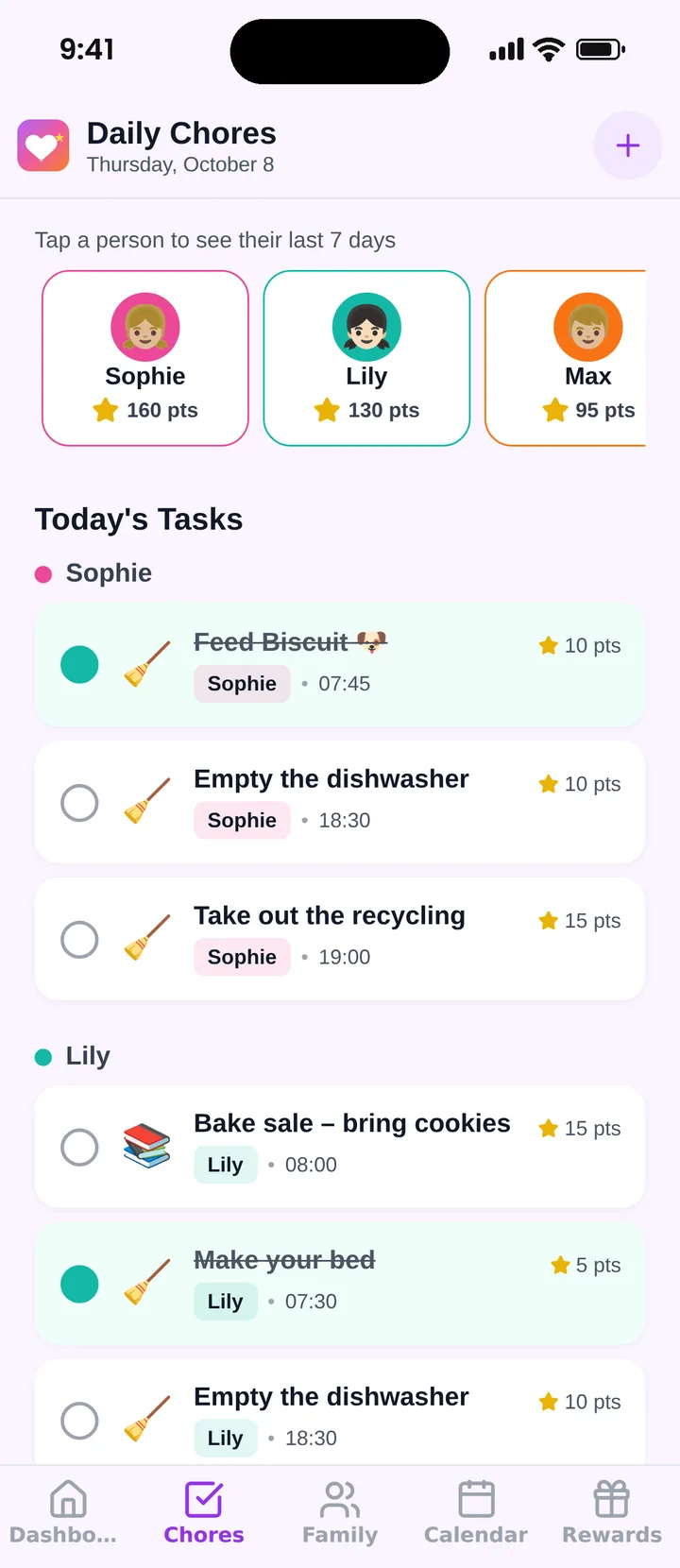
Famiyo is a free family app for iPhone and Android that combines a shared family calendar, chores with points and a rewards shop; kids join with a code, no email needed. It can replace the chart: add each job once, set it to repeat daily, weekly or every few days, pick who does it and give it points. Each family member sees their own jobs on their own phone, which stay in sync live, and kids hear about new tasks by notification. Parents hear when a chore is done. See today's chores for every child in one screen. Our list of the best chore chart apps compares options.
Start with the printable
Pick the three biggest daily jobs in your house, put one name next to each, print the grid and tape it up tonight. Add the rest next week.
Frequently asked questions
What is a family chore chart?
A family chore chart is a single chart that shows who does which household job on which day, for every person in the home. Unlike a chart for one child, it includes parents, so kids see that the whole family shares the work.
How do you make a family chore chart?
List all the recurring jobs, group them as daily or weekly, and give each person three or four that fit their age. Write them on one grid with days across the top, post it where everyone passes, and review it at a weekly family check-in.
Should parents be on the family chore chart?
Yes. Kids are more willing to do their jobs when they see adults doing theirs, and it makes the invisible work of the house visible. Give parents named jobs such as laundry, bills or the grocery run, not just supervising roles.
How many chores should each person have?
Two to three daily jobs for preschoolers, three to four for school-age kids and one weekly big job from about age 8. Teens can handle daily jobs plus ownership of a few household tasks. Fewer jobs done reliably beat a long list ignored.
Where should I hang the family chore chart?
Put it where people already stop: the fridge, a kitchen wall near the back door or inside a pantry door. Eye level for the shortest person is ideal. A chart in a drawer or a hallway nobody uses gets forgotten by Thursday.
Try Famiyo With Your Family
Chores with points, a rewards shop for kids and one shared family calendar. Set it up in a couple of minutes.



Free to download • No credit card required • Available on iOS & Android