Chore Checklist for Kids: Free Printable by Time of Day
A free printable chore checklist for kids, split into morning, after school, evening and weekly jobs, with tips for adjusting it to each age.
By Famiyo Editorial Team4 min read
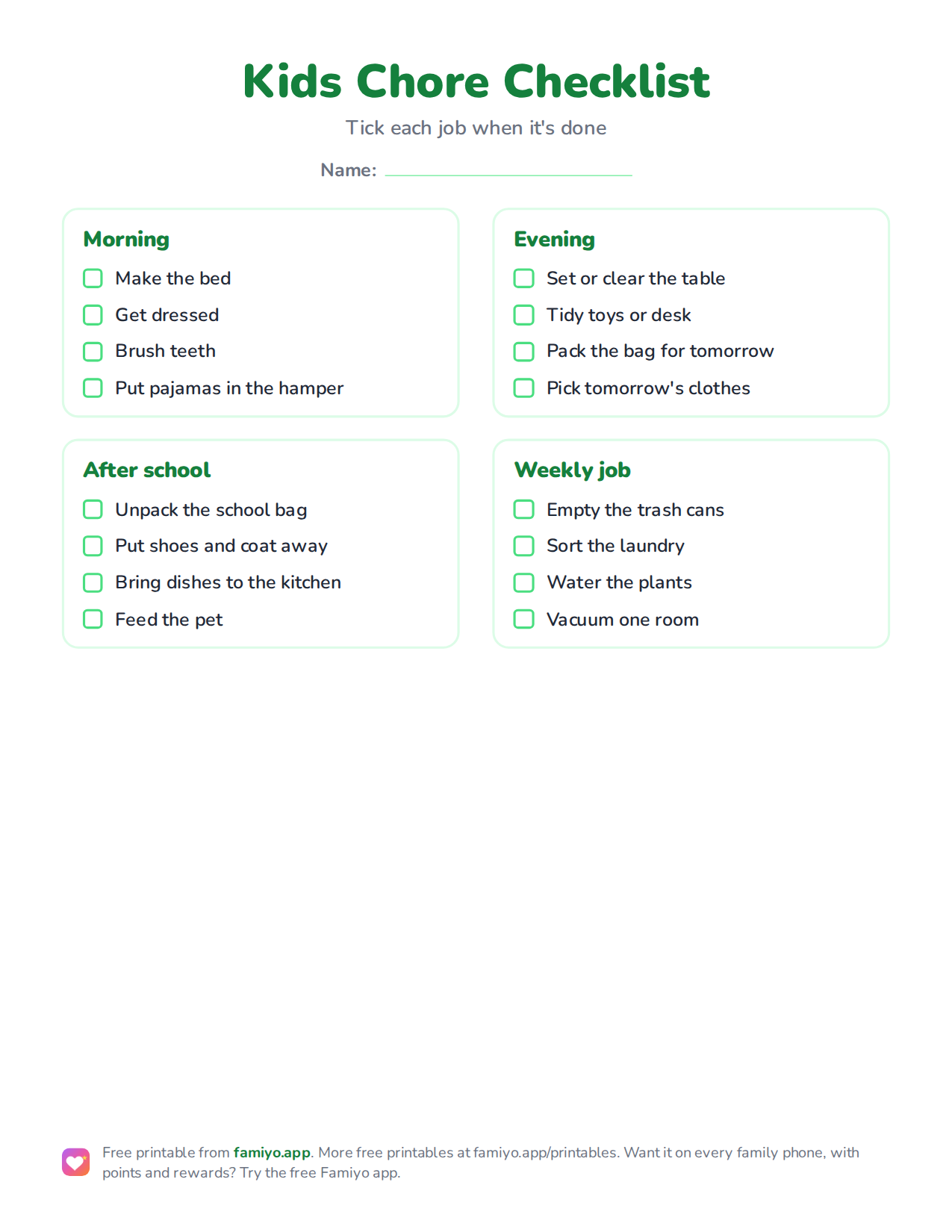
Free printable
Kids Chore Checklist
A checklist on one US Letter page. Download the PDF to print it, or save the image to use it on a tablet or in a document.
Free for home, classroom and nonprofit use, see the license. More free printables.
A chore checklist is the simplest chore system there is: a short list, some boxes, a pencil. It works because the child can see what "done" means, and you can stop saying it out loud. Below is a printable checklist split into four parts of the day, with advice on which jobs fit which age and how to keep the page from becoming wallpaper.
The checklist
The printable below has four blocks: morning, after school, evening and one weekly job. It suits kids from about 6 to 11 who can read. Each block has four jobs, and that is more than any child should do in a day. Pick three or four from the whole page, cross out the rest, and rotate in new ones every few weeks.
For the weekly job, choose one item and keep it the same for a month. A child who does a different weekly task every Saturday never gets good at one of them.
How to choose which chores go on it
Match the load to the age. These figures come from typical expectations for each age group.
| Age | Daily tasks | Time per day |
|---|---|---|
| 2 to 3 | 2 to 3, with pictures | 5 to 10 minutes |
| 4 to 5 | 2 to 3 | 10 to 15 minutes |
| 6 to 7 | 3 to 4 | 15 to 20 minutes |
| 8 to 9 | 3 to 4, plus one weekly job | 20 to 30 minutes |
| 10 to 12 | 3 to 4, plus one or two weekly jobs | 30 minutes |
| 13+ | Daily basics plus ownership of a few jobs | 30 to 45 minutes |
If your child has a lot of homework or sports, use the lower end. A checklist that fits on a busy day is more useful than a perfect one.
Write each chore so nobody can argue with it
Vague items get vague results. "Clean room" can mean anything. "Clothes in hamper, toys in bins, bed made" cannot. A few rules for the wording:
- Start with a verb: put, bring, feed, wipe.
- Name the place: "Put shoes on the rack by the door."
- Keep each item under eight words.
- One action per line. "Brush teeth and wash face" is two items.
For kids who read slowly or not yet, draw a small picture next to each line. Stick figures count.
Setting up the routine in five steps
- Sit down with your child and read through the list. Let them cross off one thing and add one.
- Pick the place. Bathroom door for morning jobs, kitchen for after school, bedroom for evening. A single spot is fine too.
- Attach each job to something that already happens. After breakfast, before screens, when the dog gets dinner.
- Start with three items and run it for two to three weeks before changing anything.
- Check the list together at a fixed time each day. Two minutes, same time, no lecture.
For a younger child, our chore chart for toddlers is a better starting point. If you have more than one kid, see the chore chart for multiple kids, which handles who does what without a fight.
What to do when the boxes stay empty
Wednesday is when most checklists fall apart. A few causes come up again and again. The list is too long, so cut it. The jobs are unclear, so rewrite them. The reminders come from you all day, so move them to one daily check. Or the child never saw the point, so sit down and talk about why the family does this.
If the checklist keeps losing, try the daily chore chart for kids, which adds a grid and a reward on top. And once one child is doing well, you can raise the bar slowly. Add a single job at a time, never three at once.
When the paper stops working
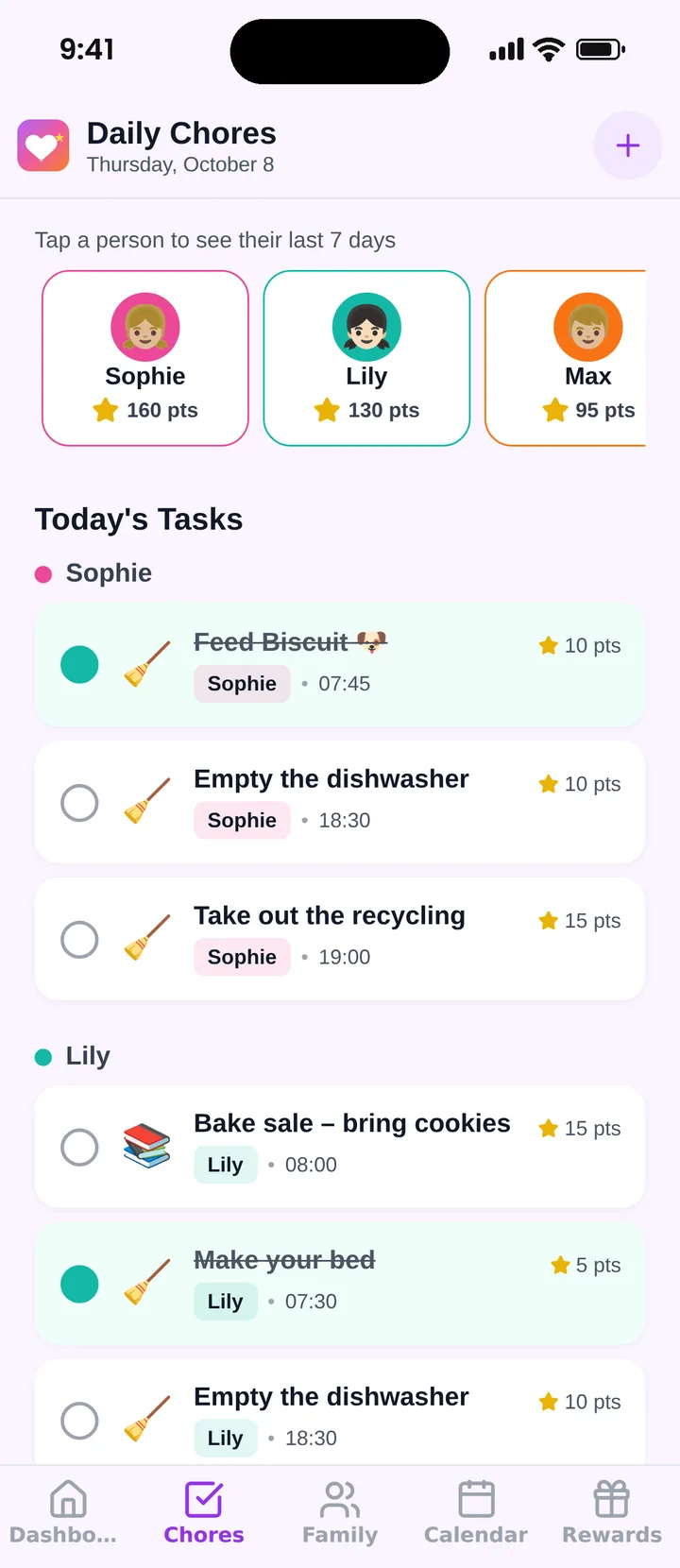
Paper checklists have limits. They get lost, wet or ignored, and you have to remember to look. Famiyo is a free family app for iPhone and Android that combines a shared family calendar, chores with points and a rewards shop; kids join with a code, no email needed. It replaces the paper with a list on each child's phone. You enter each job once and set it to repeat (daily, weekly or every few days), assign it to a child, and give it a point value if you want one. The child gets a notification about new tasks and checks them off themselves, or you approve them. You see today's chores for every child in one place, and every phone stays in sync. The free plan includes up to 3 family members and 1 repeating task. See our list of the best chore chart apps for options.
Print the checklist, pick three jobs, and put it on the door where your child will walk past it tomorrow morning.
Frequently asked questions
How many chores should be on a kid's checklist?
For school-age kids, 3 to 4 daily tasks is plenty, plus one weekly job from about age 8. Preschoolers do best with 2 to 3 daily tasks. A longer list looks impressive on paper and gets skipped in real life.
What is the difference between a chore checklist and a chore chart?
A checklist is a simple list of tasks to tick off, usually per day. A chore chart adds a grid across days or a points system. Many families start with a checklist and move to a chart once the habit sticks.
What age is a chore checklist for?
Kids who can read, about age 6 and up, can use a written checklist. Younger children do better with pictures and only a few jobs. Teens can keep a checklist on a phone instead of paper.
How do I make a kid actually use the checklist?
Put it where the jobs happen, let the child help write it, and link each task to an existing moment such as after breakfast. Check in once at the same time every day instead of reminding all day.
Try Famiyo With Your Family
Chores with points, a rewards shop for kids and one shared family calendar. Set it up in a couple of minutes.



Free to download • No credit card required • Available on iOS & Android