Behavior Chart for Kindergarten and Preschool
A free printable behavior chart for kindergarten and preschool, with what to put on it, how to use it at home or in class, and when to phase it out.
By Famiyo Editorial Team4 min read
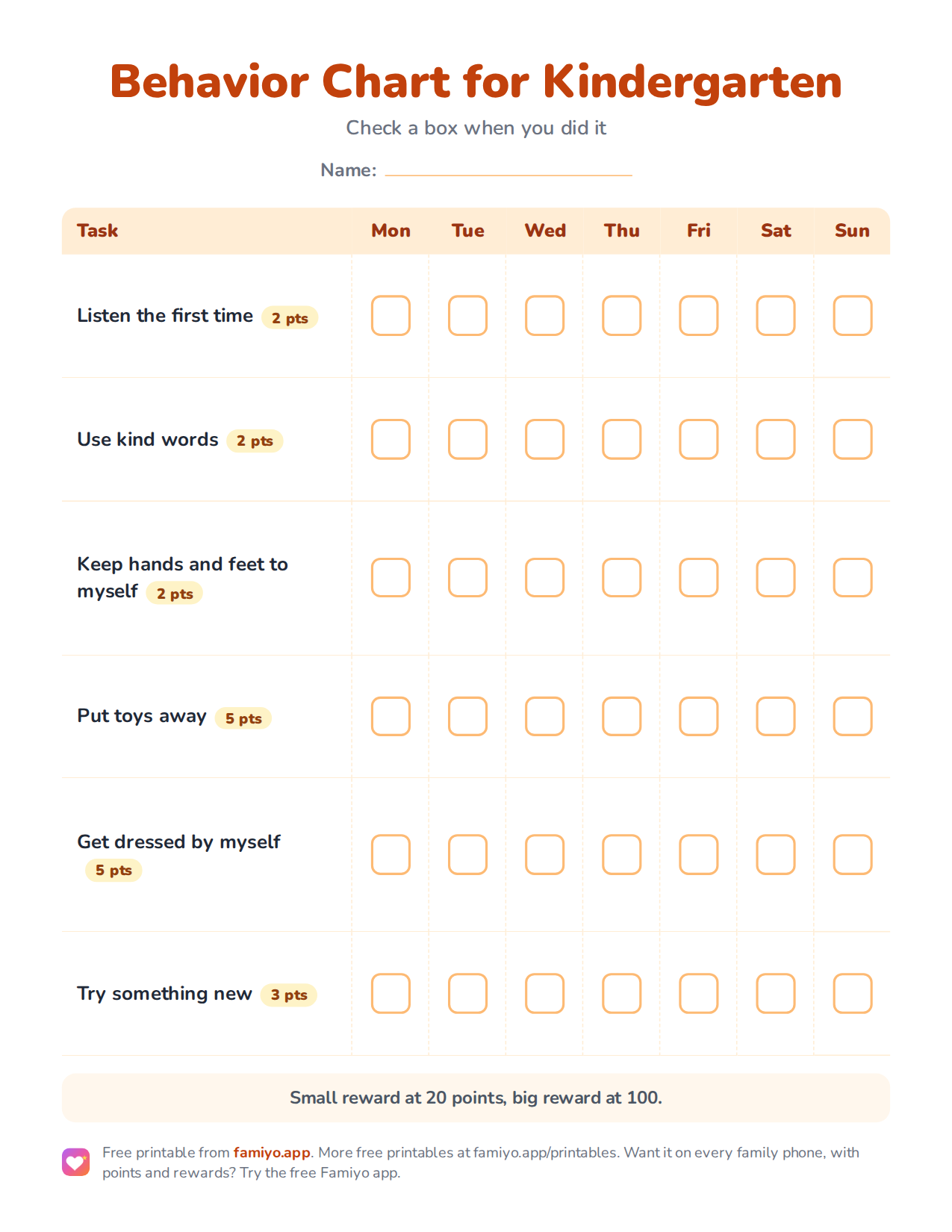
Free printable
Behavior Chart for Kindergarten
A weekly chart on one US Letter page. Download the PDF to print it, or save the image to use it on a tablet or in a document.
Free for home, classroom and nonprofit use, see the license. More free printables.
A good behavior chart for a five-year-old is small, clear and quick. It names a few things your child can actually do, gives a check or sticker right away, and pays off within a day or two. This page has a printable chart you can use at home or share with a teacher, plus the setup rules that make it work.
The printable chart
The printable below has six goals down the side and Monday to Sunday boxes across, with a point value next to each goal. It suits children from about 4 to 6, in preschool or kindergarten, who can't read yet but can follow a picture or a parent's voice. Print it, stick it at child height on the fridge or bedroom door, and pick a sticker or a marker your child likes.
Six items is the upper limit. If your child needs fewer, cross out two or three and use only those. Each box can get a check mark, a sticker or a colored dot.
What to put on a kindergarten behavior chart
The best goals are things your child does, written the way you'd say them out loud. Avoid goals built on "no" or "stop."
| Instead of | Write | Why it works |
|---|---|---|
| No hitting | Keep hands and feet to myself | Names what to do |
| Be nice | Use kind words | A child can picture it |
| Don't make a mess | Put toys away | One clear action |
| Stop whining | Ask in my regular voice | Gives a replacement |
| Be ready | Get dressed by myself | A visible, checkable result |
Start with three or four. If everything seems to be a problem, choose the two that cause the most trouble in the day and begin there. Giving a small child a long list is a quick way to get none of it.
A visual routine for kids under 7 works best with 4 to 6 steps, so the same limit helps here. For routines that need steps in sequence (morning or bedtime), see our guide on chores for preschoolers for what this age can actually manage.
How to use the chart day to day
- Explain it once, with your child, in under a minute. "When you use kind words, you get a check. Twenty points and you pick a prize."
- Mark the box as soon as the behavior happens, or at a fixed time such as before dinner. Delay weakens the link between the action and the reward.
- Say what you saw. "You waited your turn with Sam. That's a check."
- Add up points when the day is over, or at the end of the week for the older ones.
- Keep the reward promise on the same day you said you would.
Don't take marks away for bad moments. A checkmark earned is earned. If something goes wrong, deal with it separately, calmly and briefly, and let the child try again the next hour.
Rewards that fit a 5-year-old
Young children can't wait long. A reward at the end of a month is too far away. Offer something small within a day or two, and a bigger one once a week or so.
| Reward | When |
|---|---|
| A sticker or a stamp | Right away |
| Pick the bedtime story | After a good day |
| 15 minutes of a game with a parent | 20 points |
| Choose the family movie or dessert | 50 to 100 points |
| A small outing or a toy around $5 | A full week of checks |
Experiences with you tend to matter more than objects at this age. For more ideas, browse our reward chart ideas.
Using it at school or in a preschool class
If a teacher uses a class chart, ask what words they use ("kind hands," "listening ears") and use the same words at home. Children learn faster when the language matches. Don't run a second system with different goals at the same time. If the teacher's chart is public to the whole class, keep home rewards private and positive, and avoid comparing children.
When to change it or stop
Give the chart two to three weeks before deciding it works or doesn't. If your child earns every check easily, replace the easy goal with a new one. If they're earning almost nothing, shrink the list or make a step smaller (not "get dressed" but "put on your shirt"). After a month or two, many children can manage with praise and a weekly check-in.
The next stage is a proper chore routine. When your child is ready, chores for toddlers and preschool jobs are a good bridge from behavior goals to real tasks.
When a chart lives in the app
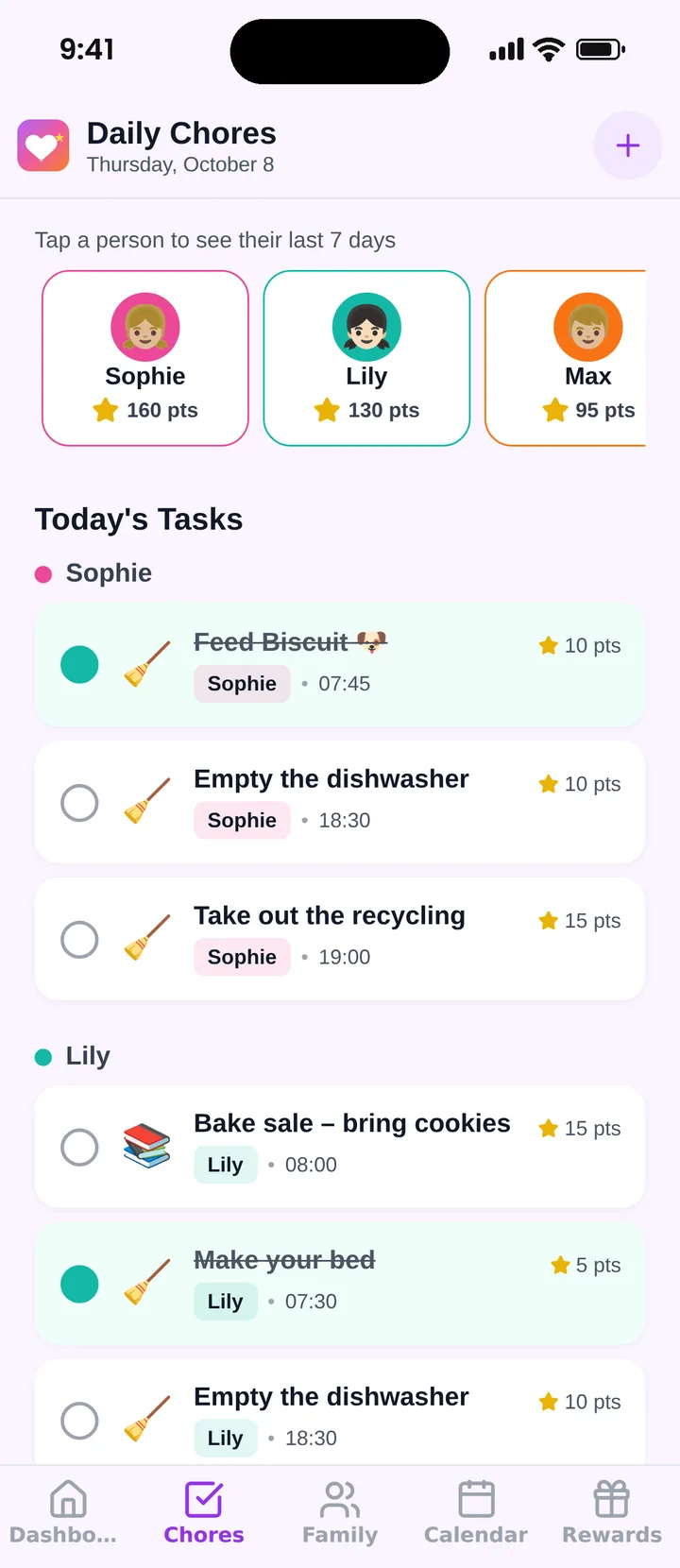
Famiyo is a free family app for iPhone and Android that combines a shared family calendar, chores with points and a rewards shop; kids join with a code, no email needed. If you'd rather not print a new chart every week, set up the same goals as repeating chores with points, and they show up each day on your child's list. A child checks off their own tasks (or you approve them), a push notification tells you when it's done, and every phone updates live. Compare options in our list of the best chore chart apps.
Print the chart tonight, circle your three goals, and start tomorrow morning.
Frequently asked questions
How many behaviors should a kindergarten behavior chart have?
Three or four. Young children can hold only a few goals in mind, and a short list lets them see their progress. Start with the ones that cause the most daily friction, such as listening and cleaning up, and add more later.
What should I reward on a behavior chart for a 5-year-old?
Reward specific things you want to see more of: using kind words, taking turns, cleaning up, getting dressed, listening the first time. Choose small, quick rewards such as a sticker, a story, a choice of game or extra playtime with you.
How long should a child use a behavior chart?
Give it two to three weeks before judging it. Many children use one for a month or two, then the chart can fade as behaviors become habits. Swap in new goals if old ones are easy, or stop and rely on praise.
Do behavior charts work at school and at home?
They work in both, provided the goals and rewards are simple. A teacher's class chart and a home chart can match goals so children hear the same words. Keep consequences and rewards separate, and never take earned marks away.
Try Famiyo With Your Family
Chores with points, a rewards shop for kids and one shared family calendar. Set it up in a couple of minutes.



Free to download • No credit card required • Available on iOS & Android