Reward Chart Ideas for Kids: 14 Formats and 30 Rewards
Reward chart ideas that fit different ages: 14 chart formats from sticker paths to marble jars, plus 30 rewards that don't cost much, and how to pick the right one.
By Famiyo Editorial Team5 min read
A reward chart is a simple idea that goes stale quickly: the first week is all stickers and excitement, and by week three the chart is a page of blank boxes. Often the problem is not the child but the format, which was a poor match for their age or too much work to keep up. Here are 14 formats to try, 30 rewards at different prices, and a few notes on how to choose.
14 reward chart formats
Different ages need different shapes. Here is a quick guide, then the details.
| Age | Formats that tend to work |
|---|---|
| 2 to 4 | Sticker path, one-task chart, connect the dots |
| 4 to 7 | Marble jar, colored-in picture, puzzle, treasure map |
| 8 to 12 | Weekly grid, points tally, bingo, passport |
| 13 and up | Points balance, goal tracker, thermometer |
- Sticker path. A winding road of 5 to 7 spaces ending in a picture of the reward. One sticker per finished task.
- One-task chart. A card with a single job, such as "brush teeth", and a box per day. Good for a new habit.
- Connect the dots. Each finished task earns one line. When the picture is complete, the reward is theirs.
- Marble jar. A clear jar and a bag of marbles. Seeing it fill is a reward in itself.
- Colored-in picture. A simple drawing cut into 10 to 20 pieces or sections. One piece per task.
- Puzzle. Cut a printed picture into pieces and give one piece per completed task. Done when the picture is whole.
- Treasure map. Spaces along a path, with a small treasure at the end. It suits kids who love stories.
- Weekly grid. Tasks down the side, days across the top, a check in each box. Familiar and flexible.
- Points tally. Each task is worth points, and a running total sits in the corner. Fits school-age kids who like math.
- Bingo card. A 5 by 5 grid of small tasks. A row earns a reward. See our chore chart ideas for more formats like this.
- Passport. Each new skill or chore earns a "stamp". Good for kids who like collecting.
- Thermometer or progress bar. Color in a bar toward a big goal. Works well for a single large reward.
- Ladder or staircase. Each step up is a day of success, and the top is the prize.
- Points balance. A simple number, updated daily. Fits teens, who often prefer something that does not look like a kindergarten poster.
A few quick rules for all of them. Keep the chart where the child sees it daily. Let them help decorate it, because ownership counts. And use the same marker each day, so the system looks the same tomorrow as it did yesterday.
30 reward ideas, sorted by cost
The reward does more than the chart does. A child who doesn't care about the prize won't care about the chart.
Free, and often the best
- Choose the bedtime story
- Pick the music in the car
- Pick the family movie
- Choose what is for dessert
- Stay up 15 or 30 minutes later
- Extra screen time, within the limits your family has agreed
- A picnic on the living room floor
- One-on-one time with a parent, chosen by the child
- Choose the next weekend activity
- Be "boss of the day" for one small decision
- Pick the game for family game night
Small and cheap
- A sticker, a small toy or a pack of cards
- A trip to the playground or park
- A special snack, or baking something together
- A new book from the library
- A small craft kit
- Painting nails or a temporary tattoo
- A bubble bath with extras
- A new pencil, notebook or hair accessory
- A treat from a favorite bakery
Bigger, saved up for
- A day out, such as the zoo or a trampoline park
- A toy of around $20
- A sleepover with a friend
- A new game or app (with a parent's approval)
- Pocket money, if that is your family's approach
- Choose a restaurant for a family dinner
- A camping night in the backyard
- A movie night with friends
- A new board game for the whole family
- Ice cream out with one parent
If you are unsure how big a reward should be, a useful guide is that a small reward should be reachable every 2 to 3 days and a big one every 3 to 4 weeks. Younger kids need a reward within the same day or the next, because a month is too far away.
Choosing the right chart for your child
Ask three questions.
- Can your child read it without help? If not, use pictures, a path or a jar.
- Does the reward arrive fast enough? For 2 to 4-year-olds, within a day. For school-age kids, within a few days.
- Will you actually update it? A chart that needs 10 minutes of work every night will die. Choose the format you can keep up when you're tired.
If your child is 5, our guide to a reward chart for a 5-year-old goes deeper on what to track. For the basic steps of building one, see how to make a kids reward chart.
What to do when interest fades
Almost every chart loses its charm. That is normal and not a failure. Try these before you give up on the whole idea:
- Change the format, not the system. Swap a sticker path for a marble jar.
- Refresh the rewards. Ask your child to list five new ones.
- Shorten the time to reward. If a chart has stopped working, the wait may be too long.
- Check the tasks. If they are too hard, kids stop trying. If they are too easy, they stop caring.
- Take a week off, then come back with a new look.
Replacing the paper chart with Famiyo
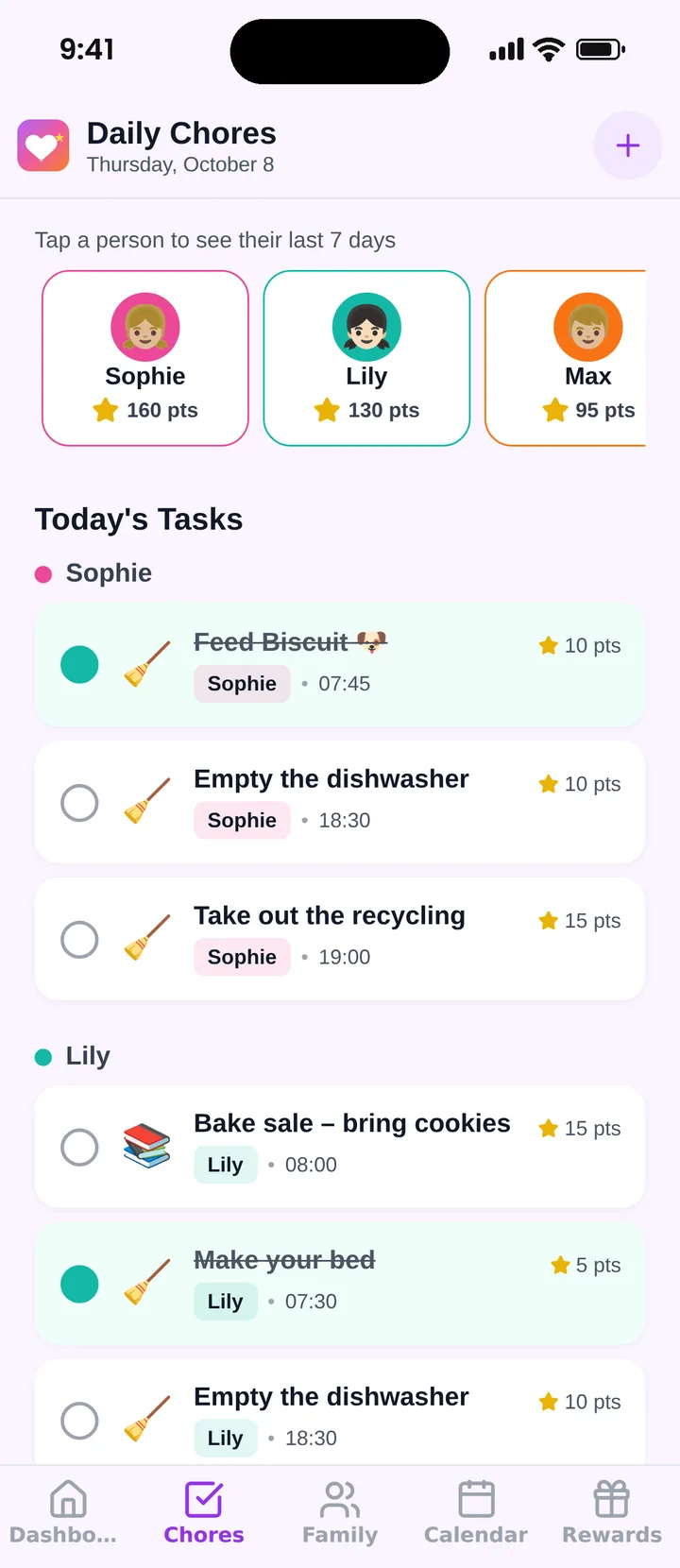
Famiyo is a free family app for iPhone and Android that combines a shared family calendar, chores with points and a rewards shop; kids join with a code, no email needed. It can stand in for the paper chart: you add a chore once, set it to repeat, give it points, and each child gets a push notification when it is due and checks it off on their own phone. You are notified when it is done, and every phone stays in sync, so there is no chart to rewrite or lose. The points then go toward rewards you set up. See our list of the best chore chart apps.
Pick one format from the list, one task, and one reward your child has chosen. Run it for two weeks before you add anything else.
Frequently asked questions
What is the best reward chart for a young child?
For ages 2 to 4, a short path of 5 to 7 spaces with a picture of the reward at the end works best. Keep it to one or two tasks, put the chart at their eye level, and let them place the sticker themselves.
How many tasks should be on a reward chart?
Two or three for preschoolers, three or four for school-age kids. More than that and the chart turns into a wall of boxes that nobody checks. Start with fewer and add one task at a time.
What are good rewards that don't cost money?
Choosing the bedtime story, picking the family movie, 15 extra minutes of screen time, a picnic in the living room or one-on-one time with a parent. Kids often value time and choice more than a prize.
How long should I keep using a reward chart?
Most families run one for 2 to 3 weeks before judging it, then change the format or the rewards when interest drops. Plan to refresh it every month or two instead of expecting one chart to work for a year.
Try Famiyo With Your Family
Chores with points, a rewards shop for kids and one shared family calendar. Set it up in a couple of minutes.



Free to download • No credit card required • Available on iOS & Android