Chore System for Kids: 5 Systems Compared
Compare five chore systems for kids: rotation, points, jobs board, daily checklist and weekly big job. See who each suits and how to choose one.
By Famiyo Editorial Team6 min read
Most families don't fail at chores because the kids refuse. They fail because the system doesn't match the household. A chart that worked for one 5-year-old falls apart with three kids and different bedtimes. Here are five systems side by side, with what each does well, where each breaks and who it fits.
The five systems at a glance
Read the table first, then the details. "Best age" is a guide, not a rule.
| System | How it works | Best age | Works well when | Breaks when |
|---|---|---|---|---|
| Rotation | Jobs move between kids every week | 6 and up, 2 or more kids | Kids argue about who got the easy job | One child can't do a job the others can |
| Points | Each chore earns points, points buy rewards | 7 and up | Kids want something to work toward | Rewards are too far away or too easy |
| Jobs board | Kids pick from a list of open jobs | 9 and up | Kids resist being told what to do | Nobody picks the dull jobs |
| Daily checklist | The same short list in the same order every day | 3 to 8 | Kids need structure and a visual cue | The list grows past 5 or 6 items |
| Weekly big job | One larger job per child per week | 8 and up | You want the house to stay cleaner | It's used instead of daily jobs |
Rotation: everyone gets every job
In a rotation, each child takes a different job each week. Week one: Maya sets the table, Leo takes out the trash. Week two they swap. It solves the "why do I always get the bathroom" argument because every job lands on everyone.
It works best with two or more kids who are within a few years of each other, since a 6-year-old can't rotate into cleaning the toilet. For a big age gap, rotate within a group of age-fair jobs. Write the rotation on one sheet with the week's dates. Switch at the same time every week, such as Sunday night, so nobody has to ask.
The main weakness is the learning curve. Every week a child starts a new job and needs a reminder, so it asks more of you than a fixed job does. If you want a fuller walkthrough, see how to split chores between siblings fairly.
Points: chores earn a currency
In a points system, each chore is worth a number, and points can be spent on small rewards. A common scale: 5 points for a small job of 2 to 5 minutes, 10 for a medium job of 10 to 15 minutes, and 20 for anything that takes 30 minutes or more, with a bonus of 2 for doing it without a reminder. Rewards can be priced at 30 to 50 points for something small, around 100 for a medium treat and 300 to 500 for a big one.
The strength is motivation. Children who find routine tasks dull often wake up when there is a score and a goal. The weaknesses are bookkeeping and inflation. Someone has to track the points, and if rewards are too cheap, kids stop caring. Aim for a child to afford something small every 2 to 3 days and something big every 3 to 4 weeks.
Points work best on top of the basics. Keep "I live here" jobs, such as making the bed, unpaid and use points for extras.
Jobs board: kids choose their own
A jobs board lists open jobs, and kids sign up for what they want. Think of a whiteboard or a list on the fridge: wash the car, vacuum the stairs, sort the recycling, walk the dog. Each has a value, in points or a few dollars, and the first child to claim a job gets it.
Tweens and teens like the control. It removes the feeling of being ordered about and gives practice in weighing time against reward. It's also a good home for the bigger jobs, such as raking leaves or the spring cleaning chores that come up once a year.
The weakness is predictable: the pleasant jobs go first and the unpleasant ones sit there. Fix it by setting a minimum, for instance "everyone must take one job from the red column by Wednesday," or by pricing the dull jobs higher. A jobs board should never be the only system, since daily needs like feeding the pet must happen with no sign-up.
Daily routine checklist: the same steps every day
A checklist is a short list, done in order, at the same time each day. For a school-age child the morning list might be: get dressed, make the bed, pack the bag, shoes by the door. The evening list: plate to the sink, tidy toys, pajamas, teeth.
This is the best starting system for children aged 4 to 8 because it asks them to remember almost nothing. The list does the remembering. For kids under 7, keep it to 4 to 6 pictured steps, and for a child who struggles to hold steps in mind, see our ideas for chores for kids with ADHD.
Its weakness is boredom and creep. Parents keep adding items until the list takes an hour, and the child stops reading it. Cap the list at 5 or 6 items, and give a routine 2 to 3 weeks of steady use before you judge it.
Weekly big job: one bigger task per child
From about age 8, add one larger job per week on top of the daily ones. It might be vacuuming a room, cleaning the bathroom, changing the bed sheets or, for older kids, doing their own laundry. Our guide to getting kids to do their own laundry shows how to hand that one over.
A weekly big job suits any age as an add-on, because it spreads the heavy work across the week and across children, and it can be done on a fixed day, such as Saturday morning. A big job also teaches finishing, which a two-minute task can't.
Don't use it as a replacement for daily jobs. If you only have a Saturday blitz, the house falls behind from Monday to Friday, and kids learn that mess is something that gets fixed once a week by someone else.
How to choose and combine systems
Start with the age of your youngest and ask what is currently going wrong. Then match the problem to a system.
- Kids forget what to do: a daily checklist.
- Kids say it's unfair: rotation.
- Kids say "why should I?": points or a jobs board.
- The house is clean on Saturday and a mess by Tuesday: add daily jobs.
- The house never gets deep cleaned: add a weekly big job.
Then pick at most two. The most common working pair is a daily checklist plus a weekly big job. Families with tweens often add a jobs board for extra earning, and families with younger kids often add points to a checklist. Run the new setup for 2 to 3 weeks, change one thing at a time and keep the rules written down in one place.
If you have a long-running system that has stopped working, don't throw it out. Ask which of the five problems above you now have and fix that one.
Running any of these in Famiyo
Famiyo is a free family app for iPhone and Android that combines a shared family calendar, chores with points and a rewards shop; kids join with a code, no email needed. It replaces the paper chart for most of the systems above. Daily checklists become repeating chores, points come built in, and each child can get their own number of points for the same task. Kids hear about new tasks by push notification, you hear when one is done, and every phone stays in sync live.
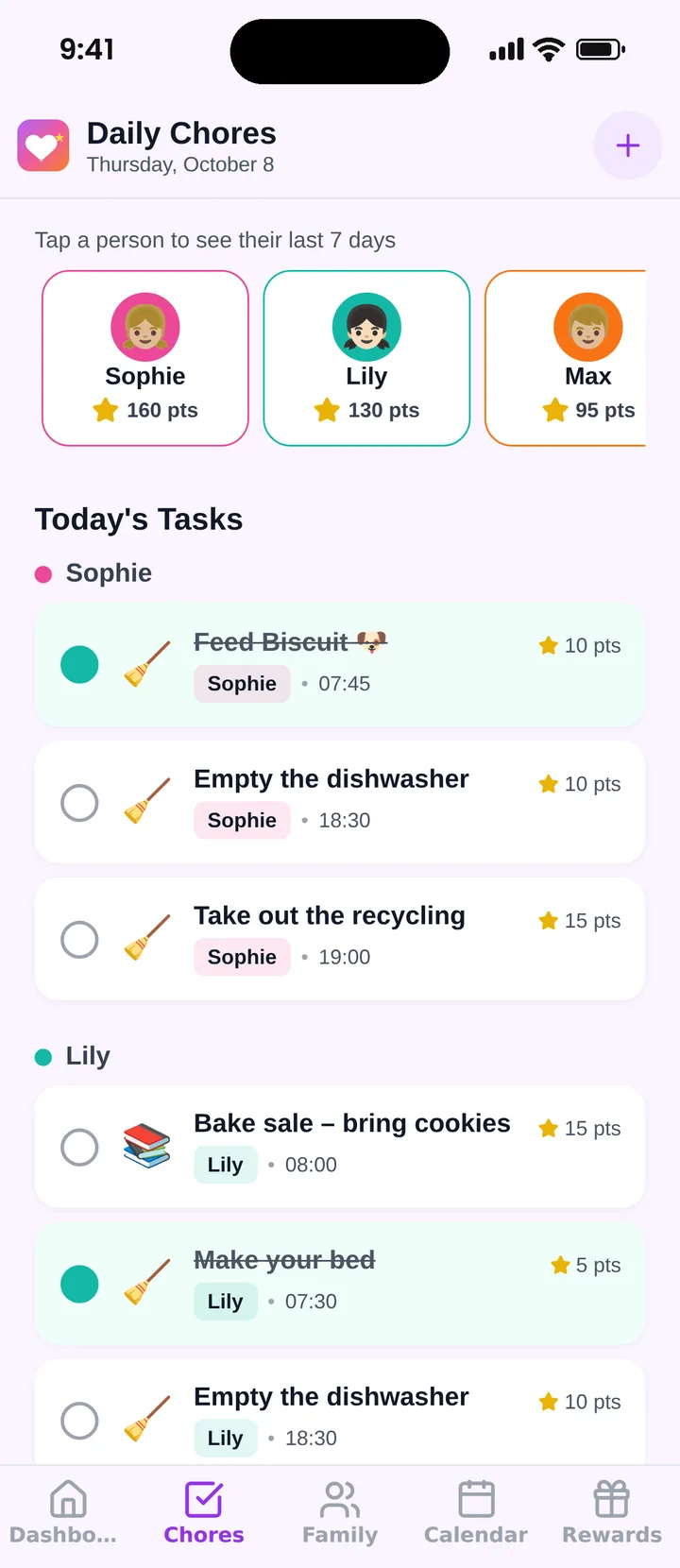
The free plan covers up to 3 family members and 1 repeating task, and Premium removes the limits. To compare apps, see our list of the best chore chart apps.
Choose the one problem that is loudest in your house this week and match it to a system from the table.
Frequently asked questions
What is the best chore system for kids?
There is no single best one. A daily checklist works for ages 4 to 8, points for kids who respond to rewards, rotation when siblings compare, and a jobs board for tweens. Most families do best with a checklist plus one weekly big job.
Can I combine two chore systems?
Yes, and it usually works better than one alone. A daily checklist for the basics with a weekly big job on top is the most common pair. Avoid mixing more than two, because kids lose track of which rules apply.
How long should I try a chore system before changing it?
Give a new routine 2 to 3 weeks of consistent use before judging it. Most systems wobble in week two. Change it only if the same problem shows up three weeks running, and change one thing at a time.
How many chores should each kid have in a system?
Start with 2 to 3 daily tasks for preschoolers and 3 to 4 for school-age kids, and add one weekly big job from age 8. Fewer chores done reliably beat a long list that collapses in week three.
Should chore systems include rewards?
Not necessarily. Basic family jobs can stay unpaid and unrewarded, with points or money attached only to extras. If you do use rewards, keep the prices simple so a child can afford a small one every 2 to 3 days.
Try Famiyo With Your Family
Chores with points, a rewards shop for kids and one shared family calendar. Set it up in a couple of minutes.



Free to download • No credit card required • Available on iOS & Android